Maintenance Planning and Scheduling Software That Only Schedules Work Already Proven Ready
iMPS, Innovapptive's Intelligent Maintenance Planning and Scheduling software, builds evidence-backed work packages, proves parts, permits and isolations are cleared, then schedules work that will actually run. Planners approve or revert every recommendation.
20-30% Less Unplanned Downtime:Readiness proven before schedule lock, not on the day of work
75-80% Schedule Compliance, Sustained: The week you commit is the week that runs. Unready work never reaches the board
15-25% More Wrench Time: Bundling and history-based durations turn paid hours into tool time
2026 · Frost & Sullivan 2026 Company of the Year, for Global Connected Worker Platforms • Frost Radar Leader, Connected Worker • 50+ ERP & historian connectors
WORK PACKAGING AGENT
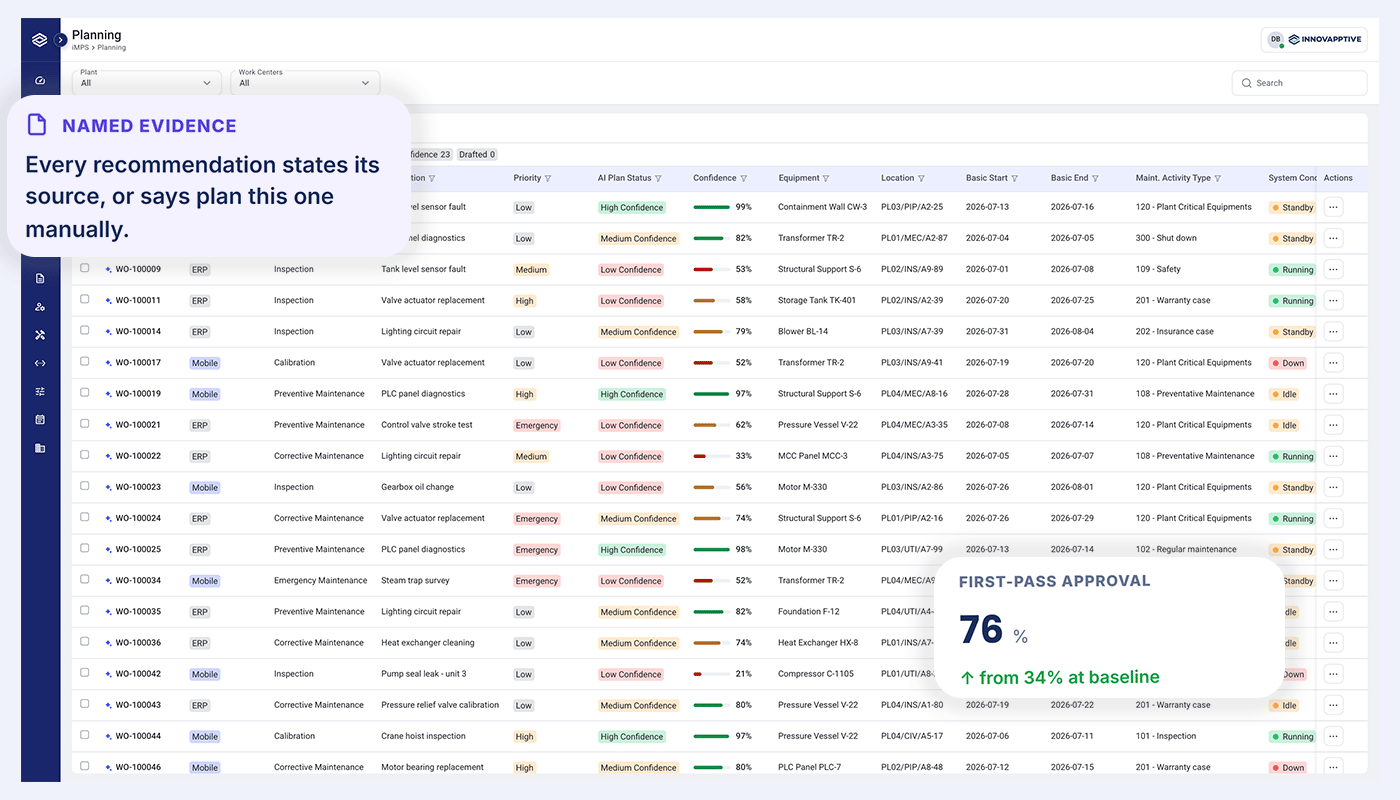
Package built from P-1001A's own history, confidence 94%, evidence named.
SCHEDULE COMPLIANCE
78%↑ from 34% at baseline
Trusted by global process manufacturers
Core Capabilities
Maintenance Planning Software That Builds the Package, Proves It Is Ready, Then Schedules It
iMPS is built around the planner, the scheduler, the supervisor and the reliability engineer. Seven purpose-built AI agents work both sides of the job: work packaging, schedule readiness, work bundling, duration optimization, frequency optimization, demand forecasting, and schedule and dispatch. They run inside one governed flow, with the downtime calendar and configurable guardrails enforcing policy before anything can be committed. Every recommendation names its evidence, and every one of them is reviewable and reversible by the planner or scheduler.
Work Packaging Agent
A complete work package arrives with its evidence attached.
The Work Packaging Agent matches a new work order to this asset's own completed history, or to a named similar asset. It then assembles operations, materials, trades and permits into a package carrying a confidence score. Planners approve it, save it as a draft, or hand it back for manual build. This is maintenance work order planning done once, with the evidence attached, rather than rebuilt three times.
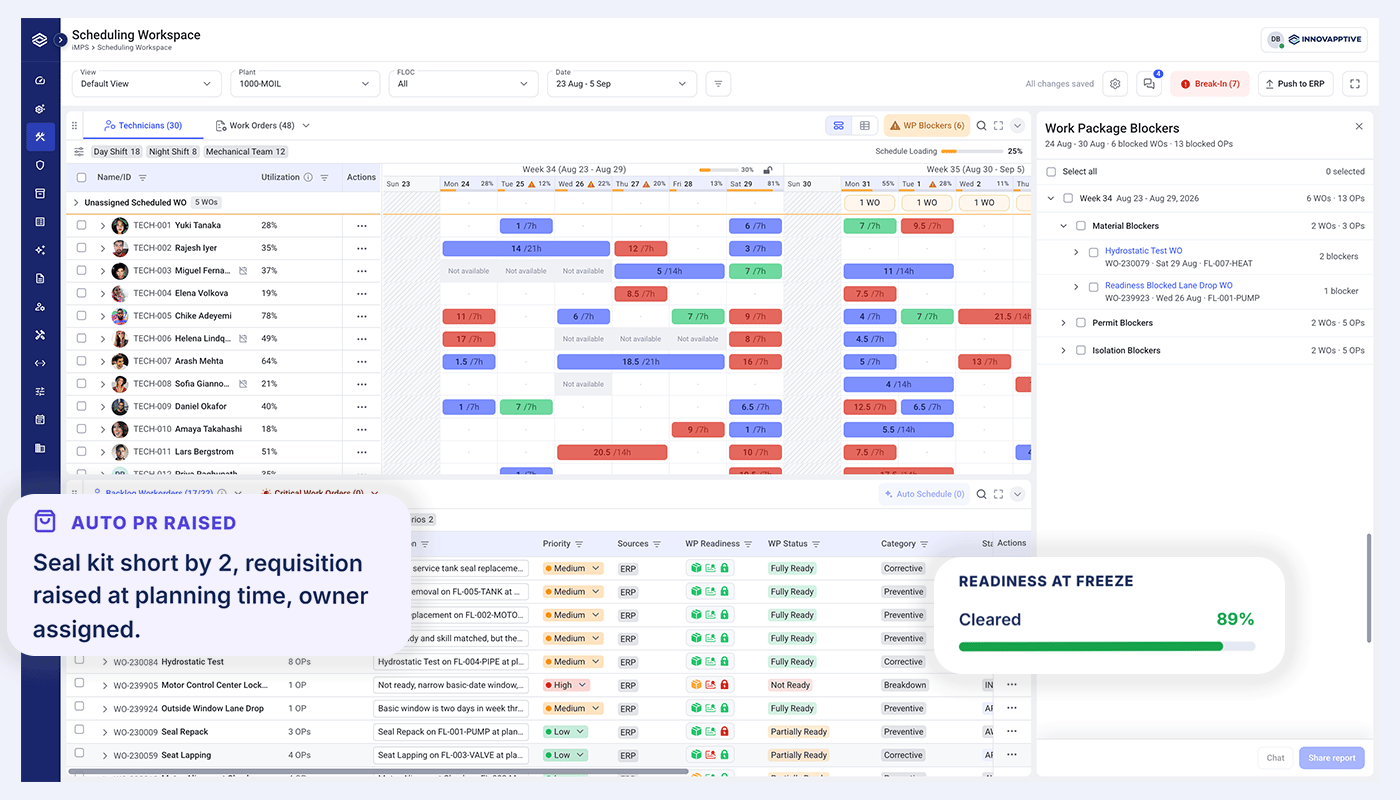
Parts, permits and isolations are proven ready before the work is scheduled.
Readiness is gated rather than assumed. The agent checks material, permit, isolation and owner-action status on every package. It raises a purchase requisition at planning time when stock will not cover the job, and holds anything unresolved off the board. Each blocker gets an owner and a due date.
Material, Permit & Isolation Gating
Auto Purchase Requisition
Owner-Assigned Blocker Workflow
Held Off the Board Until Cleared
Zero Surprises:parts, permits and isolations cleared before the schedule locks
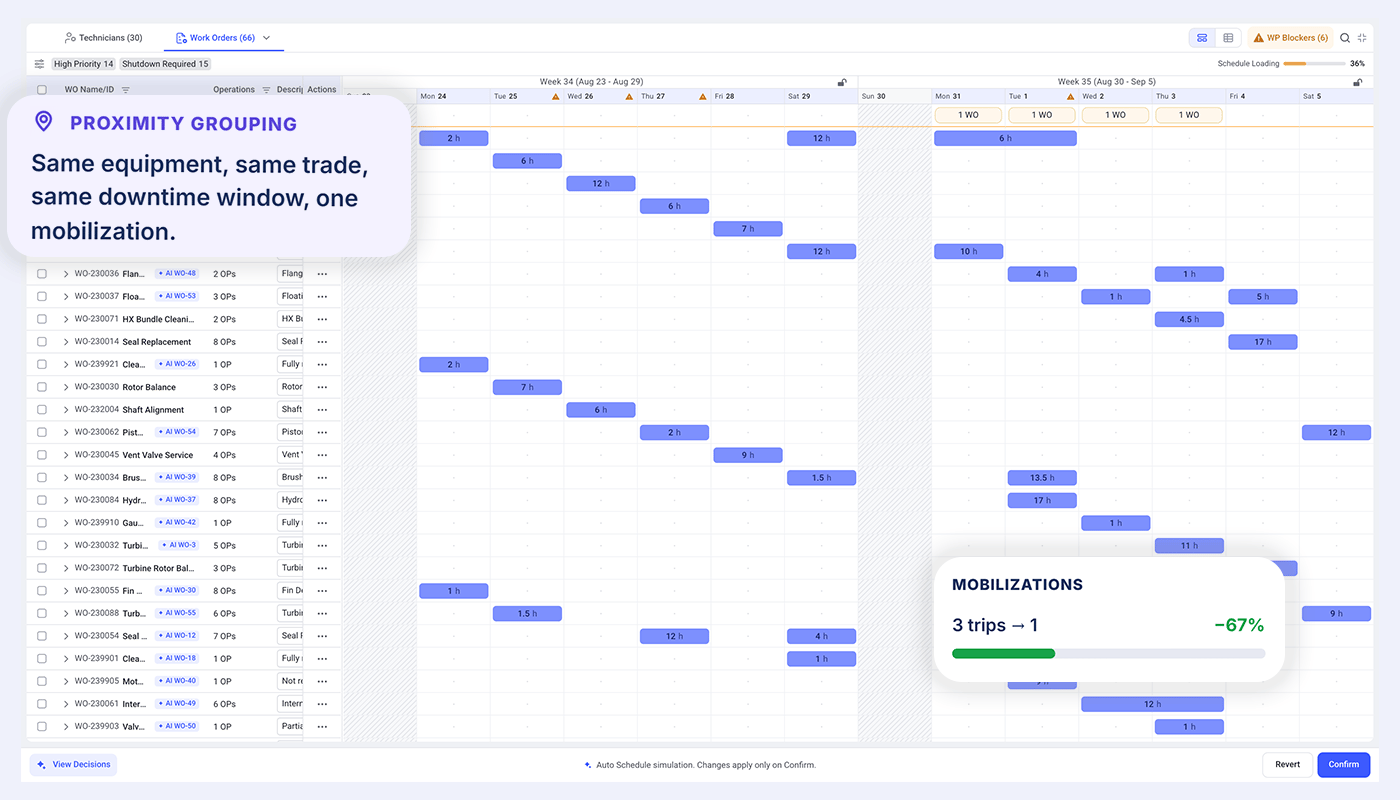
Crews finish three jobs on one trip to the same unit.
Work orders are grouped by proximity, asset hierarchy, trade and material availability, then align to shared shutdown and downtime windows. One mobilization covers several jobs on the same equipment instead of three separate trips across three separate weeks. Travel and setup stop consuming the shift.
Proximity and Asset Grouping
Trade-Based Bundling
Shared Downtime Window Alignment
Fewer Mobilizations Per Job
One Trip:several jobs on the same unit closed in a single mobilization
Plan the time and crew each maintenance job really needs.
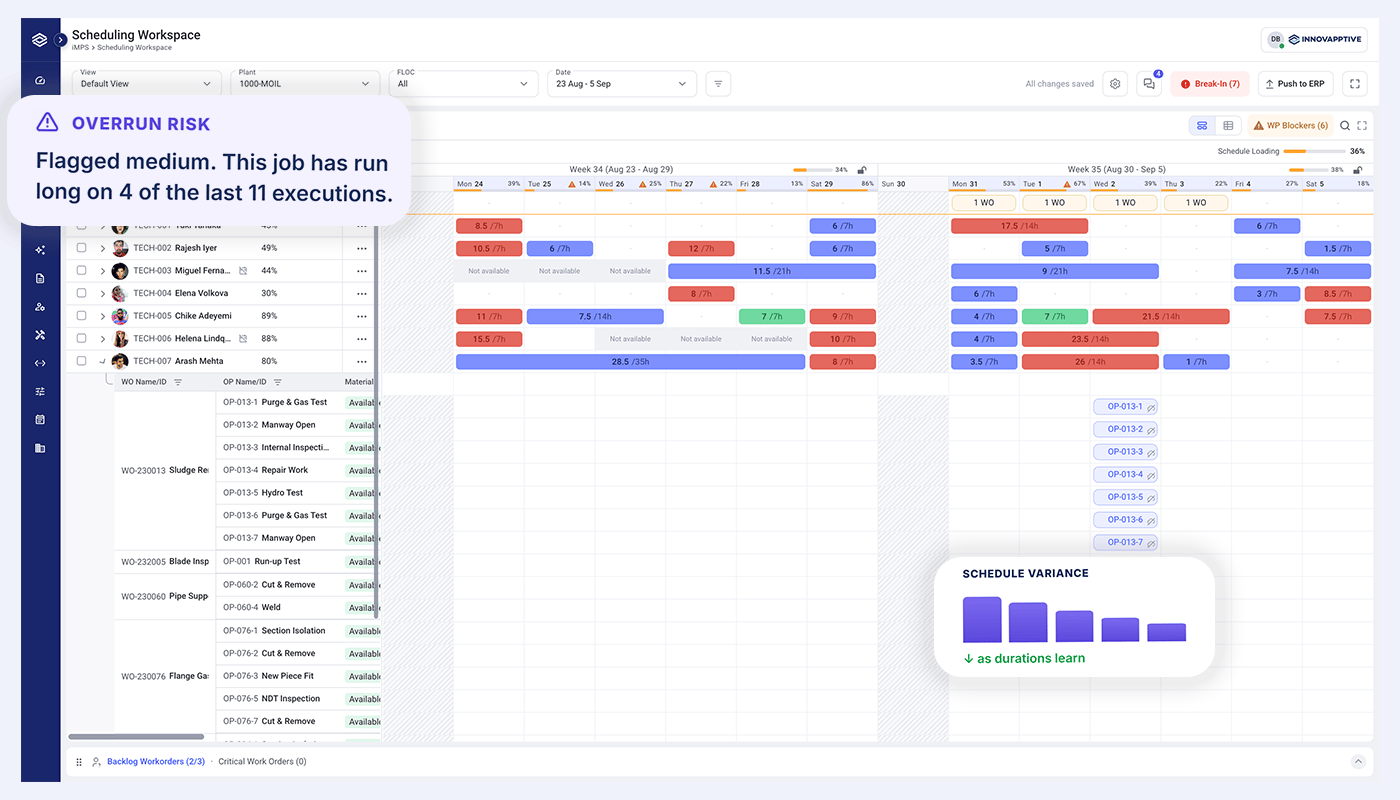
The agent analyzes recent execution records for similar work orders and recommends a realistic planned duration, an overrun-risk signal and a crew size. Static standard times stop setting expectations the field has never once met. Schedule realism improves because the numbers come from execution.
History-Based Duration Modeling
Overrun-Risk Signal
Recommended Crew Sizing
Replaces Static Standard Times
No Guesswork:durations from real execution, not standard times
Know the workload ahead. Have the right people ready.
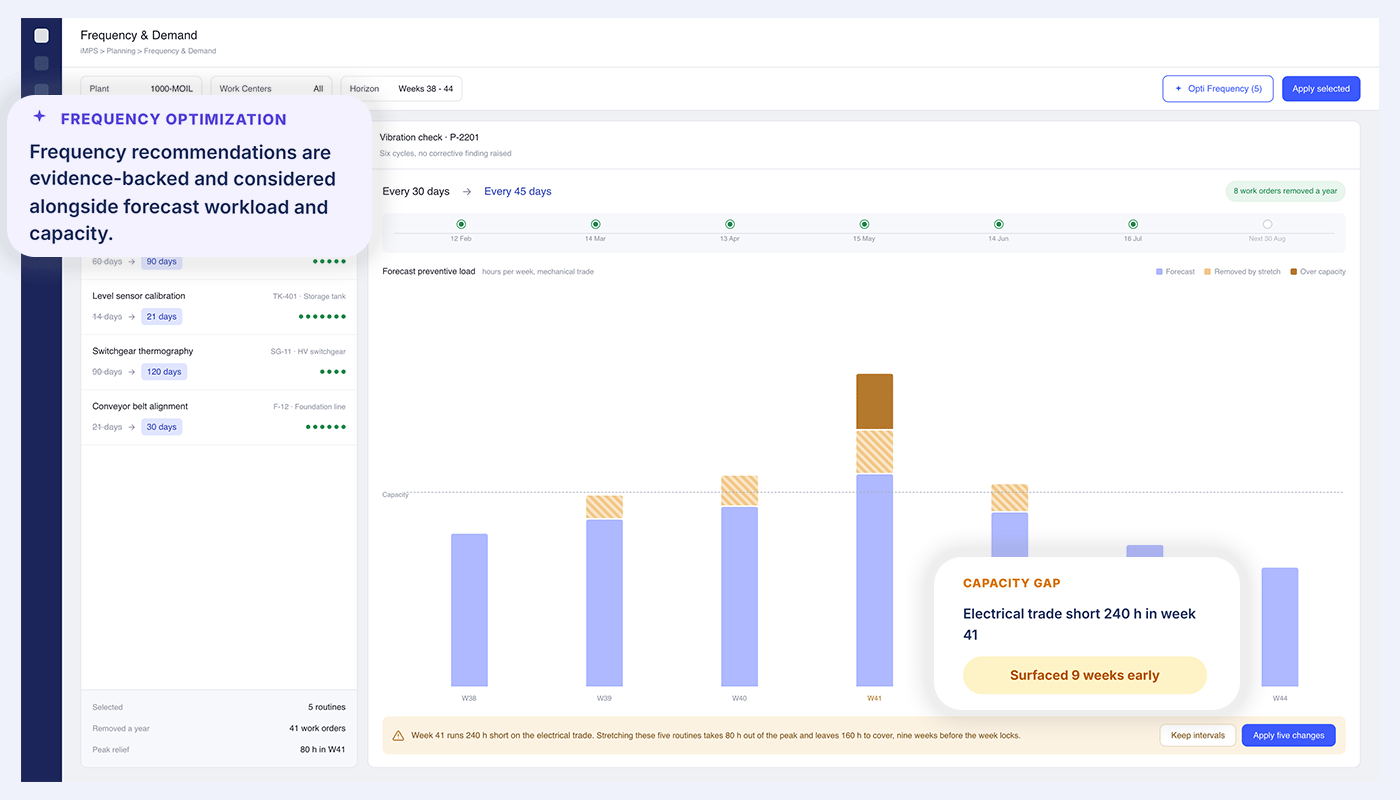
The Demand Forecasting Agent projects upcoming preventive and corrective work against workforce and trade capacity, so a resource gap surfaces while there is still time to act on it.
Preventive & Corrective Demand Forecast
Evidence-Based Frequency Optimization
Forward Capacity Forecasting
Resource Levelling by Trade
Weeks Ahead: capacity gaps surface before they reach the schedule
Scheduling rules live in the system, not in the scheduler's memory .
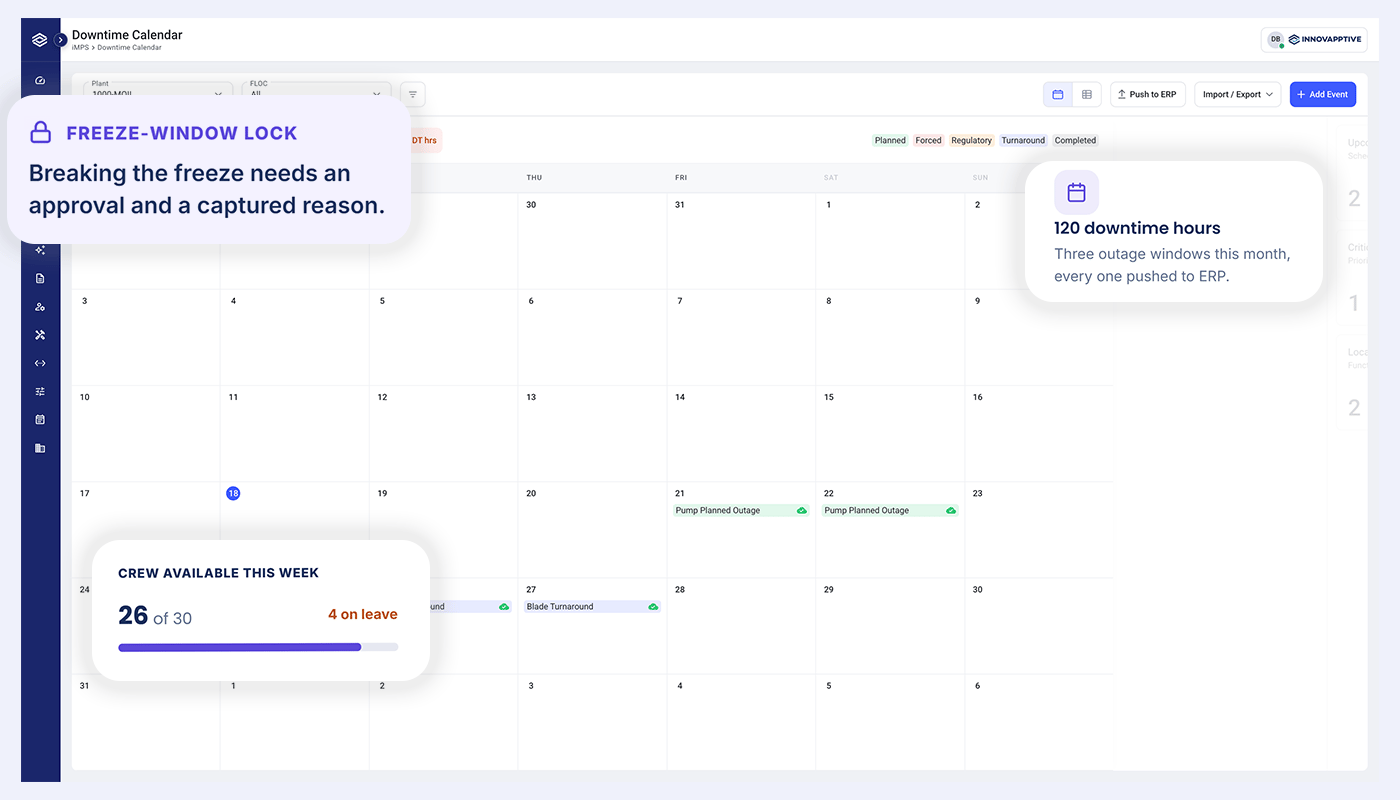
Planned, forced, regulatory and turnaround windows appear as constraints on the scheduling board, so work is never assigned into capacity that does not exist. Configurable rules check ERP and EAM dates, crew capacity, skills, freeze windows and approval routing before a schedule can be committed. It is downtime planning software and scheduling policy on the same board, not a calendar the scheduler has to remember the rules for.
Downtime Windows as Hard Constraints
ERP and EAM Date Checks
Freeze-Window Lock
Configurable Approval Routing
No Double-Booking:every job checked against real downtime and crew capacity
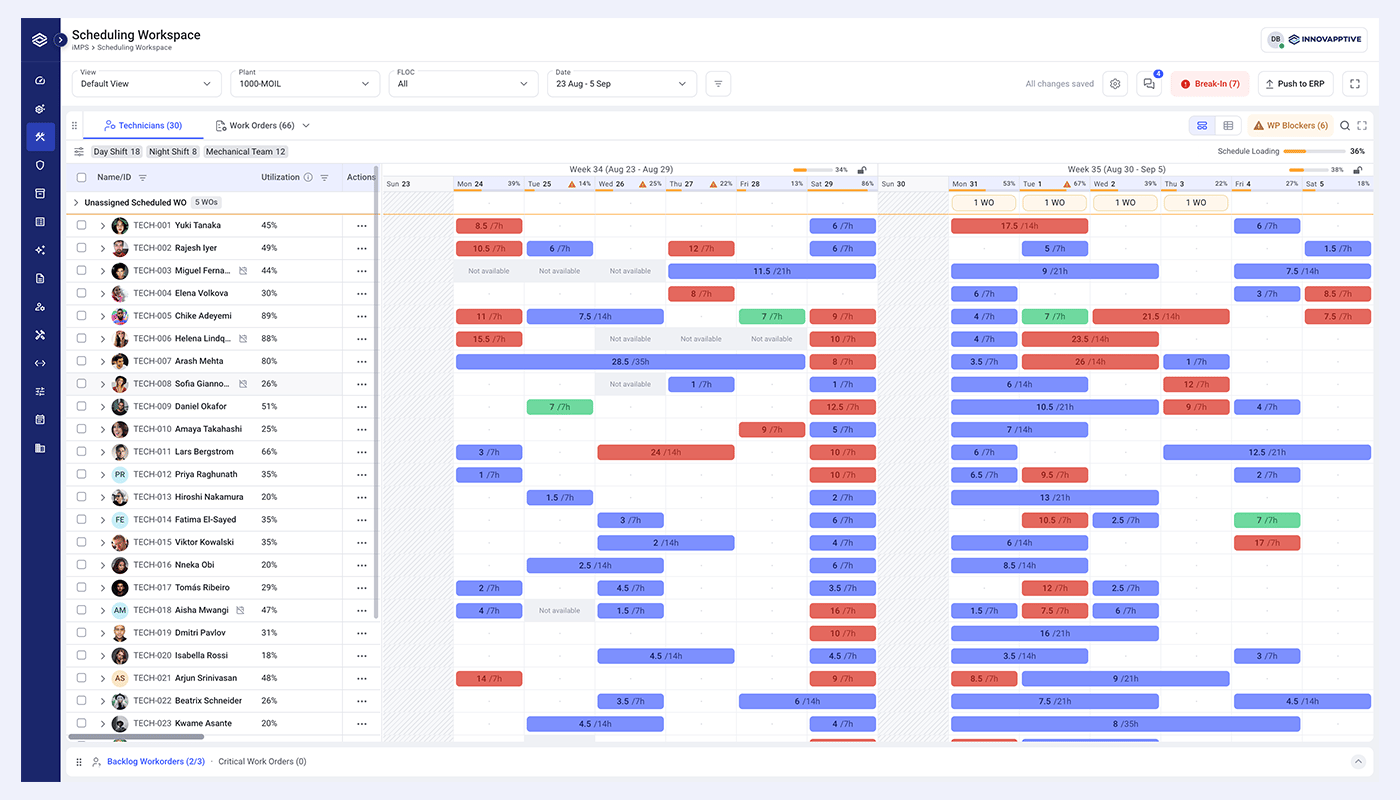
The weekly schedule builds itself from the backlog that has already been cleared.
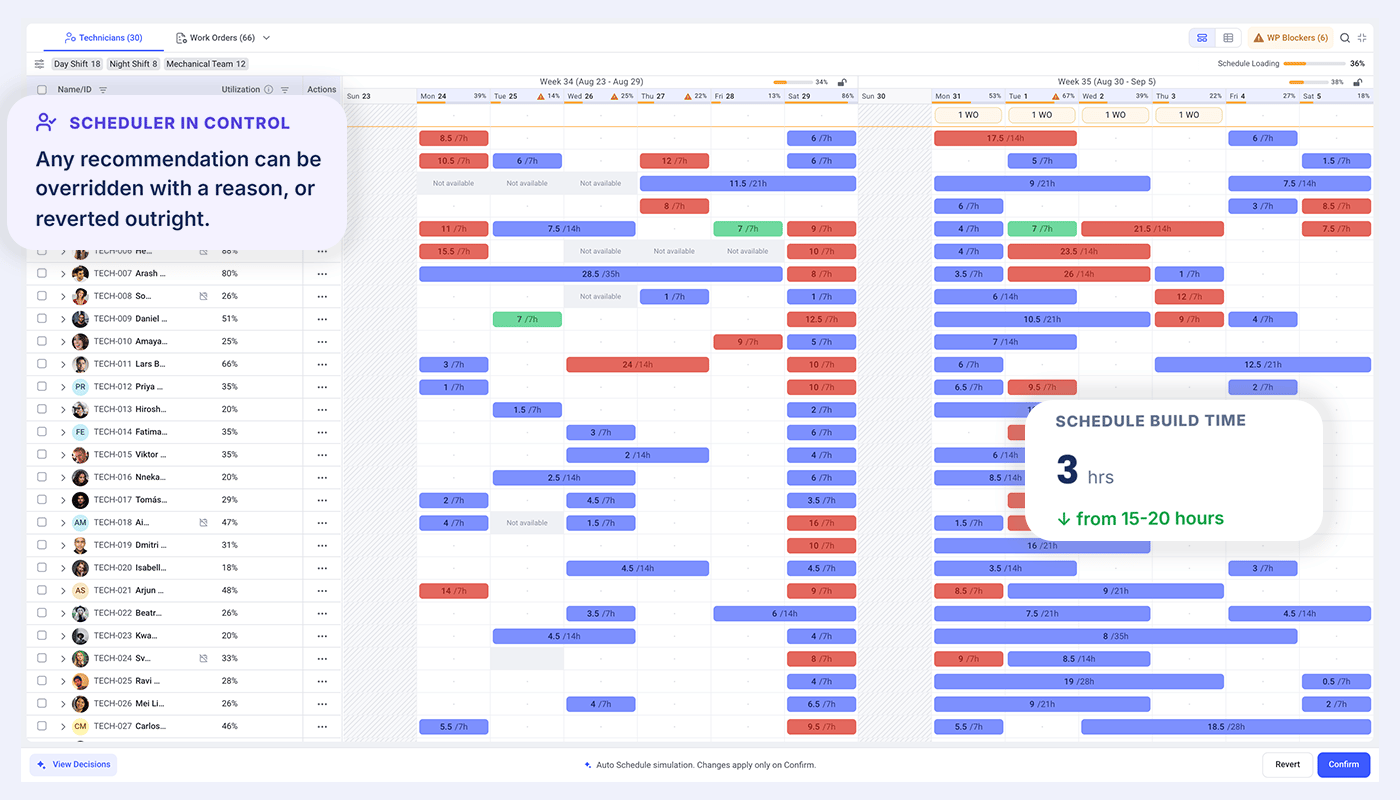
Auto-scheduling recommends feasible assignments straight from the cleared backlog, matched against real workforce availability, leave, training, shifts and skills. Schedulers keep final approval, capture a reason on every override, and revert any recommendation. The schedule reflects the people actually available, which is what separates real workforce scheduling for maintenance from a headcount assumption.
Agentic Workflow Behind Maintenance Planning and Scheduling Software
Work enters from ERP/EAM, preventive maintenance plans, corrective work and reliability signals. Purpose-built agents package and optimize the work, prove schedule readiness, check downtime and operating constraints, then recommend a feasible schedule for planner and scheduler approval.
STEP 1
Capture Work Demand
Work Intake
Work orders, PM plans, corrective demand and reliability signals enter the planning flow from connected ERP/EAM and plant systems.
STEP 2
Plan & Package
Work Packaging Agent
The agent builds an evidence-backed work package with operations, materials, trades, permits and realistic duration recommendations.
STEP 3
Ready & Optimize
Schedule Readiness Agents
Readiness, work bundling, duration optimization and the Frequency Optimization Agent prepare the backlog before anything is committed to the schedule.
STEP 4
Agentic Checks
Downtime & Constraint Integration
Agents check downtime windows, asset availability, workforce capacity, skills, shifts, freeze rules and other scheduling constraints before recommending placement.
STEP 5
Schedule & Dispatch
Schedule and Dispatch Agent
The agent recommends executable assignments from the ready backlog. Schedulers approve, adjust or override before the committed schedule is dispatched.
STEP 6
Learn
Execution Feedback
Execution history feeds future packaging, duration, demand and frequency recommendations so planning accuracy improves over time.
Readiness is proven before commitment, never assumed at executionExecution history feeds the next plan, so schedule accuracy compounds
Built to plug into the systems you already run.
Bi-directional, pre-built integrations across historians, APM, MES/SCADA, EHS, and ERP/CMMS — so your investments in OT and IT keep compounding.
How iMPS Compares With Other Maintenance Scheduling Software
Most maintenance scheduling software adds another calendar. iMPS adds proven readiness. Agentic planning raises the quality of the work before it ever reaches the schedule, so every other tool here schedules the work first and discovers what wasn't ready later.
Capability
Innovapptive iMPS
Other Tools
Planning
AI agents build evidence-backed work packages
Manual or template-driven planning
Schedule Readiness
Readiness, bundling and constraints checked before commitment
Readiness often resolved after work is placed
Optimization
Duration, demand, frequency and work bundling learn from history
Rules, calendars and manual adjustments
Scheduling Control
Recommendations remain explainable, reviewable and reversible
Automation and human control vary by tool
Innovapptive iMPS vs ERP and CMMS
When you shortlist planning and scheduling software, it usually comes down to three choices: lean on what your ERP already does, add a CMMS scheduling module, or bring in a dedicated tool. All three can fill a calendar. The difference is what happens before the work gets there, whether readiness is proven, whether live field signal reaches the schedule, and whether anything learns from what the last job actually took.
Capability
Innovapptive iMPS
ERP-Native Scheduling
ERP-Certified Add-Ons
Standalone CMMS Scheduling
Work package creation
AI-built from execution history with confidence score
Manual build from task lists
Template and rules-based build
Manual build or template
Readiness gating
Material, permit and isolation cleared before scheduling
Availability check only
Automated availability checks
Parts check where inventory is linked
Evidence behind AI output
Named source: this asset, a similar asset, or plan manually
No or limited AI recommendations
Not a standard feature
No or limited AI recommendations
Confidence scoring
Inspectable score on every package
Not a standard feature
Not a standard feature
Not a standard feature
Live field signal into scheduling
Real-time telemetry from Connected Worker execution
Varies by platform
Batched mobile feedback
Status update on completion
Learning from execution history
Durations, crew sizing and PM intervals adapt
Rules and calendars only
Not a standard feature
Static rules only
PM interval optimization
Frequency Optimization Agent extends zero-finding intervals
Manual interval editing
Not a standard feature
Manual interval editing
Work bundling
Proximity, asset, trade and downtime window
Manual grouping
Downtime and outage grouping
Manual grouping
Offline field execution
RapidSync offline mode
Varies by mobile add-on
Varies by platform
Varies by platform
System of record
SAP PM, Maximo or Oracle EAM retained
ERP
ERP
CMMS
Customer Story
How Indorama Ventures Turned Connected Execution Into $29M in Annual Maintenance Savings
Indorama Ventures connected frontline execution across rounds, maintenance and plant operations to improve how teams detect, act on and close operational issues.
58%Reduction in Maintenance backlog
38%Contractor Reduction
45% to 80%Improvement in Planned-to-corrective maintenance ratio
Maintenance Planner Software Built for Planners, Schedulers, Supervisors and Reliability Engineers
70-80%Work package first-pass approval
Stop rebuilding the same work package three times.
Packages arrive assembled from this asset's own history or a named similar asset, with a confidence score and the evidence behind it. Approve, save as draft, or hand it back for manual build. Purchase requisitions are raised at planning time, so a missing part becomes a planning problem rather than a day-of-work problem.
Build the week from work that is already proven ready.
Auto-scheduling recommends feasible assignments from the cleared backlog against real availability, skills and downtime windows. Every recommendation can be overridden with a captured reason or reverted outright. Final approval never leaves the scheduler, which is the test any maintenance scheduler software should have to pass.
Bundled work orders are grouped by proximity, asset and trade, so one mobilization covers several jobs in the same area. Crew sizes and durations come from execution history rather than standard times, which means the shift plan matches what the shift can actually deliver.
Retire the PM routines that have never found anything.
The Frequency Optimization Agent identifies preventive routines that returned zero corrective findings since the last cycle and recommends extending that interval one step. Reliability work aligns to valid downtime windows on the calendar rather than competing with production for time that was never available.
Know whether the plan you approved is the plan that ran.
One governed process across every site, with real-time visibility into schedule compliance, wrench time, downtime and planning cycle time. Schedule variance stops being a monthly reconstruction from memory and becomes a number on a dashboard.
No rip and replace, and no second system of record.
SAP ECC and S/4HANA Plant Maintenance, IBM Maximo and Oracle EAM stay the system of record. iMPS syncs work orders, statuses, dates and work centers both ways, and records who changed what, when and why. Nothing new to run as a competing master.
See Intelligent Maintenance Planning & Scheduling in Action
Bring Us Next Week's Schedule. We Will Show You What Is Not Ready.
Send one week of your real backlog. A value engineer runs it through work packaging and readiness gating, live. In thirty minutes you see exactly which jobs would have failed on the day, with the parts, permits and isolations named.
Recognized as a Leader in Connected Worker Platforms
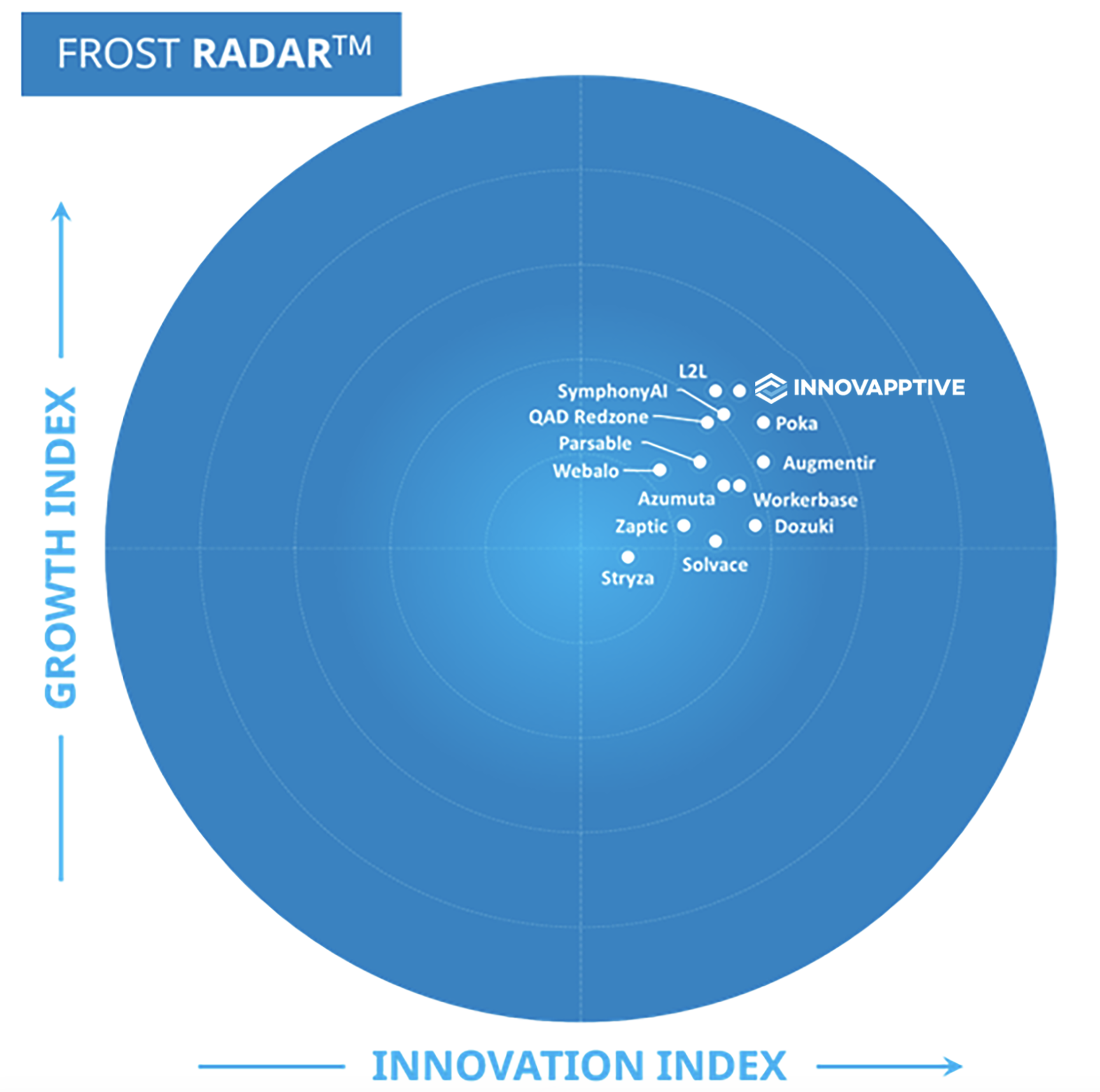
Frost & Sullivan named Innovapptive 2026 Company of the Year and a Leader in its Frost Radar™ for Augmented Connected Worker, End-to-End Platforms, based on platform breadth, AI execution capability, and measurable customer impact.
Frost & Sullivan Best Practices
2026 Company of the Year, Global Connected Worker Platforms
Frost & Sullivan recognized Innovapptive for closing the frontline execution gap with its end-to-end connected worker platform.
“Innovapptive has taken an innovative approach to AI, developing one of the most extensive AI agent portfolios available. These agents assist manufacturers with their maintenance, operations, reliability, safety, and analytics needs.”
Juan Francisco Dell'Era · Senior Research Analyst, Industrial Automation & Software, Frost & Sullivan
Resources
Must-Have Resources for Maintenance Planning and Reliability Leaders
Featured Whitepaper
The Future of Maintenance: An Effective AI Blueprint
A step-by-step blueprint to the strategies and technology stacks driving 90%+ schedule compliance and significant cost takeouts in asset-intensive industries.
Frequently Asked Questions About Maintenance Planning and Scheduling Software
What is maintenance planning and scheduling software?
Maintenance planning and scheduling software builds the work package that tells a crew what to do, then places that work on a calendar against available people, parts and equipment downtime. Planning answers what, how and with what. Scheduling answers who and when. In asset-intensive plants both run against an ERP or EAM system holding the work orders.
What does maintenance planning software do that a CMMS calendar does not?
Maintenance planning software assembles the executable package: operations, materials, trades, permits and isolations, sized against how the job actually ran before. A calendar only places a work order on a date. Maintenance planning tools that skip the package leave the readiness question unanswered until the crew reaches the asset.
How is iMPS different from other maintenance scheduling software?
Two mechanisms. Readiness is gated before scheduling, so material, permit and isolation status is proven rather than assumed, and unresolved work never reaches the board. Every AI recommendation also names its evidence, either this asset's own history, a matched similar asset, or an honest instruction to plan the job manually.
Does work order scheduling software need to replace SAP PM or IBM Maximo?
Replacement is not required. iMPS runs on top of SAP ECC and S/4HANA Plant Maintenance, IBM Maximo and Oracle EAM, which stay the system of record. Work orders, statuses, dates and work centers sync both ways, and locked schedules hand back with a full audit trail of who changed what and why.
How can a plant improve maintenance schedule compliance?
Schedule compliance improves when unready work stops reaching the schedule. Gate material, permit and isolation readiness before commitment. Size durations from execution history rather than standard times, and honor downtime windows as hard constraints. Then lock a freeze window that requires an approval and a captured reason to break.
What should a maintenance planner software evaluation cover?
Ask how the tool proves readiness, not just how it displays a calendar. Ask what evidence sits behind an AI recommendation and whether a planner can inspect it. Ask whether execution history changes future durations and PM intervals. Ask whether the ERP stays the system of record after go-live.
How does workforce availability affect maintenance scheduling?
A schedule built on headcount rather than availability overcommits every week. Leave, training, shift patterns and skill qualifications determine who can genuinely take a job. When those feed assignment directly, the plan reflects the people available to perform the work rather than the work that needs doing.
Can preventive maintenance scheduling software reduce the number of PMs you run?
Reduction is possible where the evidence supports it. The Frequency Optimization Agent identifies preventive routines that returned zero corrective findings since the last cycle and recommends extending that interval one step. Most preventive maintenance schedule software and pm schedule software only adds routines, which raises cost without raising reliability.
How are downtime windows used in maintenance scheduling?
Planned, forced, regulatory and turnaround windows appear on the scheduling board as constraints. Work cannot be assigned into capacity that does not exist, and reliability tasks needing an asset to be down align to windows where that asset is genuinely available. Downtime conflicts fall, and planning rework falls with them.
What is the ROI of maintenance planning and scheduling software?
The return comes from scheduling only work that is genuinely ready, so crews stop standing down for missing parts or permits and the committed week actually runs. For iMPS, that shows up in three ways: schedule compliance climbs from a typical 60 to 65 percent baseline 75 to 80%, wrench time rises by 15 to 25 percent as more paid hours convert to tool time, and maintenance cost as a percentage of Replacement Asset Value (RAV) falls 10 to 15 percent as wasteful PM routines are retired. The gains hold because the schedule keeps learning from what execution returns, rather than spiking during a pilot and fading after.
Is iMPS a CMMS scheduling software replacement?
No. CMMS scheduling software modules place a work order on a date inside the CMMS, and the CMMS becomes the system of record. iMPS is an EAM planning and scheduling software layer that sits above SAP PM, IBM Maximo or Oracle EAM, which stay the system of record. Plants that already run a CMMS keep it and gain readiness gating, bundling, duration modeling and auto-scheduling on top.
How does SAP maintenance planning and scheduling work with iMPS?
Work orders, statuses, dates and work centers sync both ways between iMPS and SAP ECC or S/4HANA Plant Maintenance. Purchase requisitions raise into SAP at planning time. When the scheduler commits the week, the locked schedule hands back to SAP PM with a full audit trail of who changed what, when and why. The same handoff model applies to IBM Maximo and Oracle EAM.
What is downtime planning software and why does it matter for scheduling?
Downtime planning software makes planned, forced, regulatory and turnaround windows visible as constraints on the scheduling board. Without it, reliability work is assigned into capacity that does not exist and gets displaced on the day. In iMPS the downtime calendar is a hard constraint, so industrial maintenance planning and scheduling decisions respect asset availability before a schedule can be committed.
What is a maintenance scheduling system and how does it differ from maintenance scheduling software?
The terms are used interchangeably. A maintenance scheduling system is the software and the surrounding process that decides who does which work order, when, and against which downtime window. A modern maintenance scheduling system such as iMPS goes past a shared calendar: it proves readiness before commitment, sizes durations from execution history, and keeps the ERP or EAM as the system of record rather than becoming a second one.
Do maintenance planning tools and a maintenance planning system deliver the same thing?
Maintenance planning tools are the individual capabilities: work packaging, readiness checks, duration sizing, interval optimization. A maintenance planning system brings those tools into one governed flow so a work order moves from demand to a proven, scheduled job without leaving the platform. iMPS provides the tools and the system, with every AI recommendation reviewable and reversible by the planner.
Is iMPS preventive maintenance schedule software or work order scheduling software?
It is both, in one flow. As preventive maintenance schedule software it forecasts PM demand, optimizes intervals with the Frequency Optimization Agent, and aligns routines to valid downtime windows. As work order scheduling software it auto-schedules corrective and breakdown work from a cleared backlog against real workforce availability. Preventive and corrective work compete for the same crews, so scheduling both in one system is what keeps the week honest.
Get Started
What Would You Do With Ten More Hours a Week and a Schedule That Actually Holds?
Oil and gas, chemicals, mining and power operators use iMPS to prove parts, permits and isolations before the schedule locks, bundle work by proximity and downtime window, and size durations from what the job actually took. Your ERP stays exactly where it is.