-
Platform
The #1 Platform Driving Frontline-First Digital TransformationConnected Worker PlatformLearn More
-
Product
Operations SuiteMaintenance SuiteWarehouse SuiteContinuous Improvement Suite
-
Solutions
By Business ChallengeBy Industry
- Resources
- Company
- Contact Us
Find What You Need, Instantly!
Your TPM scorecard can be green while the programme still stalls.
TPM tells every role what to do. The real loss appears between the roles: findings that wait, work that is not ready, and lessons that never make it back into the plan.
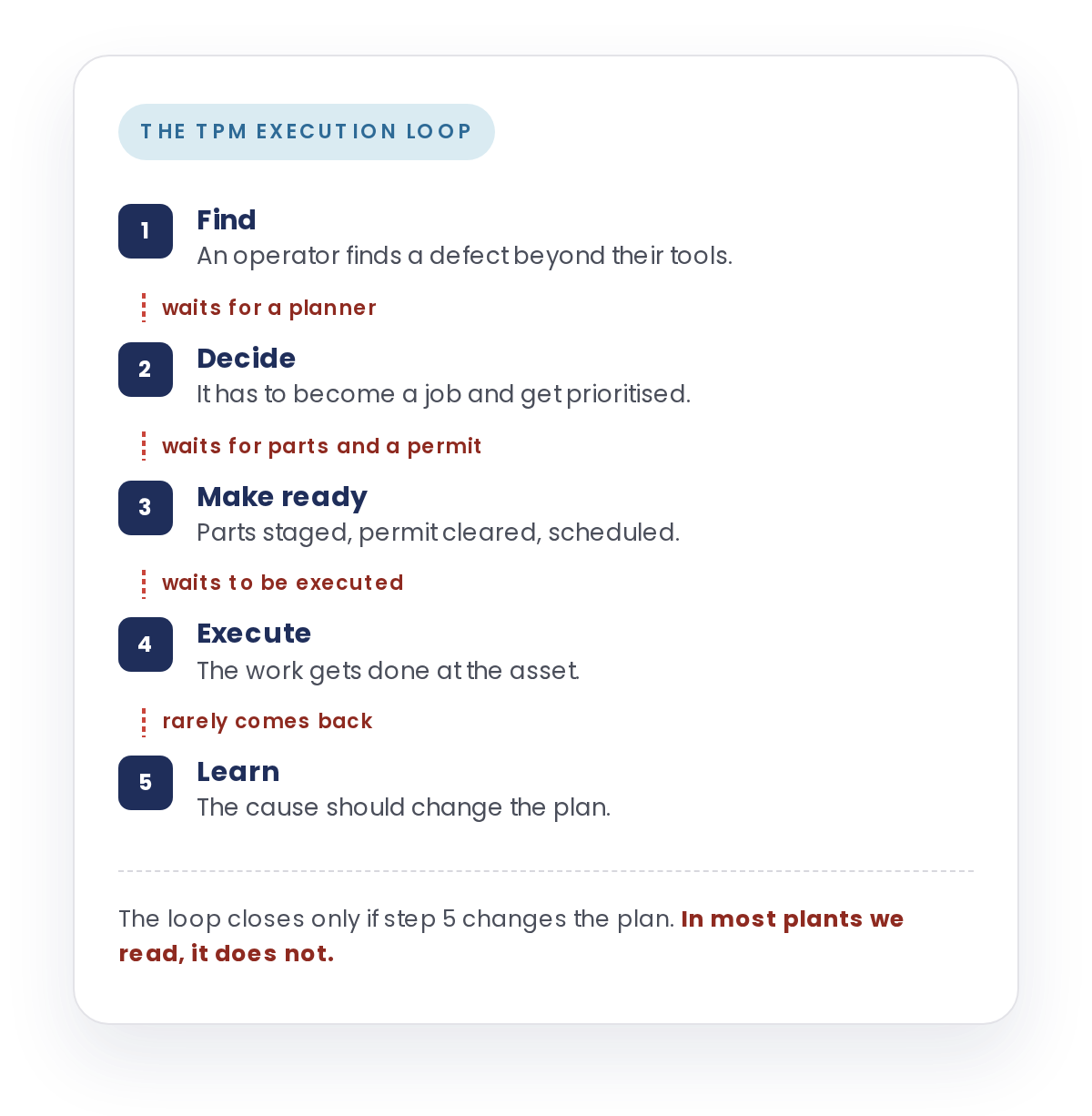
TPM does not usually stall at the pillar . It stalls at the handoff .
A round can be complete, a PM can be on schedule, and an improvement action can be marked open. None of that proves the work reached the asset, was completed without waiting, or changed what the plant does next.
Is your TPM programme actually running?
Pick a pillar. See what a conventional scorecard can show, then compare it with the operational evidence that matters.
Round compliance
The operator completed the assigned round and recorded a finding.
- Round completion can be green
- A finding can still leave the asset
- The handoff may start a queue
Resolution at the asset
The useful test is what happened to the defect after it was found.
- How many findings were restored by the operator?
- How many became actionable work?
- How long did each wait?
PM compliance
Planned jobs appear on the schedule and show a completion status.
- The job was planned
- The job was completed
- The historical plan remains unchanged
Learning from actual work
The real test is whether actual execution changes what the plant plans next.
- Actual hours return to the plan
- Failure information influences future work
- Ineffective routines can be challenged
Improvement action logged
A countermeasure exists in a tracker with an owner and due date.
- The action has an owner
- The action has a deadline
- The same loss can still return
Loss no longer repeats
Focused improvement matters when the recurring loss actually stops.
- Countermeasure is linked to the loss
- Execution evidence confirms the change
- The next review shows the recurrence is gone
Quality check completed
The process or equipment condition was inspected to standard.
- Inspection happened
- The result was recorded
- The defect may still travel downstream
Quality learning at source
The stronger test is whether equipment learning reaches the process decision.
- Condition is tied to the asset
- The issue reaches the right role
- Corrective action happens while it still matters
Design review complete
New equipment has passed a formal review before installation.
- Review is documented
- Requirements are known
- Operational learning can still sit outside the process
Learning carried forward
The value comes when asset and maintenance learning shape the next design decision.
- Known failure modes are carried forward
- Standards reflect maintenance experience
- The next asset starts with better context
Training completion
People are certified or marked complete against a curriculum.
- Training completion is visible
- Standard work exists
- Execution can still vary at the asset
Capability at the asset
The practical test is whether the person can execute the standard in the work environment.
- Instructions are available at the job
- The workflow supports the right sequence
- Evidence of execution can be reviewed
Support process on time
An administrative process meets its internal service target.
- A request exists
- A service target exists
- The plant can still wait on the handoff
Friction removed
Administrative TPM matters when support work removes plant waiting.
- The handoff is visible
- The dependency is ready when needed
- The plant can see where support delays work
Permit completed
The permit or isolation record is complete before work begins.
- Permit is documented
- Compliance is visible
- The job can still wait for readiness
Safe work that is ready
The stronger test is whether safety readiness arrives before the technician is mobilised.
- Permit status is visible in the job
- Isolation readiness is confirmed
- Execution starts without another safety queue
Seven handoffs sit between a pillar and a plant result.
TPM defines responsibilities across roles. The margin leak appears when work waits between them.
Find → plan
An operator finds a defect, but the finding is not immediately usable by planning.
- Field operator
- Planner
Plan → ready
The job exists, but parts, instructions, permits or the right skill are not ready.
- Planner
- MRO
- EHS
Ready → execute
The technician spends time finding context instead of working on the asset.
- Supervisor
- Technician
Execute → learn
Actual hours and findings close the order, but the plan never changes.
- Technician
- Reliability
Make the TPM loop visible from finding to learning.
The goal is not more TPM activity. It is less waiting between TPM activities and a plan that learns from what actually happened.
Find
The defect is captured at the asset, with context, the moment it is seen.
→Decide
It becomes a prioritised job, not a note that waits in a queue.
→Make ready
Parts, permit and instructions are staged before the crew mobilises.
→Execute
Give the frontline the context needed to complete the job.
→Capture
Return actual hours, readings and findings to the record.
→Learn
The confirmed cause changes the preventive plan and interval.
If completed work never changes the plan, TPM is recording history, not learning from it.
How Innovapptive brings every TPM pillar to life
TPM stalls when its pillars run on paper and in separate systems. Innovapptive delivers every pillar on one connected platform, on top of SAP, IBM Maximo and Oracle EAM, with no rip and replace.
Operators fix it before it fails
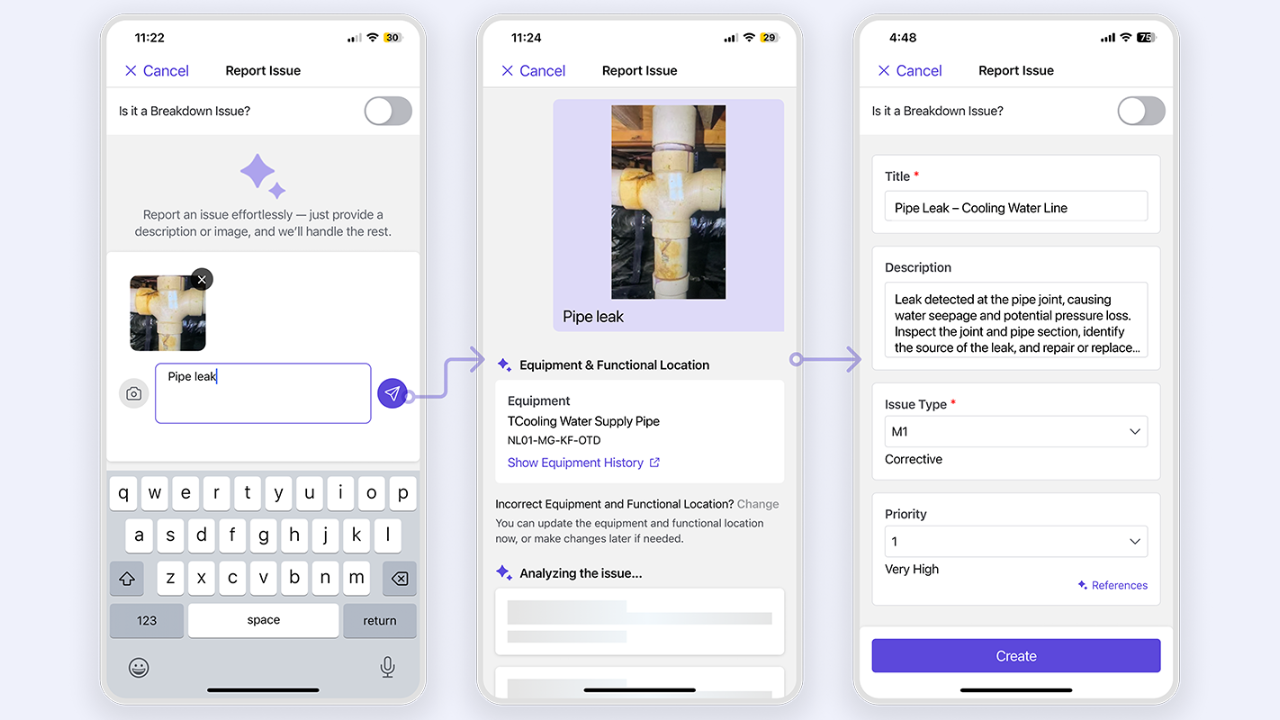
Autonomous maintenance is operator-led maintenance. When an operator spots an abnormality, AI Troubleshooting guides them through diagnosis and the fixes they’re qualified to make, using equipment knowledge, past fixes and procedures.
- Minor issues are fixed on the spot, without waiting for maintenance.
- Anything beyond operator level goes to maintenance with the diagnosis attached.
Planned work that matches asset health
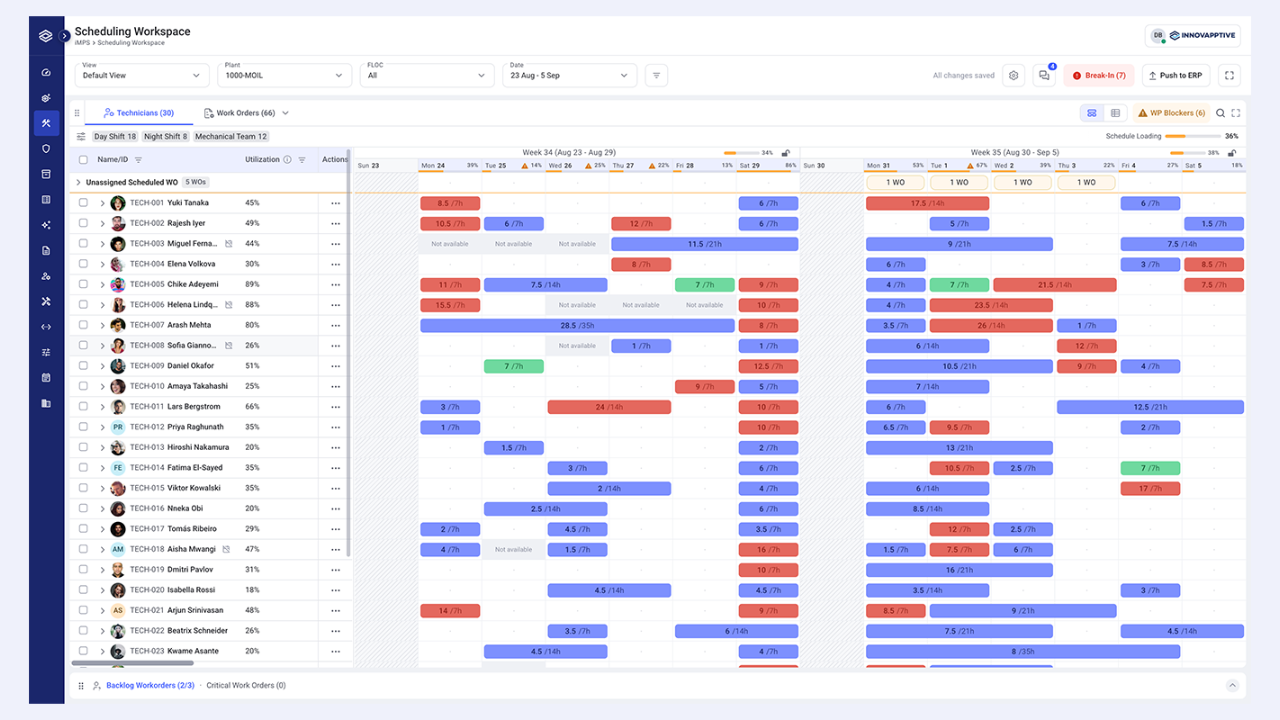
AI Planning & Scheduling sets PM intervals by condition and risk, and Mobile Maintenance delivers each planned job complete to the field.
- Stop over-servicing healthy assets.
- Move effort from reactive repair to planned work.
Kaizen aimed at the biggest losses
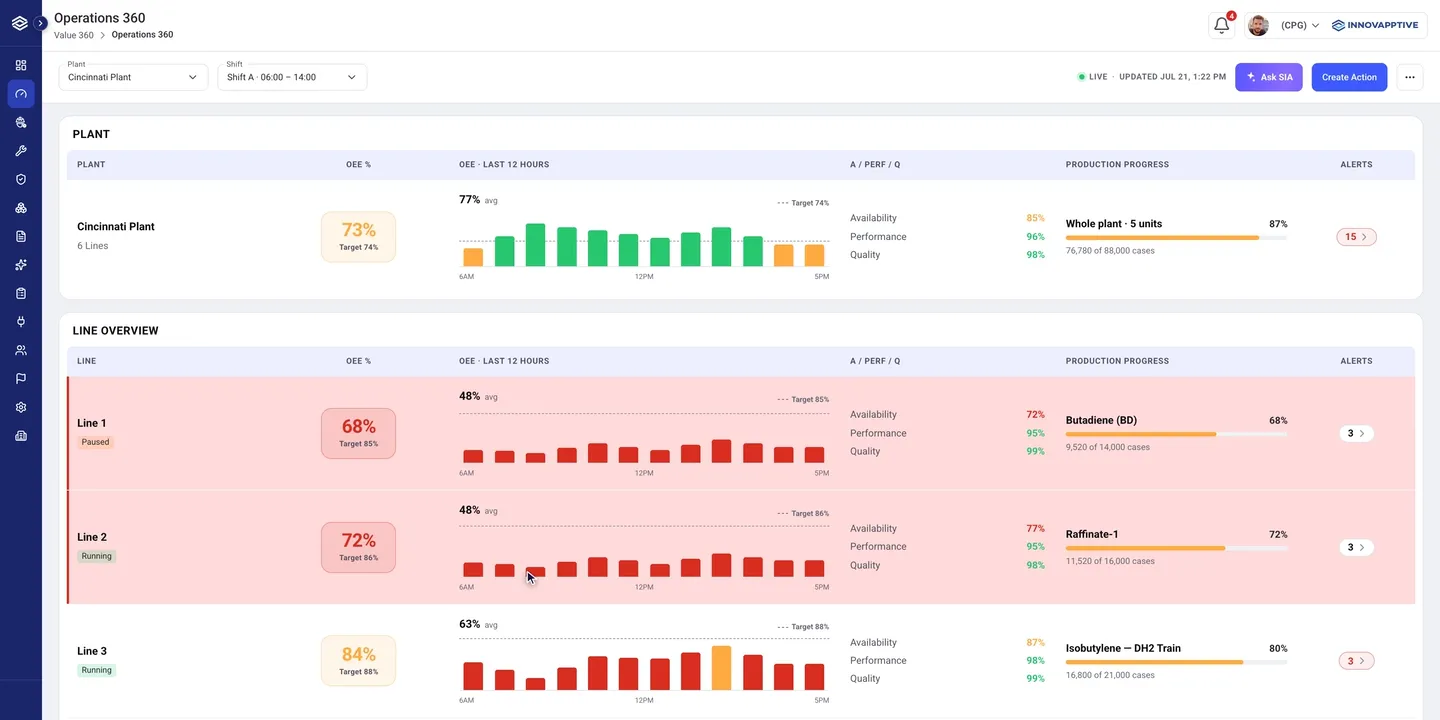
OEE Tracker ranks losses by line and cause, and AI Root Cause Analysis guides teams through a 5-Why on the ones that repeat.
- Teams work on the losses that cost the most.
- Countermeasures are tracked until the fix is verified.
Hold the conditions that make good product
Quality checks run inside Operator Rounds. Quality Management maps each spec to the conditions behind it, and AI anomaly detection flags equipment drift before it becomes a defect.
- Deviations are caught during inspections, not at final QC.
- Out-of-spec results trigger action before the batch is lost.
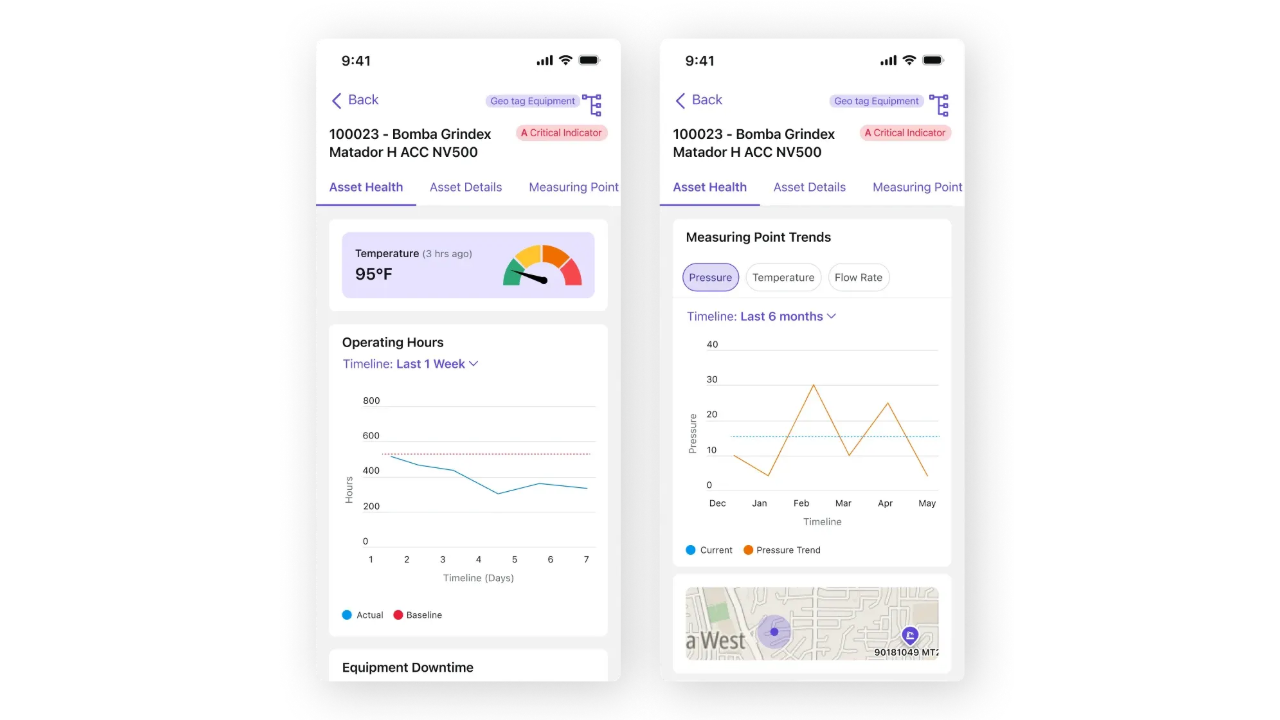
Start new equipment right the first time
New assets go live with rounds, PMs and procedures already set up, and failure history from existing equipment shapes how they are maintained.
- Baseline readings are captured from day one.
- Lessons from past failures reach the next project.
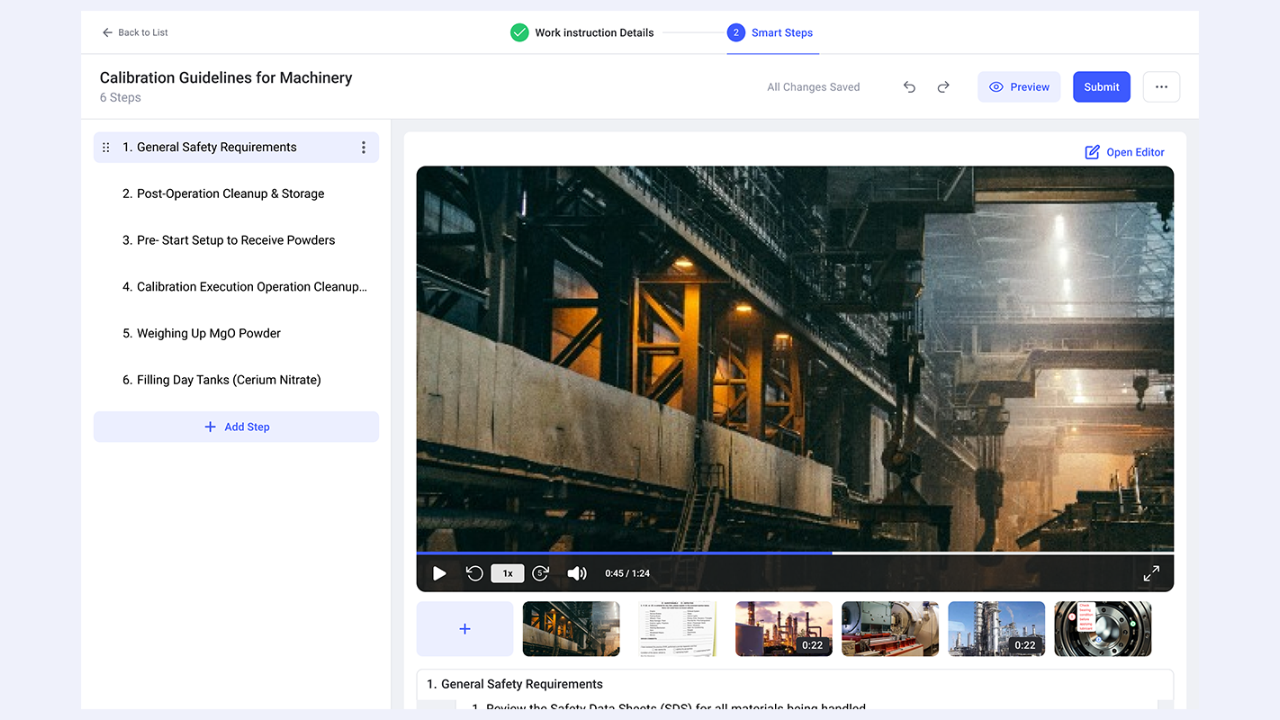
Build skills into the work itself
Digital Work Instructions guide every task step by step, with photos, video and required checks. The Skill Matrix shows who is trained and certified on each asset and task, so the right person does every job.
- New hires work to the standard from day one.
- Skill gaps show up before they turn into mistakes, so training goes where it’s needed.
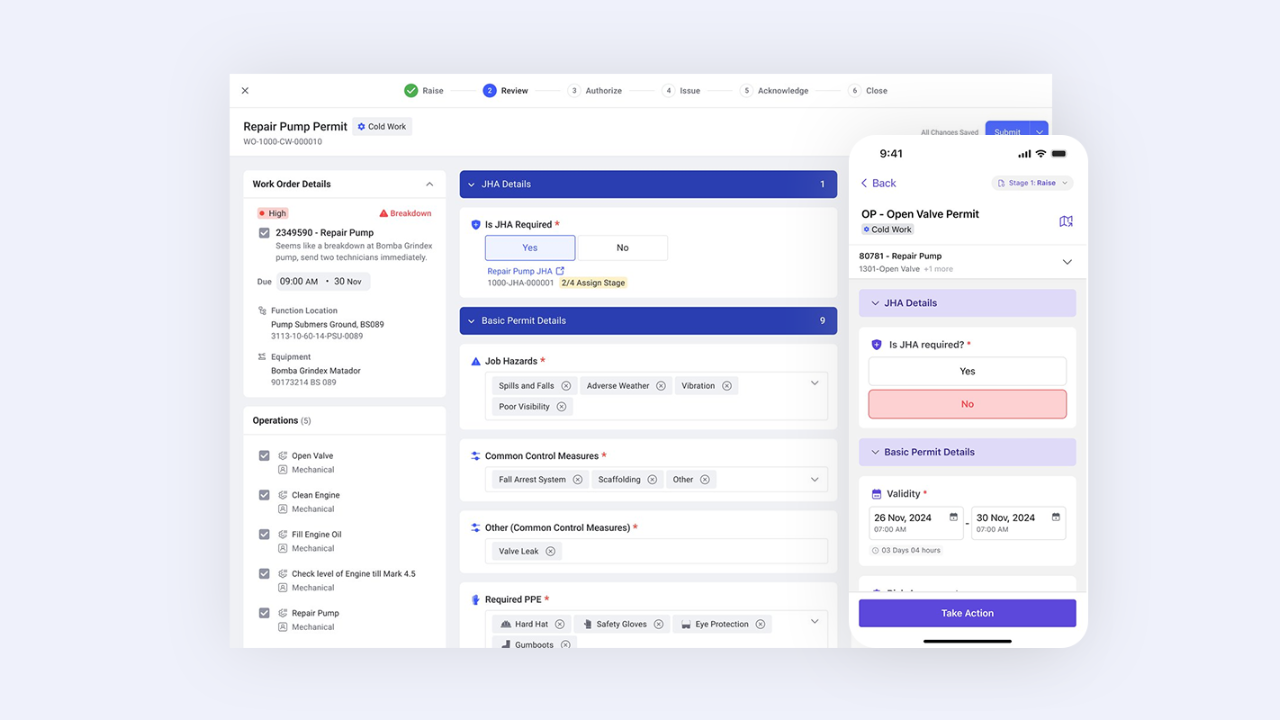
Zero harm built into every job
Permits prepares work permits, job hazard analyses and isolations alongside the job. Safety rounds run in Operator Rounds, so hazards found on the floor are tracked to closure on the same platform.
- No job starts without the right permit and isolation.
- Hazards found on safety rounds are tracked until they’re closed.
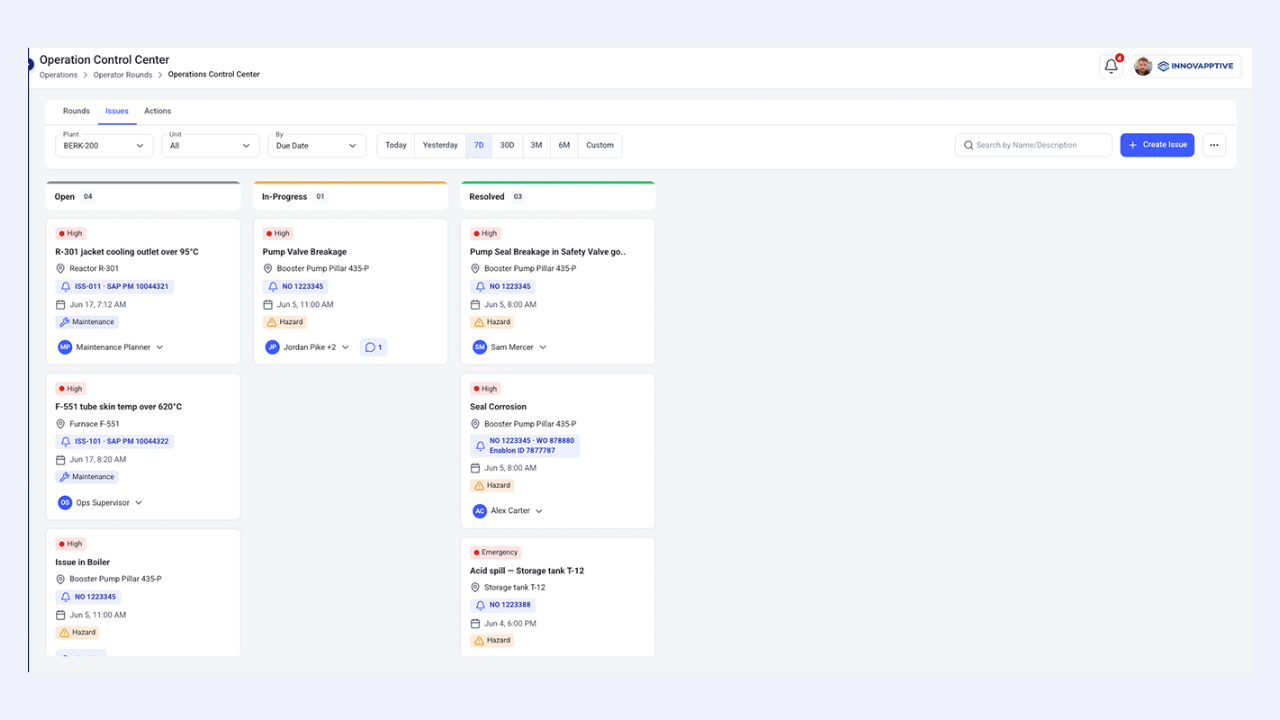
Run the plant on one daily rhythm
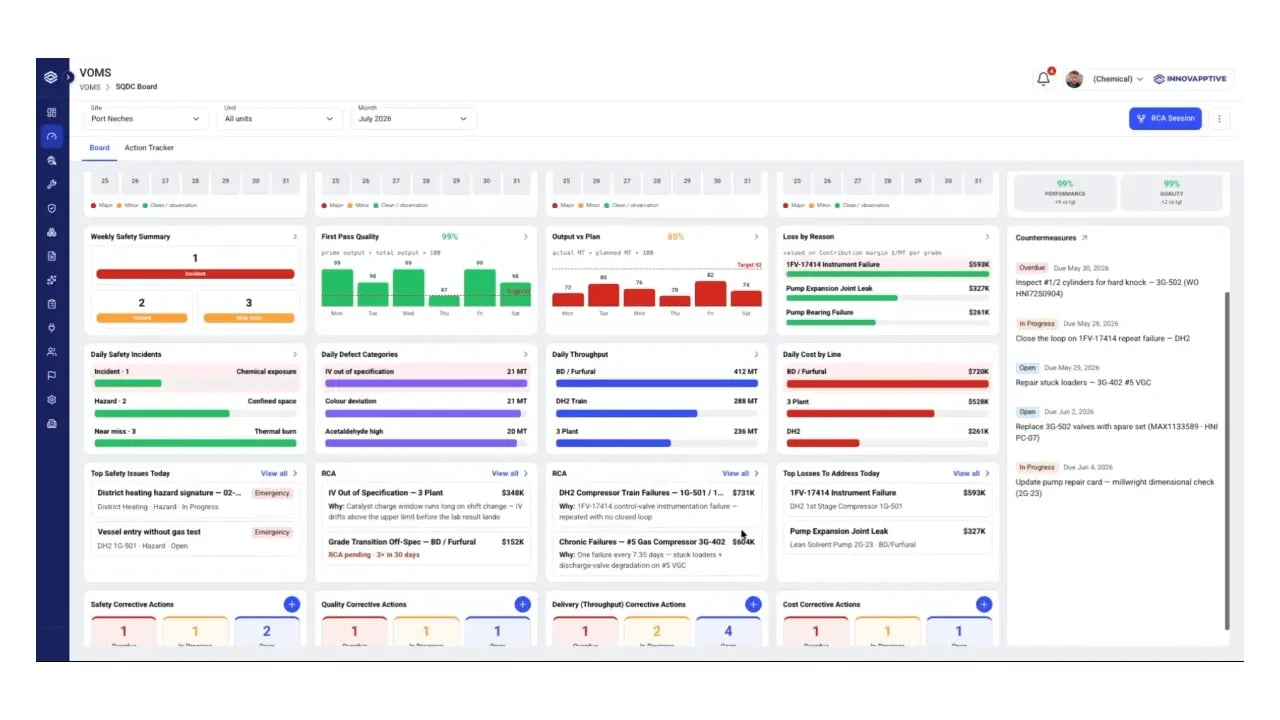
SQDC dashboards bring safety, quality, delivery and cost into tier meetings from live plant data. Daily management keeps every action owned and visible, and digital shift logbooks hand open issues to the next crew.
- Every meeting starts from the same facts, not spreadsheets.
- Actions have owners and dates, and stay visible until closed.
Take TPM from the scorecard to the shop floor.
The TPM Implementation Guide shows plant and maintenance leaders how to get all eight pillars running on the floor.
What happened when execution was connected at Indorama
Innovapptive connected frontline execution to the systems already in place, digitised paper work orders, and closed the reactive gap, without adding headcount.
Digital transformation works when it’s driven from the frontline—giving operators the power to improve execution and protect margin.
Mark Holden
Chief Manufacturing and Technology Officer
Indorama Ventures
See how the site got there, step by step.
Read the Indorama storyRecognized as a Leader in Connected Worker Platforms
Frost & Sullivan named Innovapptive 2026 Company of the Year and a Leader in its Frost Radar™ for Augmented Connected Worker, End-to-End Platforms, based on platform breadth, AI execution capability, and measurable customer impact.

2026 Company of the Year,
Global Connected Worker Platforms
Frost & Sullivan recognized Innovapptive for closing the frontline execution gap with its end-to-end connected worker platform.
Get the Report→
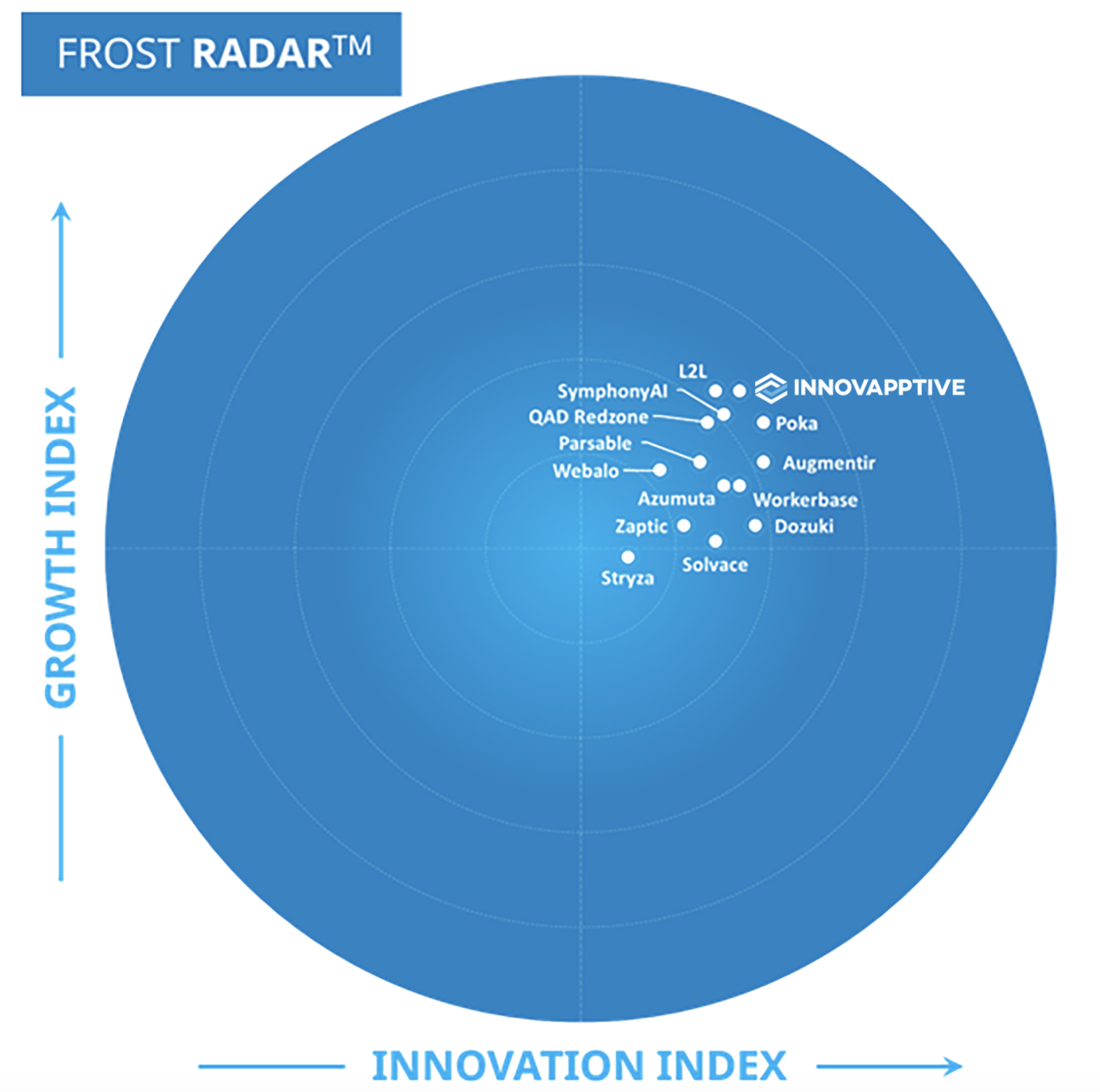
A Leader in Augmented
Connected Worker Platforms
Positioned as a Leader for connected worker platforms based on innovation, growth performance & proven enterprise scalability.
Get the Report→“Innovapptive has taken an innovative approach to AI, developing one of the most extensive AI agent portfolios available. These agents assist manufacturers with their maintenance, operations, reliability, safety, and analytics needs.”
Find the TPM gap your systems cannot show you.
The Margin Walkthrough combines your existing data with time on the floor to identify where work waits, what it costs, and what can be recovered.
Understand the data
We review your work orders, notifications and rounds, on top of the systems you already run.
Observe the floor
We review your work orders, notifications and rounds, on top of the systems you already run.
Quantify the gap
Separate real P&L impact from workload and risk, then quantify the recovery opportunity.
Prioritize recovery
Get the findings, root causes, recovery opportunities and priority actions in one executive-ready report.
See whether your TPM programme is actually landing.
Your scorecard tells you what was completed. The floor can show you what happened next. Find the gap, put a value on it, and see what changes it.
Questions we hear from plant leaders
TPM activity shows that a round, PM or improvement action happened. A working loop also shows what happened to the finding or work afterward and whether the learning changed the next plan or standard.
Innovapptive is designed as an execution layer on top of the enterprise system of record. The goal is to connect frontline workflows with the systems already used for maintenance and operations.
It combines your existing data with two days on the floor to trace where work waits across roles, verify the difference between system records and actual execution, quantify the resulting value gap, and document the actions that can address it.
No. The walkthrough is designed to examine how the programme is working in practice and where execution is getting stuck. The objective is to identify gaps in the current operating model rather than start by replacing the framework.