
What Are Operator Rounds?
Operator rounds are the scheduled inspection routes that plant operators walk each shift to check equipment, record readings, and spot early signs of failure. On each round, an operator follows a set route through a unit, logs values like temperature, pressure, vibration, and flow, and notes anything abnormal. The goal is simple: find small problems while they are still small.
Rounds are the frontline of plant reliability. They run around the clock in process industries such as oil and gas, chemicals, refining, mining, and power generation. The data an operator collects feeds reliability, maintenance, and safety decisions across the plant. Done well, rounds act as an early warning system for the whole site.
What do operators check on a round?
A single round can cover dozens of assets and checkpoints. Common checks include:
- Instrument readings such as temperature, pressure, level, flow, and vibration
- Equipment condition, including leaks, corrosion, and unusual noise
- Lubrication levels and seal integrity on rotating equipment
- Safety hazards, spills, and housekeeping issues in the area
- Asset verification, so the reading is tied to the right equipment
Paper Operator Rounds vs Digital Operator Rounds
Paper operator rounds capture a reading but rarely move it anywhere. Digital operator rounds capture the same reading on a mobile device, then route any exception to the team that owns the fix. That difference decides whether a warning sign becomes a work order or dies on a clipboard.
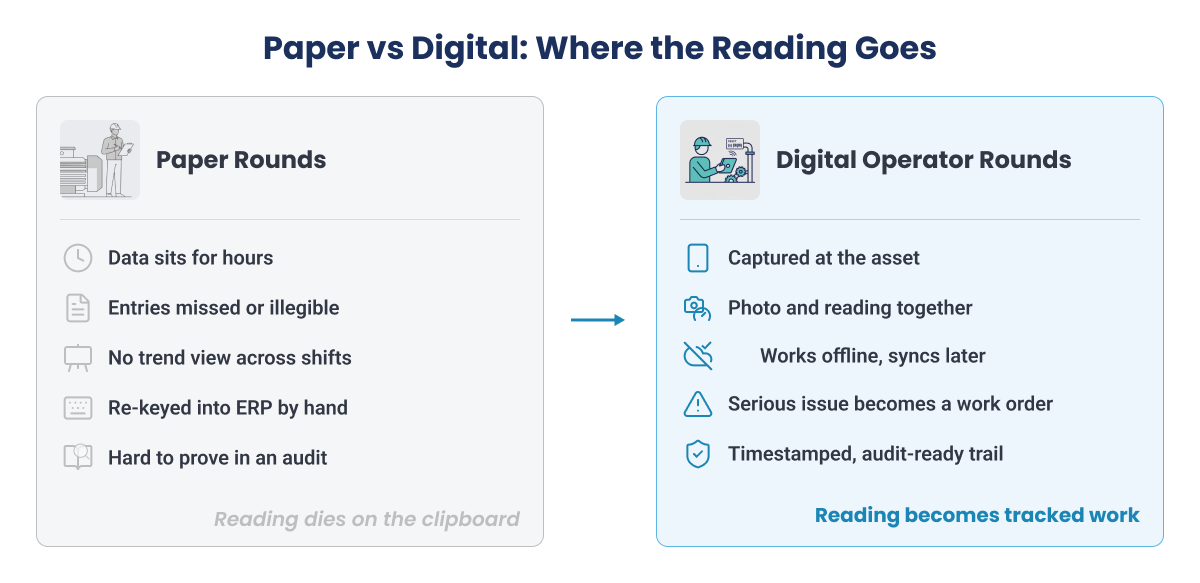
Paper rounds carry a hidden cost: Entries can be illegible or missed. Data reaches decision makers hours late, after it is re-keyed into the ERP. Trends are hard to see across shifts, and proving compliance during an audit means digging through binders. By the time a reactive repair starts, the early signal has often been buried for days.
Digital rounds close that gap: Operators capture readings, photos, and issues at the asset, even with no signal. The data is structured, timestamped, and geotagged. A serious exception is escalated the moment it is recorded, and every completed round becomes part of an inspection-ready trail.
Where Does Your Plant Sit on the Paper-to-AI Curve?
See how operator rounds evolved from paper checklists to AI, what each step unlocks for uptime and safety, and how to tell which stage your plant is in today.
Benefits of Digital Operator Rounds for Manufacturers
Moving operator rounds from paper to mobile does more than remove clipboards. It changes what happens after a reading is taken. These are the five reasons manufacturers make the switch, and what each one delivers on the plant floor.
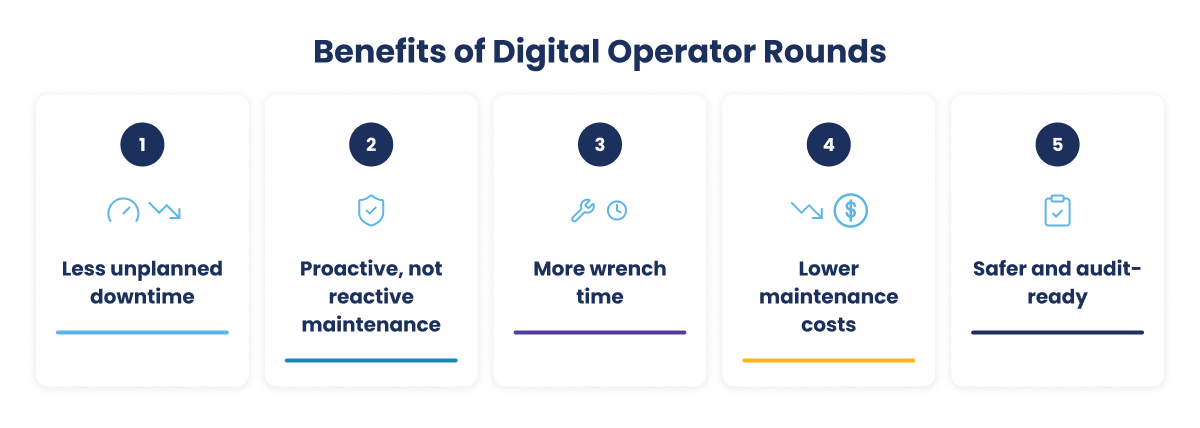
1. Catch equipment failures before they cause downtime
This is the first and biggest reason. Digital operator rounds surface the early signs of wear, such as a rising temperature, a new vibration, or a weeping seal, and turn them into action before the asset fails. Instead of sitting on a clipboard, a serious exception becomes a work order routed to the team that owns the fix. Teams that connect their rounds to maintenance this way often report unplanned downtime falling by 20 to 30 percent. For a reliability engineer or plant manager, that is the difference between a planned repair and a line-down emergency.
2. Replace reactive maintenance with a proactive routine
Most equipment failures give warning signs first, but only if someone records them consistently. Digital rounds standardize what gets checked on every shift, so a small anomaly is logged the same way whether a veteran or a new operator finds it. Photos and AI issue detection catch problems that are easy to miss, and trends become visible by asset over time. This is how a plant moves from run-to-failure firefighting to a planned program that protects output.
3. Free operators from paperwork and improve wrench time
Paper rounds burn time twice, first in the field and again at a desk re-keying the data into the ERP. Digital rounds remove that second step. Operators follow a guided route, capture readings and photos at the asset, and the data flows straight to supervisors and systems, even offline. Many operators report productivity gains of 15 to 20 percent, which means more time on real work and less on admin.
4. Cut maintenance and administrative costs
Costs fall on two fronts. Catching issues early avoids the premium price of emergency repairs, expedited parts, and overtime. Removing manual data entry cuts the back-office effort of chasing, scanning, and filing paper forms. Better data also improves planning and parts availability, so scheduled work runs smoother. For a plant manager or VP of operations, this is where digital rounds show up on the budget.
5. Strengthen safety and audit compliance
Every completed round becomes evidence. Readings, photos, and issues are timestamped and geotagged, skipped tasks record a reason code, and shift reports carry digital signatures. That gives EHS and operations an inspection-ready trail with no scramble before an audit. It also surfaces hazards sooner, and teams report compliance risk falling by up to 75 percent as records become complete and traceable.
Proof in a real plant. At its Port Neches, Texas site, Indorama Ventures connected frontline execution across operator rounds, maintenance, and inventory on Innovapptive’s Connected Worker Platform. The plant cut its maintenance backlog by 58 percent, from 24 weeks to 10, moved its planned-to-corrective maintenance ratio from 45 to 80 percent, and reported 29 million dollars in annual maintenance savings.
Types of Operator Rounds
Operator rounds go by different names depending on the plant, the asset, and the goal. The core discipline stays the same, but the focus shifts.
Plant operator rounds
Plant operator rounds are the general routes operators walk through a unit or across a whole site. They cover process equipment, utilities, and safety checks, and they set the baseline for how a plant tracks equipment condition day to day.
Power plant operator rounds
Power plant operator rounds focus on boilers, turbines, generators, and balance-of-plant equipment. Operators log readings that matter for output and efficiency, and they capture the regulatory checks that power generation demands.
Mobile operator rounds
Mobile operator rounds are rounds executed on a phone, tablet, or rugged handheld instead of on paper. The operator captures readings and issues at the asset, and the data flows to supervisors and systems in real time rather than at the end of the shift.
Remote operator rounds
Remote operator rounds cover tank farms, shielded units, and remote sites where there is little or no network coverage. Operators record everything offline, and the data syncs automatically once the device reconnects, so no reading is stranded in the field.
Maintenance rounds and work order rounds
Maintenance rounds and work order rounds focus on asset health and feed the maintenance process directly. When an operator finds a problem, the exception becomes a work order or notification, so the round drives repair work instead of just recording it.
How to Digitize Operator Rounds
Digitizing operator rounds is not just swapping paper for a form on a screen. The goal is a connected loop, where a reading in the field becomes tracked work in your system of record. These steps get you there.
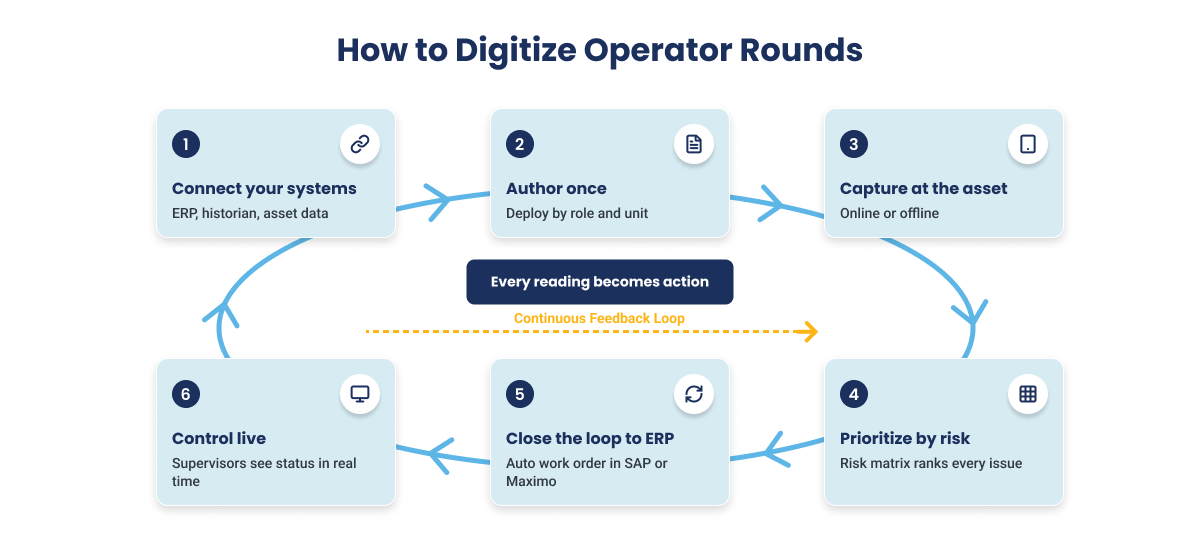
- Connect your systems first: Link your ERP or EAM, your historian, and your asset data so operators see real equipment context on the round.
- Author once, deploy by shift and unit: Build each round plan a single time, then schedule it by role, unit, and task instead of rebuilding it per site.
- Capture at the asset, online or offline: Let operators record readings, photos, and issues at the equipment, even where there is no signal.
- Prioritize exceptions by risk: Use a risk matrix so the most serious issues surface first, no matter who found them or how experienced they are.
- Close the loop to your ERP: Convert qualifying exceptions into work orders or notifications in SAP or Maximo automatically, with no re-keying.
- Give supervisors live visibility: Track round status, open issues, and closures in real time rather than waiting for handover to find out what happened.
Your Roadmap to Digital Operator Rounds That Actually Cut Downtime.
A step-by-step plan to move rounds to mobile, connect your ERP and historian data, and shift from calendar-based checks to condition-based rounds. Skip the trial and error.
How Innovapptive mRounds Digitizes Operator Rounds
Innovapptive Operator Rounds Software, mRounds is AI-powered operator rounds software built for asset-intensive plants. It connects every round to the people, systems, and work that keep the plant running, so a reading never stops at capture. Here is what that looks like in practice.
- AI-assisted authoring: Build round plans with AI, or convert the PDFs and paper sheets you already use into digital rounds, then preview exactly what the operator will see.
- Mobile execution that works offline: Operators run rounds on phones, tablets, and rugged handhelds, with more than 20 response types and full offline capture through RapidSync.
- AI issue detection and guided troubleshooting: A photo of a problem becomes a structured, prioritized issue, and guided troubleshooting brings the right knowledge into the operator workflow.
- Risk-based prioritization: A corporate risk matrix classifies every issue the same way, so critical safety and asset risks surface first.
- Closed-loop ERP integration: Qualifying exceptions post to SAP, IBM Maximo, and Oracle as notifications or work orders, with status returning to the operator.
- Automated shift handover: The handover compiles itself from the shift that just ended, carries digital signatures, and distributes automatically.
- Live operations control: Supervisors track active rounds, open issues, and closures in real time through the Operations Control Centre.
See Every mRounds Capability in One Solution Brief
A feature overview of how rounds are authored, executed, and detected, and how readings and exceptions route into SAP, IBM Maximo, and Oracle as tracked work.
The Bottom Line on Operator Rounds
Operator rounds have always been the plant’s early warning system. The question is whether the warnings reach anyone in time. On paper, most do not. A digital operator round keeps the reading, the photo, and the exception together, then turns a serious finding into tracked work before it becomes a failure.
Start by connecting your systems, author each round once, capture at the asset online or offline, and close the loop to your ERP. That is how a routine walk becomes a reliability and safety advantage across every shift.
Turn Every Operator Reading Into Planned Work
See how chemicals, oil and gas, mining, and power generation teams digitize rounds with Innovapptive.

Unlock Margins Hidden in your Maintenance
Watch how leading manufacturers improve OEE, increase PM compliance, and reduce downtime through connected execution.

- 05-10-2026
10 Best Shift Handover Software Platforms for Plant and Process Operations
Shift handover software can mean different things depending on the operating environment. Some...

- 29-09-2026
Best SAP Maintenance Planning & Scheduling Software 2026
Your maintenance work orders live in SAP Plant Maintenance (PM), while the working schedule lives...

- 28-09-2026
Best Work Order Software: Top 9 Platforms Compared
Selecting the best work order software is a different decision for a large industrial plant than...