
What Is the Skills Gap in Oil and Gas, and Why Is It Getting Worse?
The skills gap in oil and gas is the growing distance between the experience leaving the industry through retirement and the smaller, less experienced pool of workers coming in to replace it. It is widening because the workforce is aging, hiring has not kept pace, and the technical roles in shortest supply take years of field experience to fill.
The numbers make the pressure clear. The IEA reports that through 2035, two of every three new energy hires will be needed just to replace retiring workers. More than half of the 700 plus energy firms it surveyed reported critical hiring bottlenecks, with applied technical roles such as plant operators, pipefitters, and engineers in the shortest supply.
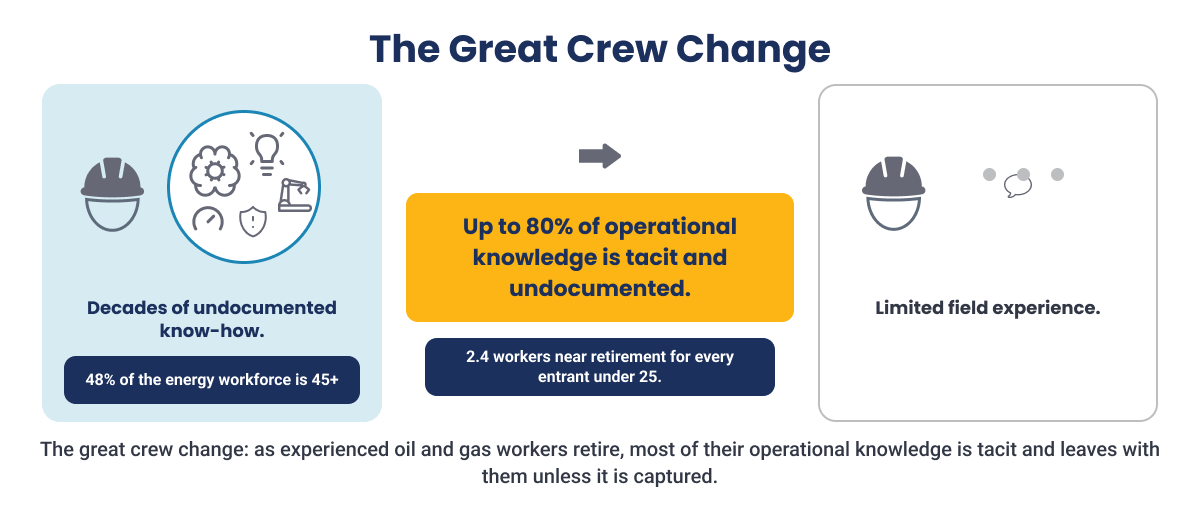
This wave of retirements is often called the great crew change. It hits oil and gas harder than most industries because decades of boom and bust hiring have left a thin mid-career band. The 35 to 50 year old group that would normally step into senior roles is exactly the group in shortest supply, so there is no easy internal bench to promote from. You cannot hire your way out of this fast enough. The more durable answer is to capture what your experienced workers know and make it usable by everyone else.
What Is Tribal Knowledge, and What Happens When It Leaves?
Tribal knowledge is the undocumented, experience-based know-how that lives in the heads of your most experienced workers. It covers the shortcuts, warning signs, and judgment calls that keep equipment running and people safe, but that rarely appear in any manual or standard operating procedure (SOP).
Analysts estimate that 70% to 80% of what an organization knows is tacit, meaning it is held in people's minds rather than written down anywhere. In an aging workforce, that is a serious exposure. When the knowledge is not captured, it retires with the person.
The impact shows up quickly across the plant:
- Safety risk. A new technician who misses a warning sign or rushes a step can turn a routine job into an incident.
- Errors and rework. Less experienced workers make more mistakes, and rework costs both time and money.
- Slower time to competency. Shadowing a veteran for months does not scale when the veterans are leaving.
- More downtime. When only one person knew how to fix a specific asset, their absence turns a quick repair into a long outage.
- Compliance gaps. Inconsistent execution and missing records create audit and regulatory exposure.
The goal is not to clone your best people. It is to capture how they work and put it in front of everyone else at the moment they need it.
Get New Hires Productive Before Your Experts Retire.
See how digital work instructions turn a veteran's know-how into guided, on-the-job training that gets new technicians to competency faster and cuts the shadowing time your senior workers can no longer spare.
Why Does Digitizing Work Instructions Matter for Knowledge Retention?
Digital work instructions are step-by-step procedures delivered on a phone or tablet that guide a worker through a task, with the photos, videos, tools, and safety warnings attached to each step. They replace paper binders, scattered PDFs, and word-of-mouth training with a single, current source of truth.
Paper does not solve the knowledge problem. Binders go out of date, sit in a control room far from the job, and cannot capture the small details that make an expert an expert. A PDF of an SOP tells a worker what to do, but not how the best technician actually does it.
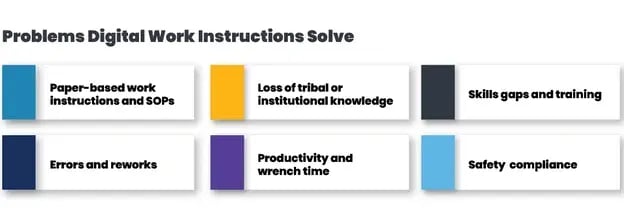
Digitizing changes that in a few important ways:
- It captures tacit knowledge in a reusable form. A short video of a veteran doing the job records the technique, not just the checklist.
- It standardizes execution. Every technician follows the same proven steps, so quality does not depend on who shows up.
- It shortens onboarding. New hires learn by doing, guided step by step, instead of waiting for a mentor to be free.
- It reduces errors and rework. Clear, visual guidance at the point of work lowers the chance of a costly mistake.
- It builds an audit trail. A digital record shows what was done, by whom, and against which version of the procedure.
Done well, digital work instructions turn tribal knowledge from a risk that walks out the door into an asset the whole team can use.
How Do Digital Work Instructions Support Compliance in Oil and Gas?
Oil and gas work is closely regulated, and much of the risk sits in execution. When two technicians do the same job in two different ways, or a safety step is skipped, or a record is missing, the exposure is real. Consistent, documented execution is your best defense in an audit.
Digital work instructions help in three ways. They give every technician the same current, approved procedure, so a new hire follows the exact steps a veteran would. They keep safety warnings and required checks attached to the task, so nothing critical gets dropped. And they capture a record of what was done and against which version, which stands up to review. Paired with mobile maintenance and permit workflows, this creates a consistent and auditable execution trail across the site.
Turn Undocumented Expertise Into a Standard Everyone Follows.
The digital work instructions solution brief shows how to capture procedures from video or existing documents and deliver them to the right job automatically, so execution stays consistent even as your workforce turns over.
What to Look for in a Digital Work Instructions Solution
Not every tool that stores procedures will close a skills gap. When you evaluate options, look for a solution that does the following:
- Fast authoring from what you already have. It should turn a video or an existing document into a structured draft, not force you to rebuild every procedure by hand.
- Automatic delivery to the right job. The correct instruction should attach itself to the work order, asset, and location, so nobody has to remember to link it.
- Offline access in the field. Procedures must work at remote sites and in low-coverage areas, not just at a desk.
- Step-level feedback and version control. Field teams should be able to flag a bad step, and every change should be tracked and reversible.
- A fit with your existing systems. It should connect to the maintenance systems you already run, such as SAP, and support IBM Maximo, so it strengthens what you have instead of replacing it.
Innovapptive's Digital Work Instructions for Oil and Gas Industry
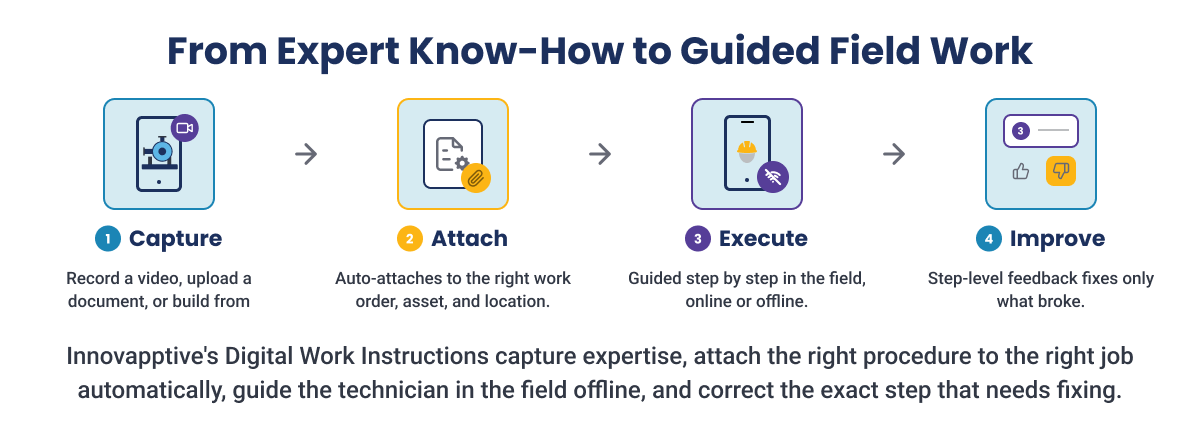
Innovapptive's Digital Work Instructions Software is built around a simple idea: capture what your experts know, attach it to the exact job, and put it in the technician's hands in the field, even without a signal.
Capture Knowledge in Minutes, Not Weeks
A subject matter expert (SME) can record a short video of a task or upload an existing document, and the software turns it into a structured, step-by-step draft. A procedure that used to take days or weeks to write, review, and format can start as a usable draft in minutes, which cuts initial creation time by around 90%. For procedures with no source material, a scratch authoring mode lets an author build steps with drag-and-drop sequencing, warnings, hints, and custom sections.
Put the Right Instruction on the Right Job, Automatically
This is where most work instruction efforts break down. The right procedure exists, but it never reaches the actual job. Innovapptive links each instruction to a task list while it is being created, and maps it to a work order type against a specific asset or functional location. Any qualifying work order then attaches the matching instruction on its own, with no manual lookup or linking. The work order types, assets, and locations come from the maintenance system you already run, such as SAP or IBM Maximo, so the correct procedure is already sitting on the job before a technician goes looking for it.
Built for the Field and Available Offline
A supervisor attaches the instruction at the planning stage, and it stays available without a live connection. So a technician in a plant basement, at a remote wellsite, or in an area with poor coverage still has the full procedure, with every step, warning, and visual in hand. This closes the gap between what the system plans and what actually happens at the point of work.
Fix the One Step That Broke, Not the Whole Procedure
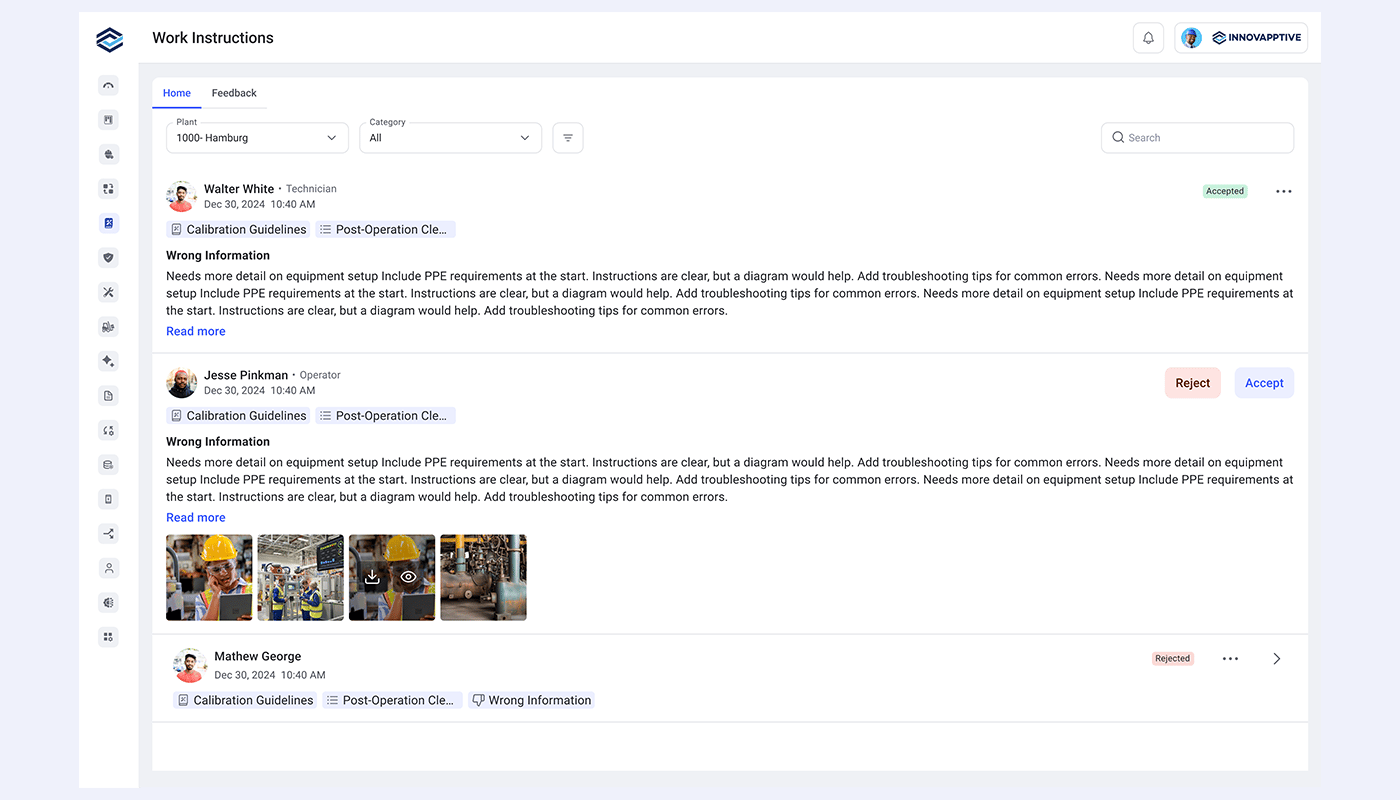
When something in a procedure is wrong, a technician flags that specific step with a thumbs up or down, a reason code, and an attachment. An author then reviews and accepts or rejects the change. Because the correction is scoped to the exact step, the rest of a good procedure is not touched, re-reviewed, or republished. That keeps instructions accurate as equipment and methods change, without slowing anyone down.
Version Control and Audit Readiness
Every instruction carries a complete history with author attribution, timestamps, and one-click rollback. This protects against lost or overwritten content during collaborative editing and supports audit readiness, which matters in a heavily regulated industry like oil and gas.
Don't Let Decades of Expertise Walk Out the Door.
See how Innovapptive's Digital Work Instructions capture what your experts know and put it in every technician's hands, on any site, online or off.
Real-World Proof: Work Instruction Use Rose From Under 20% to 85%
Indorama Ventures, a global chemical manufacturer, deployed the Connected Worker Platform at its Port Neches, Texas site. Despite existing investment in SAP PM and IBM Maximo, frontline execution was still largely paper-based and reactive. After moving technicians onto mobile execution with digital work instructions, the site changed how work actually got done.
The results within 12 months:
|
Metric |
Before |
After |
|---|---|---|
|
Work instruction use |
Under 20% |
85% |
|
Maintenance backlog |
24 weeks |
10 weeks (58% reduction) |
|
PM-to-CM ratio |
45% |
80% |
|
Parts availability |
55% |
95% |
The shift contributed to $50M in realized EBITDA savings in 2025. Indorama also named reduced knowledge attrition risk as a strategic outcome, which is exactly the goal when a workforce is aging.
See How a Global Chemical Manufacturer Lifted Work Instruction Use to 85%.
Read how a connected worker approach moved a paper-based, reactive site to mobile execution, cutting maintenance backlog by 58% along the way.
Preserve Expertise Before It Retires
The oil and gas skills gap is not closing on its own. Hiring is slow, the mid-career bench is thin, and every retirement takes knowledge that was never written down. The organizations that come through this well will be the ones that treat expertise as an asset to capture, not a person to replace.
Digital work instructions are how you do that. They record how your best people work, deliver it to the right job automatically, and guide new technicians step by step in the field. The result is faster onboarding, safer and more consistent execution, and a workforce that keeps its knowledge even as its people change.
Consistent Execution Is Your Best Defense in an Audit.
Learn how mobile maintenance and digital procedures help oil and gas operations meet regulatory demands without slowing the field down.

Unlock Margins Hidden in your Maintenance
Watch how leading manufacturers improve OEE, increase PM compliance, and reduce downtime through connected execution.
- 12-10-2026
Manufacturing Skills Gap: What It Costs and How to Close It
A plant can have every role filled and still experience a manufacturing skills gap. Very often,...

- 05-10-2026
10 Best Shift Handover Software Platforms for Plant and Process Operations
Shift handover software can mean different things depending on the operating environment. Some...
- 29-09-2026
Best SAP Maintenance Planning & Scheduling Software 2026
Your maintenance work orders live in SAP Plant Maintenance (PM), while the working schedule lives...