
What Is SLOB Inventory?
SLOB stands for slow-moving and obsolete inventory. It is an inventory management category that groups slow-moving inventory and obsolete inventory so they can be reviewed, valued and reduced together. Slow-moving inventory still has a use, but it is being consumed or sold less often than expected for that stock category. Obsolete inventory on the other hand has no remaining operational or commercial use. The age at which stock is treated as slow-moving is set by company policy and differs by stock type.
Supply chain, manufacturing and finance teams use the term in the same way. Finance usually reports SLOB as a dollar value and may hold a reserve against it on the balance sheet.
The distinction between slow-moving and obsolete inventory matters in manufacturing. Slow movement is a reason to review stock levels and future demand, not proof that the material should be removed. Obsolete stock is a stronger signal that the inventory value may need to be reduced or written off. Both can tie up working capital, occupy space and incur handling, insurance and counting effort for every year they are held. Inaccurate inventory records can also make a plant believe it has a usable part when the part no longer fits an operating asset.
Slow-Moving, Obsolete, Excess and Dead Stock: How the Terms Differ
These terms are often used synonymously, but they describe different stock conditions and lead to different actions. Excess refers to quantity, slow-moving refers to how often stock moves, and obsolete refers to whether the stock still has a use.
|
Term |
What it describes |
Is it SLOB? |
How to treat it |
|---|---|---|---|
|
Slow-moving inventory |
Stock that still has a use but moves far less often than expected for its category. |
Yes |
Review future demand, replenishment settings and the quantity held. |
|
Obsolete inventory |
Stock with no remaining use, because the product has been discontinued, the part has been replaced or the equipment it is linked to has been removed. |
Yes |
Confirm there is no approved use, substitute requirement or recovery route, then arrange disposition and accounting treatment. |
|
Excess inventory |
Quantity above what is required over the planning period. The item may still move regularly. |
Not by itself. Surplus of an active item is a quantity problem, not SLOB. |
Reduce the surplus quantity, not necessarily the entire material number. |
|
Dead stock (non-moving inventory) |
Stock with no recorded movement during the selected review period. This is a status, not proof that the material is obsolete. |
Not yet. It needs validation before anyone treats it as obsolete. |
Check for open demand, unposted transactions and critical-spares requirements. |
|
Critical (insurance) spares |
Parts held on purpose because a failure would stop production or create a safety risk, and a replacement would take months to arrive. |
No |
Protect from age-only reduction. Review criticality, lead time and asset status with maintenance or reliability. |
Critical spares are the category most plants get wrong. A spare motor for a main process compressor may never be issued, so on an aging report it looks the same as dead stock. Its value lies in the downtime it prevents, which is why it should be judged by risk rather than by how recently it moved.
Find Where Your Inventory Records Lose Accuracy
See the 11 points in the material lifecycle, from receiving to returns, where records and physical stock go out of sync, and learn which ones to fix first.
How to Identify SLOB Inventory Without Flagging Critical Spares
An inventory aging report gives you a starting list. It cannot tell you which materials are genuinely excess, which are obsolete and which are held for a valid operating risk. A part may be idle because the plant no longer needs it, or because it is held for a failure that rarely happens. Use the report to find candidates, then validate them with the four steps below before changing stock levels or approving a write-off.
Step 1: Set Review Windows for Each Stock Type
A single cut-off applied to every item, such as 180 days without movement, treats finished products and spare parts as if their demand behaved the same way. For example, finished goods follow sales demand, raw materials follow the production plan, and MRO spares follow equipment use and failure patterns. A better approach is to set a review window for each stock type. The periods below are examples for a first review, not industry standards or automatic SLOB classifications.
|
Stock type |
Review as slow-moving after |
What to verify before classifying it as obsolete |
|---|---|---|
|
Finished goods |
No sale or shipment for 90 to 180 days, or sales consistently below plan. |
Check open orders, forecast demand, product discontinuation and whether a newer model has replaced it. |
|
Raw materials and components |
No production issue for 6 to 12 months, or quantity is above the confirmed production plan. |
Check the current bill of materials, engineering changes and scheduled production. |
|
Shelf-life items (resins, sealants, lubricants) |
Remaining shelf life may be shorter than the time needed to use the stock. |
Check the expiry or retest date, storage condition and whether the material can still be used safely. |
|
MRO consumables (filters, gaskets, fasteners) |
No issue for about 12 months. |
Check whether a maintenance plan, equipment bill of materials or active work still calls for the material. |
|
MRO spare parts |
No issue for about 24 months, and the item is not a protected critical spare. |
Check the installed equipment base, failure consequence, supplier lead time, approved substitutes and asset retirement plans. |
These periods are review triggers, not disposal rules. Set the final windows with materials management, maintenance and finance, and keep them stable so the SLOB value can be compared from one period to the next. Adjust them for demand patterns, supplier lead times, planned turnarounds, shelf life, equipment criticality and the expected life of the asset.
Step 2: Build a Candidate List From Movement History
Start by pulling the movement history for every stocked item, including its quantity and value on hand, last issue or sale date, and usage over the past one to two years. The list should also account for open demand, such as reservations and open work orders, so parts already assigned to upcoming work or a turnaround are not mistaken for idle stock. For MRO inventory, include the plant or asset each part supports and its supplier lead time. This additional context helps distinguish stock that has lost its purpose from parts that are simply used infrequently.
You can use days of supply and inventory turnover to assess the list further. Days of supply compares the available quantity with average daily usage, making it useful for identifying items that may be held in excess of expected demand. Inventory turnover helps reveal broader patterns across a category. However, neither metric should determine whether a spare part is unnecessary. A critical spare may have low turnover and still be essential to keeping an asset operational. SAP users can also refer to transactions MC46 for slow-moving items and MC50 for dead stock, depending on their system and reporting setup. These reports help identify candidates for review, but the final decision requires checking how the material is actually used.
Before relying on the results, verify that the movement history reflects what happens in the storeroom. For example, when a technician issues a mechanical seal but the transaction is posted several days later, the system may show stock that is no longer physically available. Similarly, if unused material from a canceled job is returned to the shelf but the return is not recorded, the system may understate the quantity on hand. These gaps can distort the SLOB list, which is why checking how consistently issues and returns are recorded should be part of the review.
Step 3: Validate Each Candidate Against Equipment and Demand
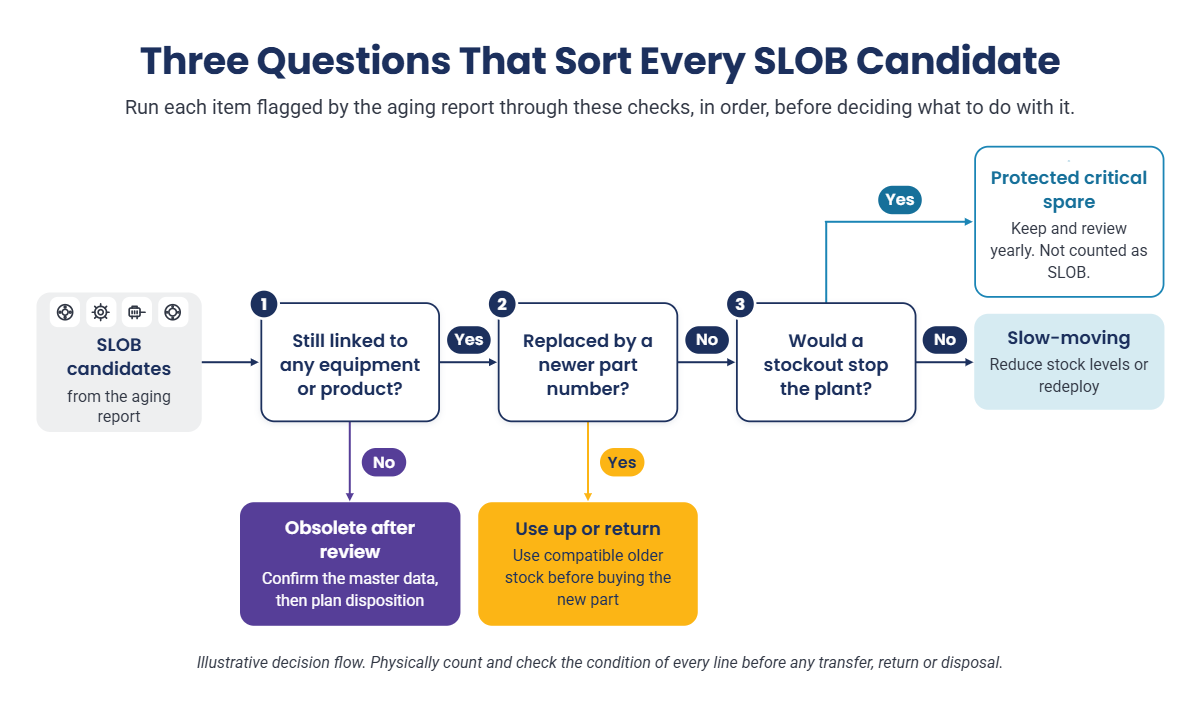
Movement data shows that a part is idle, but it cannot show whether the plant still needs it. Review each candidate with a maintenance planner or reliability engineer, using three questions.
- Is the part still linked to any equipment, bill of materials or active product? Check the equipment bill of materials, parts lists and where-used records. If no active asset is linked, confirm that the master data is complete before calling the material obsolete.
- Has the part been replaced by a newer part number? Confirm whether the new part fits the same equipment and whether the older version remains an approved spare. If it is compatible and still needed, the stock may be used before another version is purchased.
- Would a stockout stop the plant? If running out would halt a production asset or create a safety risk, and a replacement would take months, treat the part as a critical spare. Move it to a protected list that is reviewed once a year, rather than keeping it on the SLOB list.
A few further checks prevent common errors. Look for duplicate material numbers and for the same part stored at more than one site. One physical part recorded under more than one material number can distort the movement history. A part held at one plant may also be needed at another, so check open demand across locations before reducing it. Also confirm whether an upcoming turnaround or capital project has already reserved the material.
Step 4: Confirm the Stock Physically
Before approving a transfer, return or disposal, confirm the quantity and condition of the stock you plan to move. Check the main storeroom, satellite cribs, project and turnaround leftovers, and kits staged for jobs that were canceled. Confirm that unused parts have been returned to the correct storage location and recorded in the system.
Check shelf life, corrosion, packaging and storage conditions as well. A material that has expired or failed its required retest may no longer be usable, even if the system shows it as available. Physical verification should be completed for the lines selected for disposition, and inventory accuracy issues should be addressed alongside the SLOB review. Once every line has a confirmed status, the plant can put a reliable value on its SLOB.
Turn Your SLOB Review Into a Working Capital Plan
Book a Margin Walkthrough to estimate the working capital tied up in slow-moving and obsolete inventory at your plant, and where to start reducing it.
How to Calculate SLOB Inventory: Formula and Worked Example
After the review, calculate the value of the lines confirmed as slow-moving or obsolete. Use the same valuation basis for the SLOB value and total inventory value, and classify each line only once. Report protected critical spares separately so they are visible without being counted as stock to reduce.
|
SLOB inventory formula: SLOB value = Value of Slow-Moving Stock + Value of Obsolete Stock Value of each line = Quantity on Hand x Unit Cost SLOB % = (SLOB Value / Total Stocked Inventory Value) x 100 |
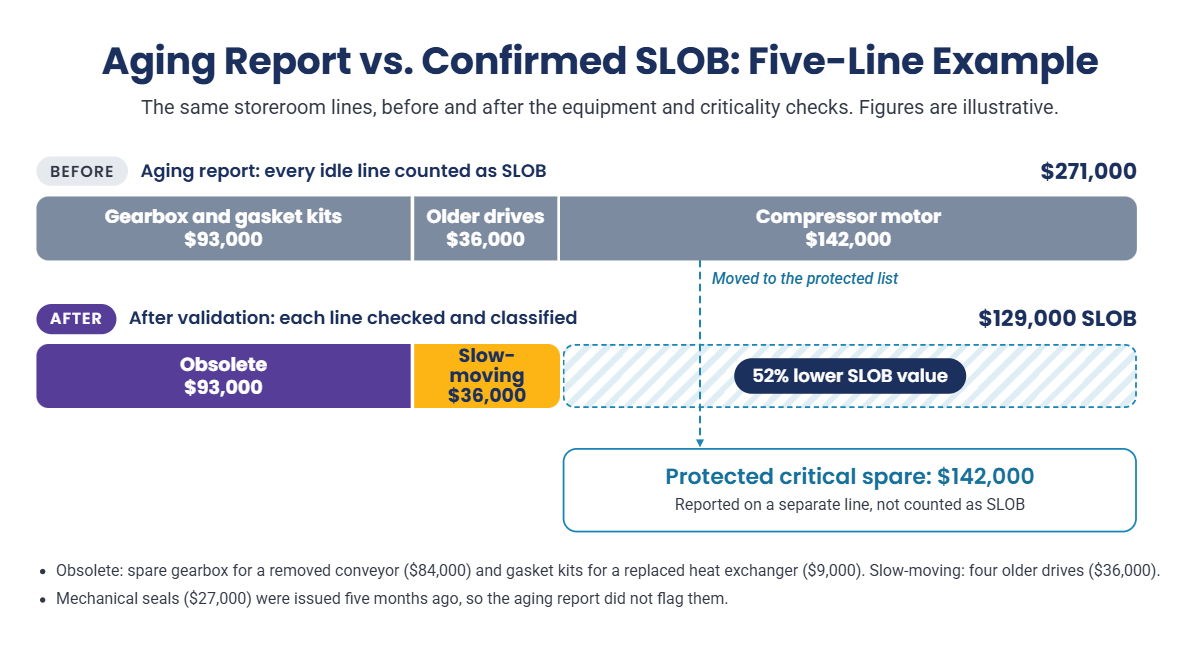
The illustrative example below shows how validation changes the result for five lines in a chemical plant storeroom.
An aging report alone would flag the four lines other than the seals, totaling $271,000. After validation, SLOB on these lines is $129,000, because the compressor motor moves to the protected list and the seals remain in active stock. In a storeroom holding $5 million in stock, $650,000 classified as SLOB would give a SLOB rate of 13%.
| Item | Value on hand | Last issued | Review result |
|---|---|---|---|
| Spare gearbox for a conveyor removed in 2022 | $84,000 | 2021 | Obsolete |
| Four drives replaced by a newer model that fits the same panels | $36,000 | 30 months ago | Slow-moving: use the approved stock before buying the new model |
| Spare motor for the main process compressor, 40-week lead time | $142,000 | Never | Protected critical spare |
| Mechanical seals for the feed pumps | $27,000 | 5 months ago | Active stock |
| Gasket kits for a heat exchanger that was replaced with a new design | $9,000 | 3 years ago | Obsolete |
There is no reliable cross-industry benchmark for combined SLOB. APQC's open benchmark measures obsolete inventory only, defined as stock at the end of its life cycle with no sales or usage for an industry-defined period. Its median across 4,612 organizations is 1.6% of total inventory value. That makes it useful context for the obsolete portion of the figure, but not a target for the SLOB rate as a whole.
A SLOB report, whether it is built in Excel or exported from the ERP, should list each line's location, quantity, value, last issue date and usage. It should also show open demand, linked equipment, criticality, the proposed action and the person who approved it. Tracking the SLOB rate monthly alongside other MRO inventory metrics shows whether the number is falling because stock was cleared or because it was simply reclassified.
How to Reduce Slow-Moving and Obsolete Inventory
Reducing SLOB starts with deciding what to do with each item confirmed as slow-moving or obsolete. A blanket target, such as cutting storeroom inventory by 20%, does not account for whether the stock is genuinely unnecessary or still supports plant operations. Instead, the decision should be based on the value that can be recovered without affecting production. If another site can use the part, transferring it may avoid a new purchase. Unused, current stock may qualify for a supplier return, while resale can recover part of its cost if another operator still needs it. The best option depends on expected demand, equipment compatibility, item condition and the terms available.
These actions address the SLOB already sitting on the shelves. Preventing it from accumulating again requires looking at the purchasing, planning and maintenance decisions that allowed it to build up in the first place.
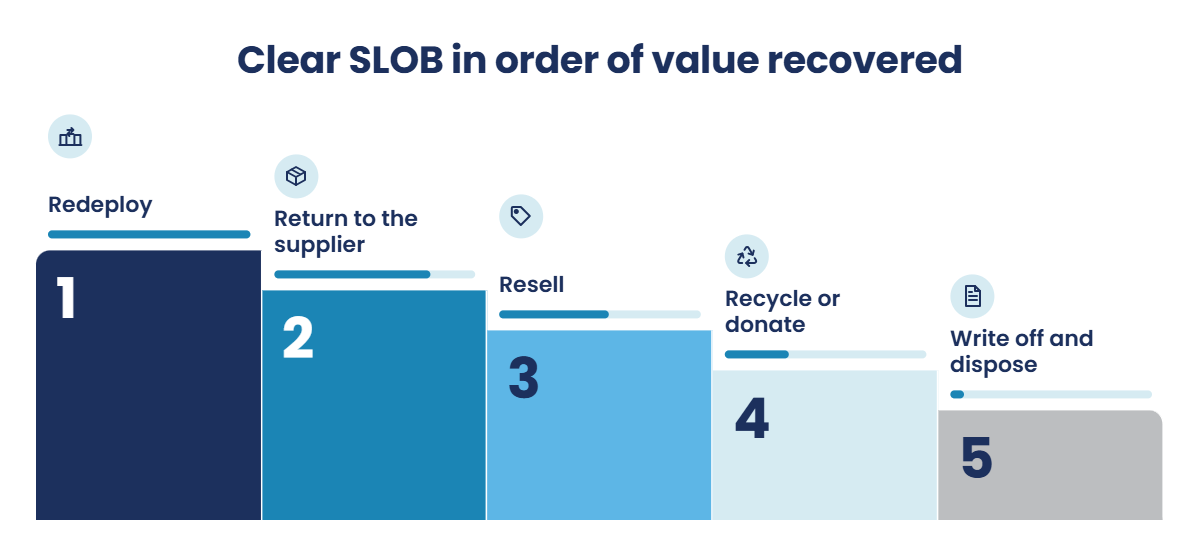
Clear Confirmed SLOB in Order of Value Recovered
Start each line with the option that recovers the most value, and move to the next option only when the first does not fit. Before any transfer or sale, check that the part fits the receiving equipment and that real demand exists. Confirm who owns the stock, what condition it is in and who needs to approve the move.
Disposal is the final option, and it involves more than removing the item from the shelf. Batteries, solvents, used oil and other hazardous materials must be handled under waste disposal regulations, so the environmental team should approve the method before the material leaves the site. Finance should approve the write-off before disposal as well, so that the accounting entry and the physical removal match.
| Option | When it fits | Value recovered or spend avoided |
|---|---|---|
| 1. Redeploy | Another plant, storeroom or job has confirmed demand, or the part can replace an item about to be purchased. | Avoids a new purchase and may prevent excess at one site from becoming a shortage at another. |
| 2. Return to the supplier | The item is current, unused and eligible under supplier return terms. | May provide a credit or refund, less any restocking or handling charges. |
| 3. Resell | Other operators still run the equipment, or finished goods can be sold through a discount or another channel. | Recovers part of the original cost. Verify condition, traceability and any restrictions before sale. |
| 4. Recycle or donate | There is no operational buyer, but the material has salvage value or an approved donation route. | May recover scrap value or support an approved donation. Check tax and environmental requirements first. |
| 5. Write off and dispose | There is no remaining use or economic recovery route. | No recovery is expected, but the stock can be removed from the records and holding cost is removed. |
Stop New SLOB From Forming
SLOB often builds up when the conditions behind a purchase change but the stocking decision stays the same. The following controls help teams catch those changes earlier.
| Cause | Control that prevents it |
|---|---|
| Usage falls, but reorder points and min/max levels stay the same | Review reorder points and maximum levels when demand changes. Pause new replenishment for flagged materials until the review is complete. |
| Equipment is replaced, upgraded or retired without a spares review | Include a spare-parts review in engineering changes, equipment upgrades and asset retirement decisions. |
| A supplier requires large minimum orders | Negotiate smaller lots, or move high-use consumables to consignment or vendor-managed stock. |
| The same material is held under duplicate numbers or descriptions | Maintain material-master records, manufacturer part numbers and approved interchangeable-part links. |
| Issues, returns and transfers are not posted when the work happens | Record the transaction at the point of issue, return or transfer so stock and movement history stay aligned. |
| Project and kit leftovers stay off the books | Return unused parts to the correct location and post the return when the job or project closes. |
These controls work best when they run continuously rather than as an annual clean-up. Set an owner and an alert for material that crosses its review window or has demand that falls below the agreed level. The alert should prompt a review, not automatic removal. Forecasts can help with finished goods and regularly consumed materials. For failure-driven spare parts, combine consumption history with installed base, asset criticality and replenishment lead time.
|
Review the wider MRO inventory picture SLOB is one part of MRO inventory performance. Compare it with inventory accuracy, parts availability and stockouts on planned jobs to understand whether a reduction is improving working capital without creating new maintenance risk. |
How Indorama Ventures Improved Inventory Accuracy and Parts Availability
At Indorama Ventures' Port Neches, Texas site, the full Connected Worker Platform deployment raised inventory accuracy from 89.5% to 99.5% and parts availability from 55% to 95%. These results are not a direct measure of SLOB reduction. They show the two conditions a reliable SLOB review depends on: stock records that match the shelf, and parts that are ready when work starts.
See How Indorama Ventures Raised Inventory Accuracy to 99.5%
Find out how Indorama Ventures made its stock records match the shelf and got parts ready before work started.
How to Account for SLOB: Reserve, Write-Down or Write-Off
Operations decides which stock is SLOB, but finance decides when the loss is recorded. The treatment depends on the applicable accounting framework, the company's policy and the evidence supporting the value of the stock. The table below is a simplified explanation of the three common treatments.
|
Treatment |
When finance uses it |
What happens on the books (simplified) |
|---|---|---|
|
Reserve (allowance for obsolete inventory) |
The company expects some inventory value may not be recovered, but the stock remains on hand. |
An obsolescence expense is recorded against a reserve account. Book value falls, but the units stay on record. |
|
Write-down |
The inventory's required carrying value is below its recorded cost. |
The carrying value is reduced to what the stock could be sold for, less selling costs (net realizable value). |
|
Write-off |
The stock has no remaining recoverable value or has been approved for removal from inventory. |
The inventory value is removed from the books, using any existing allowance as appropriate. The physical disposition should follow company approval and control procedures. |
The two main accounting frameworks treat a recovery in value differently. Under IFRS (IAS 2), inventory is measured at the lower of cost and net realizable value. If the circumstances that caused a write-down no longer exist, the write-down is reversed, up to the original amount. Under US GAAP (ASC 330), the measurement basis depends on the inventory cost method. FIFO and average-cost inventory generally use the lower of cost and net realizable value; LIFO and retail-method inventory follow a lower-of-cost-or-market approach. A write-down is generally not reversed in a later period.
A book reserve and a tax deduction are not the same thing. Finance should agree the review windows, valuation basis and evidence requirements with the company's accounting and tax advisers before the first reporting cycle.
Stop Kit Leftovers From Becoming Tomorrow's Write-Offs
See how plants stage parts against work orders and return what goes unused, so material records stay accurate and fewer parts end up written off.
How Innovapptive Helps Plants Find and Reduce SLOB Inventory
Most unreliable SLOB lists trace back to transactions that were never posted. If an issue, return or transfer is not recorded when it happens, the system may show stock that is no longer available or miss material that has been returned. That makes it harder to identify genuine slow-moving and obsolete inventory. Innovapptive's Connected Worker Platform works as an industrial execution layer on top of systems such as SAP, IBM Maximo and Oracle. The ERP or EAM remains the system of record for inventory valuation, stocking policy and reserves. Innovapptive supports the frontline transactions that keep material movement records current.
- Accurate issue, return and transfer records: Innovapptive's warehouse inventory management software records every issue, return and transfer with a barcode scan and posts it to the ERP immediately, including at sites with poor connectivity. Parts in use stop appearing as dead stock.
- Fewer unrecorded kit leftovers: Spare parts kitting and staging links materials to work orders. When unused parts are returned at job close, the return can be recorded rather than leaving the system and physical stock out of sync.
- Transfers that are reflected in the system: A redeployment between storerooms or sites needs a recorded transfer. Capturing the movement helps teams see where stock is held and prevents a transfer decision from remaining only in an email or phone call.
Innovapptive does not decide which materials are obsolete, set demand forecasts or calculate finance reserves. It helps ensure the movement data and material transactions used in those decisions are captured where the work takes place. Frost & Sullivan, which named Innovapptive its 2026 Company of the Year for Global Augmented Connected Worker Platforms, highlighted the Warehouse suite's spare parts management, barcoding and inventory tracking capabilities.
See Every Issue, Return and Transfer Recorded at the Point of Work
See how barcode-based issues, returns and transfers give your materials, maintenance and finance teams one accurate view of idle stock in SAP, IBM Maximo or Oracle.

Unlock Margins Hidden in Your Maintenance
Watch how leading manufacturers improve OEE, raise PM compliance and cut downtime through connected execution.
Request a Demo
2026 Company of the Year, Global Connected Worker Platforms
See why Frost & Sullivan recognized Innovapptive for closing the frontline execution gap.
Read the Report
- 24-11-2026
What Is SLOB Inventory? How to Find, Measure and Reduce It
Slow-moving and obsolete inventory, usually shortened to SLOB inventory, builds up gradually in...

- 19-11-2026
Unplanned Downtime: Definition, Causes, Examples, Formula
Unplanned downtime is the time an asset, production line or process unit is unavailable during...

- 18-11-2026
What Is MRO Inventory? Management & Optimization Guide
Most plants that struggle with MRO inventory face two problems at once: cash tied up in parts that...