
What Is Inventory Accuracy?
Inventory accuracy is a KPI that measures how closely your system records match what is physically on the shelf, expressed as a percentage. In a manufacturing storeroom or MRO facility, it tells you how reliably your ERP data reflects the real count of parts, consumables, and materials in each bin.
It qualifies as a KPI, not just an operational statistic, because it directly determines whether maintenance teams can execute work orders, whether procurement decisions are based on real data, and whether capital tied up in inventory is actually available when needed. A 95% accuracy rate means one in twenty parts recorded in the system either doesn't exist, is in the wrong location, or is in a condition that makes it unusable.
In practice, inventory accuracy failures in industrial environments don't just create admin headaches. They stall work orders, trigger emergency procurement, extend equipment downtime, and inflate carrying costs on items that were never actually there.
Inventory Accuracy vs. Inventory Record Accuracy: What's the Difference?
While both terms are often used interchangeably, inventory accuracy and Inventory Record Accuracy (IRA) measure related but distinct things. Inventory accuracy asks: does the quantity in the system match the physical count? IRA asks a harder question: does the quantity match and is the item in the correct bin and is it assigned the right unit of measure in the ERP?
| Inventory Accuracy | Inventory Record Accuracy (IRA) | |
|---|---|---|
| What it measures | Quantity match only | Quantity + bin location + unit of measure |
| When it passes | Physical count = system count | All three fields match simultaneously |
| Failure mode | Wrong quantity | Wrong quantity, wrong location, or wrong UoM |
| Best fit | General performance tracking | MRO storerooms, maintenance-driven retrieval |
The location dimension is where IRA earns its place in industrial environments. A storeroom may hold the correct number of valve actuators. But if the ERP pick instruction sends a technician to Bin C-12 and the stock has been placed in Bin A-07, the count is correct and the part is unreachable, at least until someone searches the storeroom manually. During a time-sensitive repair, that search costs real downtime.
For industrial facilities running ERP-generated pick lists, IRA is the right performance standard. A quantity-accurate storeroom with poor location discipline will still generate failed picks and extended repair cycles.
Master the Best Practices of High-Accuracy MRO Inventory
Discover modern MRO optimization strategies that perfectly align your warehouse inventory records with frontline operational demand.
Why Inventory Accuracy Matters
Most of the costs that stem from poor inventory accuracy don't appear in a single budget line, they distribute across maintenance, procurement, production, and sometimes safety, which is exactly why the root cause rarely gets directly addressed in asset intensive industrial operations. According to APQC's Open Standards Benchmarking data, the difference in inventory carrying cost between low-performing and top-performing companies can be as large as 11% of revenue, equivalent to $108 million for a $1 billion operation. And that's only the carrying cost gap. It doesn't include emergency procurement premiums, unplanned downtime, or the maintenance labor wasted on jobs that can't execute.
What makes inventory accuracy pivotal for industrial operations is that they directly impact asset uptime, wrench time and productivity of maintenance teams. Its impact on business areas are as follows:
- Equipment uptime: Inventory accuracy directly influences Mean Time to Repair (MTTR). When critical parts are inaccessible due to record discrepancies, repair windows extend, increasing downtime costs. Even a 3 to 5% accuracy gap on critical spares contributes materially to unplanned downtime.
- Financial performance: Inaccuracies cause simultaneous failures: overstocking items that inflate working capital and failing to reorder essential parts, which risks production. This drives up reactive maintenance and extends emergency wrench time.
- Work order integrity: Over 50% of work orders stall because parts are missing or misidentified. When a technician arrives to find parts missing or misplaced, the job must be rescheduled.
- Internal team confidence: Low accuracy forces field teams into shadow inventory behaviors, such as hoarding parts or submitting duplicate orders, which further inflates costs. It also leads to demotivation for the maintenance teams as inventory inaccuracy directly impacts schedule compliance and wrench time which are often performance benchmarks for maintenance teams.
- Compliance exposure in regulated industries: In regulated industries like oil and gas or power generation, inaccurate counts on safety-critical spares are more than operational errors, they represent significant regulatory risks.
The Cost of Inventory Inaccuracy in Industrial Environments
A single inventory accuracy failure in a continuous process plant can produce a cost cascade that far outstrips the value of the missing part. The financial impact of poor inventory accuracy runs in two directions simultaneously: cost of stockout and parts unavailability leading to unplanned downtime, cost of overstocking resulting in tied up working capital, increasing carrying cost, tied up warehouse space and the risk of excess spare parts getting corroded or expired.
What further compounds the cost of inaccurate inventory for industrial operations is the cascading effect it has. A single stockout on a critical spare can trigger this chain: work order issued, technician arrives, part unavailable, emergency procurement initiated, equipment runs degraded or is idled, production loss accumulates, job is rescheduled into an already-stretched maintenance calendar.
Inventory inaccuracy also results in emergency purchases that carry a significant cost premium over planned procurement, not just in price per unit, but in expedited freight, administrative burden, and the disruption to purchasing cycle the team was managing. When procurement is reactive rather than planned, organizations lose negotiating leverage, volume discount structures, and the ability to manage supplier performance against agreed lead times.
Read More: Proven Strategies to Reduce Maintenance Cost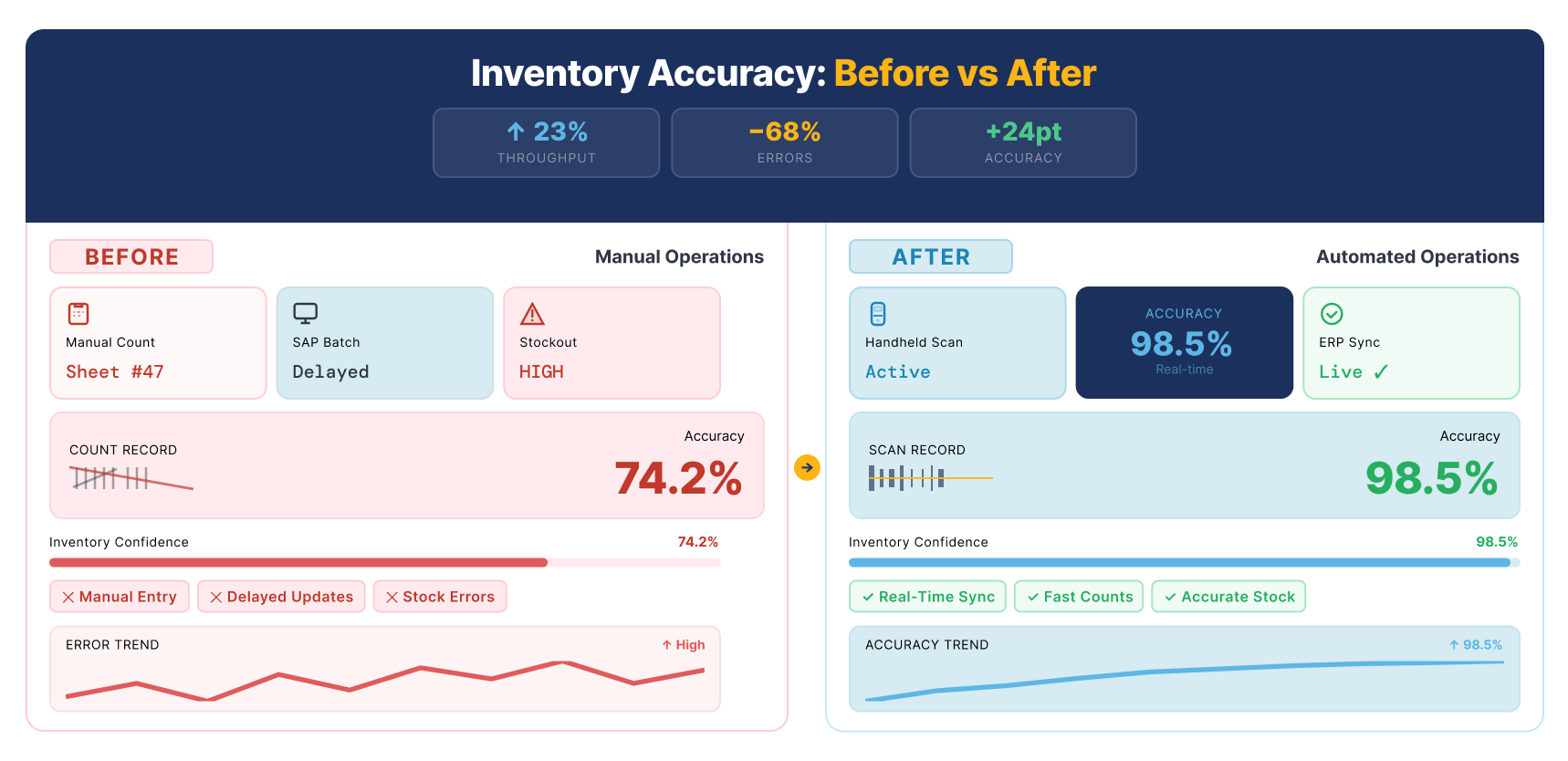
How to Calculate Inventory Accuracy
Inventory accuracy is calculated by dividing the number of accurately recorded items by the total items on record in your system, then multiplying by 100.
Standard Inventory Accuracy Formula
Where:
- Accurately recorded items = items where physical count matches the system record exactly
- Total items on record = all SKUs or line items counted in the audit period
This formula gives a binary score per line item: the system count either matches the physical count or it doesn't. It's fast to calculate from cycle count data and straightforward to report.
Worked example — plant storeroom, 5 SKUs:
| SKU | Recorded Count (SAP) | Physical Count | Match? |
|---|---|---|---|
| Hydraulic seals | 24 | 24 | ✓ |
| Valve actuators | 12 | 10 | ✗ |
| Motor bearings | 8 | 8 | ✓ |
| Pump impellers | 5 | 5 | ✓ |
| Filter cartridges | 30 | 28 | ✗ |
Accurately recorded items: 3 of 5 — Inventory Accuracy = (3 ÷ 5) × 100 = 60%
This result flags an accuracy problem immediately, two SKUs have discrepancies, and one of them (valve actuators) shows a system overcount. That overcount matters more than it looks as an overcount doesn't trigger a reorder, leaving the storeroom at risk of a stockout without any system alert firing.
Variance-Based Inventory Accuracy Formula
The variance-based method is the more rigorous approach for MRO and industrial storerooms because it treats both overcounts and undercounts as failures. The standard formula scores a SKU as either right or wrong. The variance-based method captures magnitude, not just pass/fail. A 10-unit discrepancy is treated differently from a 1-unit discrepancy, which the standard formula does not distinguish.
Using the same five SKUs:
| SKU | Recorded | Physical | Variance |
|---|---|---|---|
| Hydraulic seals | 24 | 24 | 0 |
| Valve actuators | 12 | 10 | 2 |
| Motor bearings | 8 | 8 | 0 |
| Pump impellers | 5 | 5 | 0 |
| Filter cartridges | 30 | 28 | 2 |
Total absolute variance: 4 | Total recorded inventory: 79
Inventory Accuracy = [1 − (4 ÷ 79)] × 100 = 94.9%
The two formulas tell different stories: 60% (standard) vs. 94.9% (variance-based). The standard formula tells you how many SKUs are wrong. The variance formula tells you how far off the overall inventory picture is.
In MRO environments, the variance-based formula is typically preferred because it reflects the real operational risk more accurately. A system showing 12 valve actuators when only 10 exist may prevent a reorder from triggering before stock reaches zero. A ghost inventory overage is as dangerous as a shortage, sometimes more so, because it's invisible.
What Is a Good Inventory Accuracy Rate?
The average inventory accuracy rate across businesses sits at approximately 83%, according to CAPS Research (2024). Most supply chain frameworks define 90% as the minimum acceptable threshold and 95%+ as world-class performance.
| Performance Level | Rate | Notes |
|---|---|---|
| Average | ~83% | CAPS Research 2024 baseline |
| Good | 90 to 94% | Minimum acceptable for most operations |
| World Class | 95%+ | Top-performing general warehousing |
| Critical MRO Target | 99%+ | Recommended for critical spares in continuous process operations |
The 95% world-class benchmark is the right target for general warehousing. For critical spares in a refinery, chemical plant, or power generation facility, the internal target should be higher. The reason is risk concentration: a 5% accuracy gap spread across routine consumables is manageable. The same gap sitting on a single critical item, where a stockout disables a production unit is not. Facilities managing safety-critical spare parts inventories should set and track a separate 99%+ accuracy target for that item class, independent of the overall storeroom rate.
See how Innovapptive's connected storeroom solution helps MRO teams close the gap between SAP records and physical reality, without manual counts or spreadsheet reconciliation.
What Causes Poor Inventory Accuracy?
The default explanation given for storeroom inaccuracy is counting errors. However, most inventory discrepancies trace back to a predictable set of process failures. In industrial and MRO environments, the consequences are amplified because the items in question are often critical spares with no on-site alternatives.
- Manual data entry errors accumulate at every transaction point. Every storeroom transaction recorded manually often results in errors such as wrong material number, wrong quantity, wrong storage location that surfaces at the next count. In high-transaction environments like busy plant storerooms, these errors accumulate quickly.
- Disorganized receiving creates discrepancies before parts reach the shelf. When physical goods are placed into storage before the ERP goods receipt is posted, or when a partial delivery is recorded as complete, the storeroom and system record vary from day one. This is one of the most correctable root causes; it requires process discipline, not technology.
- Misplaced inventory is when items are returned to the wrong bin after a job, or received into a staging area that's never moved to the assigned location, creating a location accuracy failure. The part exists in the storeroom but isn't where the system says it is. From a work order execution standpoint, a misplaced critical spare is effectively a stockout.
- Shrinkage from damage and deterioration accumulates without triggering any system event. Inventory reduction from damage during handling, deterioration in storage, or unrecorded consumption (partial-package use that isn't transacted) creates persistent accuracy gaps that only surface during counts. In dense MRO storerooms holding thousands of SKUs, shrinkage across many small items can represent a meaningful accuracy gap.
- Bin labeling and storeroom layout failures allow parts to go disorganized. Without a clear, enforced bin addressing system, technicians store items wherever is convenient. The same material might end up in three bins. Further new staff often sort parts by visual similarity rather than material number.
- Inaccurate physical counts owing to miscounts, skipped bins, double-counted items, introduce new inaccuracies even as they attempt to correct old ones. Without a systematic cycle counting program, count errors pile up between audits.
- Receiving inspection delays create a specific accuracy problem: items are physically in the storeroom but hold-coded or uncleared in the ERP. They show as unavailable in the system even when physically present. In a work order emergency, a technician may manually retrieve a part that the system shows as on hold, without posting a goods issue, creating both a compliance gap and an accuracy discrepancy simultaneously.
Additional Causes Specific to Industrial and MRO Environments:
- Emergency maintenance pulls without ERP transactions often occur when a critical asset fails, the technician's immediate priority is to fix it. Scanning the part out of the storeroom system may feel like a secondary concern. Parts get pulled, jobs get completed, and the ERP record still shows the item as in stock. This is one of the most common MRO-specific accuracy failures, and one of the most persistent, because it happens exactly when people are under the most pressure.
- Similar-part-number confusion happens in industrial storerooms frequently holding variant SKUs with nearly identical descriptions: bearings of the same type in slightly different sizes, seals that differ by a single dimension, pump components across multiple generations of the same asset. Picking or issuing the wrong variant creates both a discrepancy on the intended item and a phantom transaction on the wrong one.
- Multi-plant transfer lag often occurs when inventory moves between plant locations and there's often a gap between the physical movement and the ERP goods receipt at the receiving end. During this window, the item might show as in stock at both locations simultaneously. If either plant attempts to use or count that inventory during the lag period, the discrepancy compounds.
- ERP goods movement batch lag happens when goods movements are processed in batch rather than real time in some ERP configurations. A parts issue processed in the afternoon shift may not update the system until overnight, leaving the storeroom record wrong for hours. In high-frequency environments, this creates a persistent accuracy gap that's easy to misdiagnose as a counting error.
Read More: 6 Common Inventory Management Errors That Cost Your Business
See how 15+ AI Agents Unleash $30M + EBITDA Gains
How to Improve Inventory Accuracy
Improving inventory accuracy is not a one-time project. It's a continuous operational discipline that requires the right technology, clear processes, and consistent behavior from everyone who manages inventory. Sustained accuracy, 95% and above, 99%+ on critical spares, requires process discipline and technology working together, in the right order.
1. Implement Barcode Scanning and RFID Tracking
Handheld barcode scanners are mechanically robust and highly reliable, even in harsh, metal-dense industrial environments where other technologies may struggle. By using these devices for receipts, issues, returns, and cycle counts, you eliminate the manual data entry errors that commonly occur with paper-based systems. This foundational step ensures that data is captured correctly at the source, creating a high-accuracy audit trail that is critical for operational trust.
2. Conduct Routine Cycle Counts
Prioritize your counting schedule using a dual-dimension approach that considers both inventory value and parts criticality. While standard ABC analysis (high-value items counted most frequently) focuses on value, MRO environments must account for the fact that a low-cost item can still cause major production delays if it is missing. Items identified as safety-critical or essential for uptime should be counted with the same frequency as your highest-value inventory. Your inventory management system should automatically schedule these counts, ensuring that critical spares are never overlooked due to their low unit cost.
3. Standardize Processes and Train Your Team
Technology is only effective when the underlying processes are consistent across the entire team. Documented Standard Operating Procedures (SOPs) for receiving, picking, and returns must be enforced, not just archived in onboarding materials. Training should focus on the why behind accuracy, showing staff how ERP records directly impact equipment uptime and their own maintenance schedule compliance. When technicians understand that an un-scanned emergency pull stalls their own work orders, they are more likely to prioritize transaction discipline.
4. Automate Manual Inventory Tasks
ERP records should update at the moment of physical action, not hours later. Key automations that directly close the accuracy gap:
- Parts issues on mobile post to ERP immediately at the point of transaction.
- Stock below safety level triggers an automatic reorder notification.
- Cycle count mismatches generate an instant discrepancy alert for investigation.
The requirement that determines whether automation holds: every transaction must write directly to the ERP, not to an intermediate database that syncs on a delay. Innovapptive's Integration Manager handles real-time bidirectional sync between field transactions and SAP/Oracle, ensuring every movement, regardless of where it originates, updates the same source of record.
5. Integrate Your CMMS With Your ERP System
In many plants, the CMMS and ERP function as separate systems, creating a structural lag where physical usage and system records never align. To fix this, your systems should operate from a single, shared inventory record that eliminates the need for periodic manual reconciliation.
A goods issue posted from a CMMS work order should write directly to the ERP in real time. This ensures that maintenance planners and procurement staff are always looking at the same source of truth, preventing the double-work of reconciling two different systems.
6. Use Real-Time Inventory Dashboards and Alerts
Dashboards give storeroom managers and maintenance planners live visibility into stock levels, discrepancies, reorder status, and cycle count completion, without waiting for a report or a scheduled count. Actionable alerts take this visibility a step further by notifying staff the moment a discrepancy occurs. This allows for immediate investigation, stopping small errors from compounding into major, system-wide inventory failures over time.
7. Investigate Discrepancies With Root Cause Analysis
Correcting a count without understanding why it was wrong produces repeated adjustments, not lasting accuracy. In ERP, the goods movement history report traces any material number back to who issued it, when, against which work order, and from which bin. Most discrepancies fall into three categories:
- Missing goods issue transaction (most common in emergency maintenance scenarios).
- Master data error: wrong unit of measure or duplicate material number.
- Unrecorded physical event: damage, deterioration, or an unauthorized pull.
Patterns across discrepancies (the same SKU short in consecutive counts, a cluster from one shift) indicate systemic causes. This proactive investigation ensures that your accuracy improvement efforts result in permanent changes rather than temporary corrections.
8. Leverage Spare Parts Kitting and Staging for Work Order Readiness
Pre-kitting confirms parts accuracy before the maintenance window opens, not after the technician arrives at the job site. Key outcomes:
- Last-minute shortfalls on planned jobs are caught and resolved at staging.
- Every kitted item scanned updates the ERP reservation in real time.
- Unstaged items return to available stock automatically with no manual correction required.
Innovapptive's Spare Parts Kitting & Staging solution pulls materials lists directly from CMMS work orders, eliminating manual translation errors between planning and storeroom execution.
Stop Letting Wrong or Missing Parts Stall Your Critical Maintenance Schedules
See how structured kitting protocols keep your maintenance teams on schedule and your stock records accurate.
How Modern Technology Enhances Inventory Accuracy
Modern technology transforms inventory accuracy by replacing manual, error-prone data entry with real-time, automated capture. By deploying mobile barcode scanners, RFID, IoT sensors, and AI-driven auditing, organizations ensure that every physical stock movement updates the ERP within seconds. This creates a single, reliable source of truth, effectively bridging the gap between field technicians, storeroom staff, and enterprise systems to eliminate the data lag that drives most inventory discrepancies.
| Manual Inventory Management | Technology-Enhanced Inventory Management |
|---|---|
| Data capture point: End-of-shift ERP entry | Data capture point: Real-time scan at moment of transaction |
| Discrepancy detection: Next physical count | Discrepancy detection: Immediate alert on mismatch |
| Cycle count prioritization: Fixed schedule by value | Cycle count prioritization: AI-driven by risk, criticality, and variance history |
| ERP synchronization: Batch or manual | ERP synchronization: Real-time bidirectional sync |
| Offline environments: Not supported | Offline environments: Offline scan, auto-sync on reconnect |
Mobile-First Connected Worker Apps
Mobile apps replace paper-based processes by capturing data at the exact moment of transaction, eliminating the delay between a physical move and the system record. This is essential for industrial environments where manual data entry at the end of a shift introduces significant room for error. For sites with limited connectivity, such as tank farms or confined spaces, apps with offline synchronization are a necessity. These tools capture the transaction locally and automatically sync the data to the ERP once the technician returns to a network zone, ensuring accuracy without interrupting the repair workflow. Innovapptive's RapidSync™ Offline Mode captures the transaction locally, continues functioning without network connectivity, and syncs to SAP automatically when coverage returns.
RFID Tags and IoT Smart Sensors
RFID technology enables rapid, no-line-of-sight batch scanning, which significantly reduces the labor required for large-scale receiving and cycle counts. While signal degradation can occur near dense metal shelving, a hybrid approach, using RFID for high-volume zones and barcodes for standard items, often yields the most reliable results in complex plant environments.
Complementing this, IoT weight sensors placed under bins provide continuous monitoring for high-value critical spares. These sensors automatically trigger discrepancy alerts or reorders the moment a physical weight diverges from the system record, providing a level of oversight that human counting simply cannot match.
AI-Powered Cycle Counting and Predictive Auditing
AI transforms cycle counting from a rigid, calendar-based duty into a dynamic, risk-managed process. Instead of counting every item on a fixed schedule, AI analyzes transaction history, variance trends, and criticality ratings to prioritize counts for items most at risk of inaccuracy. This predictive capability extends to identifying unusual consumption patterns before they become major discrepancies.
An AI system can flag a spike in bearing usage without a corresponding work order, allowing the team to investigate potential shrinkage or non-compliance within days rather than months later.
Real-Time ERP and CMMS Integration
True accuracy is achieved only when the inventory tool is bidirectional, meaning it communicates in real time with the central ERP (such as SAP or Oracle). A system that merely updates its own local database creates a data silo where the storeroom team sees one number and the ERP team sees another.
Bidirectional integration ensures that a goods receipt in SAP immediately appears in the mobile field app, and every parts issue from the floor updates the ERP within seconds. This creates a single source of truth, ensuring that every role, from purchasing to maintenance, operates with the same live, accurate data.
Eliminate Warehouse Data Gaps with Mobile Execution
Discover how transitioning to a mobile-first inventory strategy eliminates manual transcription errors and provides instant, absolute visibility into stock levels.
Inventory Accuracy Best Practices: A Quick Reference
Sustained inventory accuracy comes from combining the right technology with consistent operational discipline. Here are the best practices that matter most for inventory accuracy including two that most operations teams overlook.
| Best Practice | Key Action |
|---|---|
| Make barcode scanning the baseline transaction method | Implement handheld scanning for all storeroom transactions, receipts, issues, returns, and cycle counts |
| Cycle count continuously | Replace annual full counts with ongoing cycle counting; catch discrepancies while they're small and traceable |
| Segment cycle count frequency by criticality, not just value | Count critical spares frequently regardless of unit cost, one stockout on the wrong item can stop a production unit |
| Standardize receiving procedures | Post goods receipt in ERP before or simultaneously with physical putaway, never after |
| Build emergency scanning into mobile field workflows | Design the goods issue transaction to take seconds on a mobile device, so there's no reason to skip it during an emergency repair |
| Integrate CMMS and ERP | Ensure every work order parts issue updates the ERP in real time, no deferred reconciliation |
| Set safety stock levels with automated reorder alerts | Use safety stock levels and automated alerts to prevent stockouts before they happen |
| Investigate every discrepancy | Don't just correct the count, use movement history to identify the root cause and prevent recurrence |
| Track bin location accuracy as a separate KPI | Monitor bin-level accuracy as a distinct KPI; a correctly counted item in the wrong bin is still an IRA failure |
| Audit master data on a defined schedule | Unit of measure errors, duplicate material numbers, and outdated bin assignments in SAP cause permanent accuracy problems that cycle counting cannot fix |
| Use kitting and staging to verify materials before the job starts | Pre-verified kits eliminate last-minute parts shortfalls and confirm accuracy at staging, not at the job site |
How Innovapptive Helps Industrial Operations Achieve Inventory Accuracy
Most inventory accuracy problems in asset-heavy operations share the same structural root cause: a gap between where physical inventory transactions happen and where ERP records get updated. Innovapptive's Warehouse Suite is built to close that gap at every point in the transaction lifecycle.
Mobile Inventory & Warehouse digitizes inbound, outbound, internal movements, and cycle counting through a mobile-first interface that posts directly to SAP IM, WM, and EWM in real time, with RapidSync™ Offline Mode ensuring transactions are captured even in areas without network coverage.
Warehouse Barcoding handles the data capture layer, multi-barcode scanning, RFID integration, OCR-powered label verification, and offline scanning across 30+ industry-standard devices, so every goods movement updates the system in real time, not hours later.
Mobile SAP EWM extends this integration to advanced warehouse processes, transfer orders, putaway, pick confirmation, and inventory posting, from a mobile device, with every action writing back to SAP EWM in real time.
Customers running these workflows have achieved 99% inventory accuracy, with documented reductions in emergency procurement spend and measurable improvement in first-time work order completion rates. The result isn't just better storeroom numbers. It's a maintenance operation that can trust what the system says and plan accordingly.
Achieve 99% Inventory Accuracy in Your ERP Environment
See how real-time mobile data entry eliminates data lag between the physical warehouse and your SAP records.

Unlock Margins Hidden in your Maintenance
Watch how leading manufacturers improve OEE, increase PM compliance, and reduce downtime through connected execution.

- 21-10-2026
10 Best Work Instructions Software: Compared and Reviewed
Choosing work instructions software is about more than turning a PDF into guided steps on a tablet....

- 15-10-2026
Maintenance Digitalization: A Digital Transformation Guide
Maintenance digitalization is the shift from paper, spreadsheets and disconnected tools to...

- 12-10-2026
Manufacturing Skills Gap: What It Costs and How to Close It
A plant can have every role filled and still experience a manufacturing skills gap. Very often,...