
What Is MRO Inventory?
MRO inventory is the stock of spare parts, maintenance supplies, tools and operating materials a plant keeps to repair its equipment and keep its facilities running. These items support production, but none of them becomes part of the finished product. MRO stands for maintenance, repair and operations; in aviation, the same letters usually mean maintenance, repair and overhaul.
It matters because a missing part delays a repair, while an overstocked part locks up cash and may become obsolete. Boston Consulting Group puts total MRO spending, including services and spare parts, at 0.5% to 4.5% of revenue, with heavy industries at the top of that range.
MRO demand comes from equipment condition, preventive maintenance plans and failures, not from customer orders. Many MRO parts are rarely used, but they matter a great deal on the day a job needs them.
MRO Inventory Examples by Category
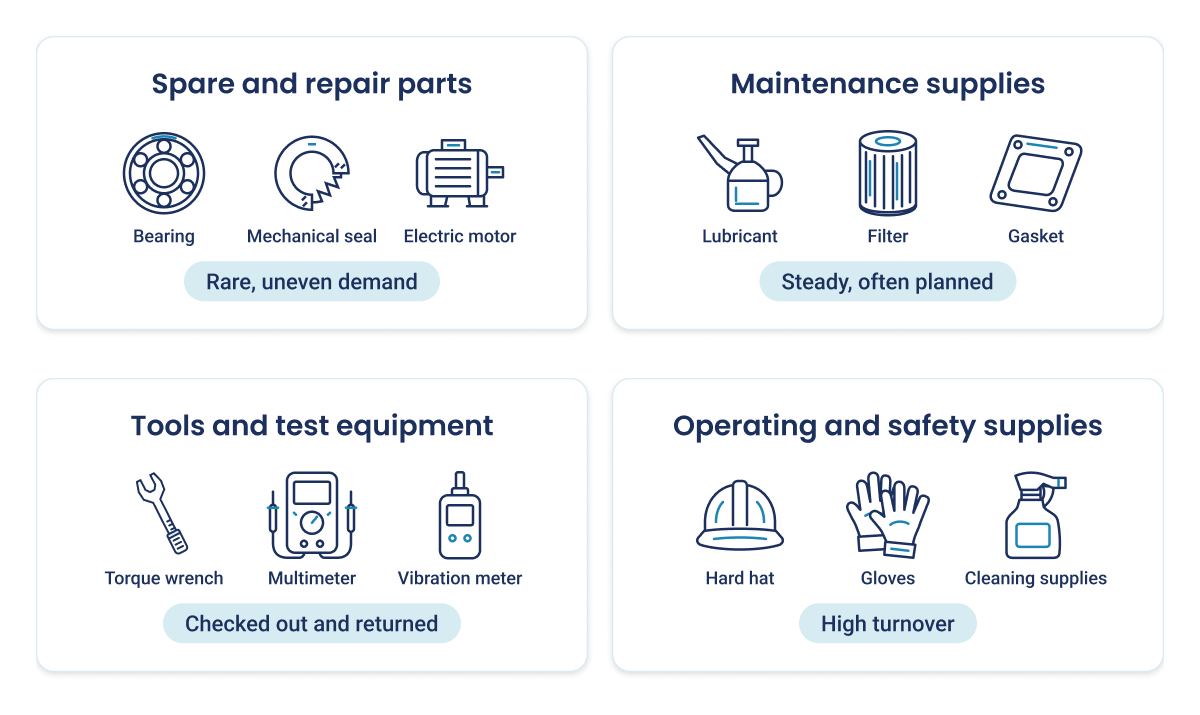
Most MRO storerooms hold four kinds of stock:
| Category | Plant examples | How demand behaves | Cost of getting it wrong |
|---|---|---|---|
| Spare and repair parts, including critical spares and rotables | Bearings, mechanical seals, electric motors, VFDs, gearboxes, pump impellers | Rare and uneven, driven by failures and overhauls | Too few can stop an asset; too many can sit unused for years |
| Maintenance supplies | Lubricants, filters, gaskets, belts, fasteners, welding rods | Fairly steady, and much of it follows the PM plan | Too few delays PM work; too many adds up across thousands of part numbers |
| Tools and test equipment | Torque wrenches, multimeters, vibration meters, calibration kits, hand and power tools | Checked out and returned rather than used up | Lost tools, damage and missed calibration dates |
| Operating, safety and facility supplies | PPE, cleaning supplies, lighting, signage | High turnover and low unit cost | Small per item, which makes these good candidates for supplier-managed refills |
The first category needs the most care. It includes critical spares, kept for failures that are rare but expensive, and rotables, which are repaired and returned to stock after removal.
Plants also buy direct-charge items: these are non-stock items ordered for one work order and not held in a bin. They are recorded as an MRO purchase and on the work order, but any leftover quantity can stay in the plant without appearing in stock records.
MRO Inventory vs Production Inventory
Raw materials, work in progress and finished goods make up production inventory, and all three move toward a customer order. MRO inventory is the fourth common type of inventory, and it moves toward a work order instead. The table below shows why the two groups need different planning:
| MRO inventory | Production inventory | |
|---|---|---|
| Purpose | Keeps equipment and facilities running | Becomes the product or carries it to the customer |
| What drives demand | Equipment condition, preventive maintenance plans and failures | Sales forecasts and production plans |
| Who manages it | Shared by maintenance, stores, procurement and finance | Supply chain and production planning |
| Accounting | Depends on policy: treated as inventory, a supply or a capital spare | Carried as inventory and moved into cost of goods sold |
That is why reorder rules designed for sales forecasting cannot be used for MRO purchase as it often leads to plants buying the wrong amounts of maintenance parts.
Is Your Storeroom Above or Below 95% Accuracy?
Learn how to measure inventory accuracy and close the gaps between your ERP and the shelf.
What Is MRO Inventory Management? The Six-Step Cycle
MRO inventory management is the routine work of keeping the right maintenance parts available for each job at the lowest total cost. This involves describing each part, deciding how to stock it, buying and storing it, issuing it to work orders, and counting and refilling it. Most MRO inventory challenges start at the handoffs between teams, so each step below has a usual owner and a typical weak point.
- Describe the part: Maintenance engineering and stores create one item master record, the system record that describes the part, linked to the equipment it serves. The weak point is duplicate or vague descriptions.
- Classify it: Rank each part by how critical it is and what it is worth. Reliability and maintenance teams should make this call. The common failure is skipping it, which leaves every part on the same reorder rule.
- Set the stocking policy: Materials planning decides whether to stock the part and sets its minimum, maximum and reorder point. The common failure is setting levels once and never looking at them again.
- Buy and receive: Procurement orders the part, and stores receives it against the purchase order and puts it in a bin. The weak point is a delivery that is not recorded on arrival.
- Reserve and issue: Planners reserve parts for a work order, and stores picks and issues them against that order. The common failure is a part that leaves the storeroom without a goods issue, so the system still shows it on the shelf.
- Count and replenish: Stores runs cycle counts, and materials planning reviews reorder triggers and stock levels. The common failure is counting on paper and keying the results in days later, which steadily erodes inventory accuracy.
Running this cycle well keeps parts moving day to day, but it does not fix a storeroom that already holds the wrong mix of stock. That takes a one-time optimization effort, explained below.
Why MRO Inventory Holds Too Much Cash and Still Runs Short
Most plant storerooms hold too much of the parts they seldom need and too little of the parts that stop work. In other words, the plant has the wrong mix of stock, not simply too much of it, and cutting stock across the board without fixing the mix usually makes shortages worse.
McKinsey's 2026 research on maintenance in asset-heavy industries finds the same pattern: poor forecasts, poor visibility and obsolete materials lead to stockouts and excess stock at the same time. In one example, a global airline lowered spare parts inventory by 14% while also reducing disruptions from missing parts, so the two goals do not have to conflict.
MRO stock is also one of the less visible maintenance costs. It sits on the balance sheet rather than in the maintenance budget, so it is easy to miss when plants try to reduce maintenance costs.
Stockouts and Idle Capital: Two Costs With One Cause
Most storerooms pay both costs at once:
| Too little stock costs you | Too much stock costs you |
|---|---|
| Planned jobs taken off the weekly schedule, which hurts schedule compliance | Cash tied up in parts that may sit for years |
| Longer breakdowns while a part is rushed in | A yearly holding cost on every dollar of stock |
| Premium freight and emergency purchases | Obsolete parts once equipment is replaced |
| Technicians waiting for parts, which lowers wrench time | Shelf-life loss: seals harden and lubricants degrade |
| Lost production while equipment waits for the part | Storage space, handling and insurance |
One shortage on a critical asset can outweigh years of holding cost, because the cost of unplanned downtime is measured in lost production, not part prices. An MRO inventory shortage and an overstock usually share the same roots: records that do not match the shelf, and stocking rules that ignore how critical each part is.
How Much Working Capital Is Tied Up in MRO Inventory?
To judge whether a storeroom holds too much, compare its stock to the size of the plant it supports. The Society for Maintenance and Reliability Professionals (SMRP) measures this with Metric 1.4, using replacement asset value (RAV): the current cost of replacing the plant's maintainable assets and facilities.
| Measure | Formula |
|---|---|
| SMRP Metric 1.4 | Stocked MRO inventory value divided by replacement asset value (RAV), multiplied by 100 |
A result of 1.5% or lower is often quoted as best in class, but it is not a target for every plant. SMRP Best Practices, Metrics and Guidelines recommends setting each facility's target with expert input, and plants with less mature maintenance often need more stock. Always read this number alongside how often planned jobs wait for parts.
Illustrative example
| Item | Value |
|---|---|
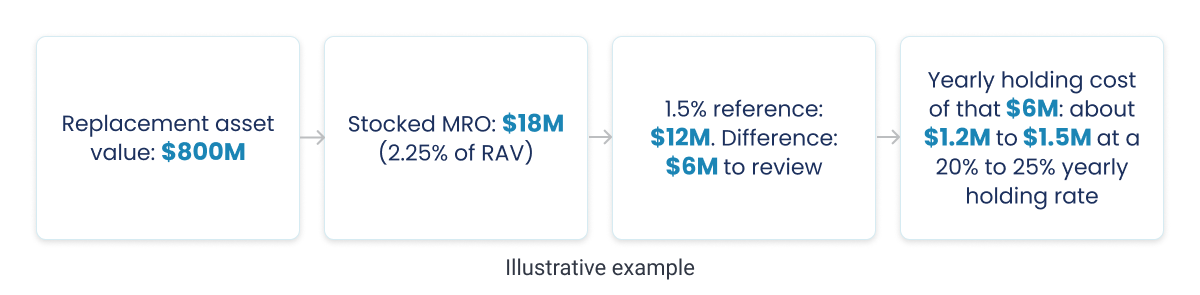
| Replacement asset value | $800M |
| Stocked MRO inventory | $18M |
| Stocked MRO as a percentage of RAV | 2.25% |
| Stock value at the 1.5% reference | $12M, a difference of $6M |
| Yearly holding cost of that $6M at 20% to 25% | About $1.2M to $1.5M |
Holding cost is the yearly cost of keeping a part on the shelf: the money tied up in it, plus storage, handling, insurance and the risk of obsolescence. Many finance teams assume 20% to 25% of stock value per year, a planning estimate rather than a measured figure.
The $6M difference is a list of parts to review, not an amount to remove, because some of it will be critical spares the plant should keep.
Five Reasons Why MRO Stock Keeps Growing
Excess MRO stock rarely comes from one bad decision. It builds up through five patterns that most plants will recognize:
- Irregular demand: Many parts go unused for months and are then needed all at once, so reorder rules based on averages buy too much or too little.
- Reactive maintenance: Unplanned work cannot be predicted, so storerooms hold extra stock as a buffer. A NIST survey of manufacturing machinery maintenance found that manufacturers relying more on preventive and predictive maintenance reported 52.7% less unplanned downtime than more reactive peers, and less unplanned downtime means fewer surprise demands on the storeroom.
- Duplicate item records: When one bearing exists under three descriptions, each record has its own reorder point, and the plant buys the same part three times.
- Stock kept outside the system: Crews keep parts in local cabinets, tool cribs or vehicles so they can reach them quickly, especially once they stop trusting the main record. If that stock is not recorded, planners reorder parts the plant already has.
- Split ownership: Maintenance specifies the part, procurement buys it, stores holds it and finance values it. Each of these functions is measured on something different, such as uptime, price or inventory value, and ARC Advisory Group points to these conflicting measures as a common cause of MRO inventory problems. The fix is one owner for the stocking policy, with measures all four teams review together.
How Much Working Capital Is Stuck in Your Storeroom?
Get a site-specific view of idle stock, duplicate records and the yearly cost of holding them.
MRO Inventory Optimization: How to Release Working Capital Without Causing Stockouts
MRO inventory optimization is the work of matching each part's stock level to its real risk and demand. Done in the right order, it frees working capital without adding stockouts, because reductions land on parts nobody will miss. However, if it is done in the wrong order, for example before records are clean, it removes the wrong parts. Any sound MRO optimization program follows a sequence like this:
- Baseline stock value, accuracy and planned-job stockouts.
- Clean the item master.
- Sort parts by criticality, demand pattern and value.
- Reset stocking levels for each group.
- Release excess stock in a safe order.
- Reserve and kit parts for planned work.
- Keep records accurate with a monthly review.
Step 1: Run a Baseline Audit of Value, Accuracy and Planned-Job Stockouts
Before you cut anything, record how much capital the storeroom holds and how often planned work waits for parts. This baseline is your MRO inventory audit, and it is the only way to prove later that a reduction was safe. Capture five numbers:
- Stocked value by site and by segment, and as a percentage of RAV.
- Inventory accuracy from a sample count of high-value and critical parts.
- Stockout rate on planned jobs, counting every job whose parts were missing when the weekly schedule was locked or the kit was built, not only jobs that found an empty bin at the counter.
- The value of parts with no use in 12 months and in 24 months. These are review flags, not automatic reductions.
- Parts with no link to any installed equipment.
Put these five numbers on one page and share it with finance before any stock moves.
Step 2: Fix the Item Master Before You Touch Stock Levels
Every later calculation reads from the item master, so any error there is copied into every new stock level. Duplicates do the most damage. Each duplicate record carries its own minimum, maximum and safety stock, so two records for one bearing means two buffers for a single need. That is why cleaning your MRO inventory master data comes first:
- Merge duplicate records and standardize descriptions, starting with the noun, then the type, then key attributes such as size and material.
- Link each part to the equipment it serves.
- Flag parts whose equipment has been removed or replaced.
Step 3: Sort Parts by Impact, Demand and Value
In most storerooms, a small share of part numbers holds most of the stock value, often close to the 80/20 split that an ABC analysis by value tends to show. However, price alone is a poor guide in MRO, because a $40 seal can shut down a unit as surely as a $40,000 motor. Assess every part on three factors:
- Criticality: What happens if the part is not available, combined with how long it takes to get one. Many plants grade this as vital, essential or desirable, a method known as VED analysis. The consequence-of-failure logic used in reliability centered maintenance is a good basis for these grades.
- Demand patterns: Group parts as used regularly, used occasionally, or not used in the last 24 months.
- Value: As a rule of thumb, a small share of parts holds most of the stock value. Ranking parts by value shows which ones to review and count most often.
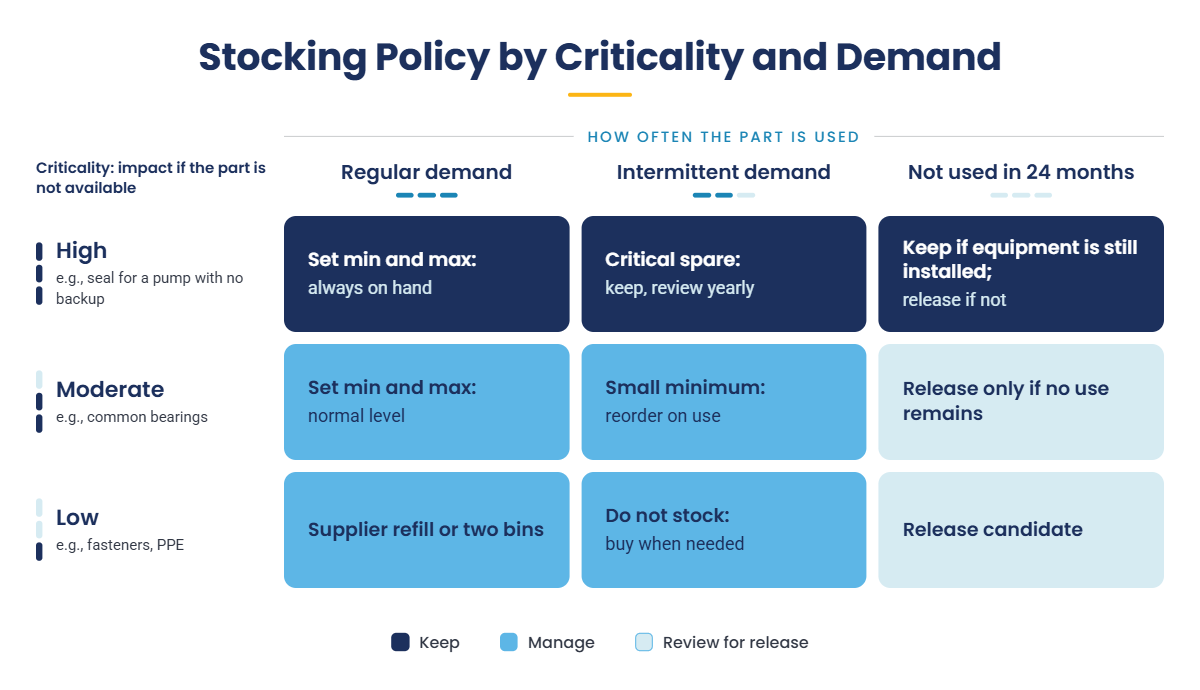
The first two criteria set the stocking policy in the matrix below; the third decides how closely each part is watched. ARC Advisory Group warns that running critical spares on ordinary reorder rules or supplier-managed refills can lead to serious stockouts, because they are held to cover risk, not regular use.
| Criticality | Regular demand | Intermittent demand | Not used in 24 months |
|---|---|---|---|
| High | Minimum and maximum set so the part is almost always on hand | Keep as a critical spare; review yearly with reliability engineering | Keep if the equipment is still installed |
| Moderate | Minimum and maximum at a normal level | Small minimum; reorder each time one is used | Release only if review finds no remaining use |
| Low | Supplier refills, or two bins with a reorder when the first empties | Do not stock; buy when a job needs it | Review for release |
Step 4: Reset Stocking Levels for Each Group
Once parts are segmented, reset each reorder point from the supplier's actual lead time and the service level its segment calls for, not from whatever an earlier planner chose. Where condition monitoring gives earlier warning of a failure, the extra time it buys can also justify a lower buffer for that asset's parts.
- Parts used in preventive maintenance: Order filters, belts and gaskets for preventive maintenance from the maintenance calendar, since you already know when those jobs will happen.
- Parts used now and then: A part may go unused for a year, then be needed three at once. An average of past use gives a level that is too high most of the time and too low when the failure comes, so base these levels on shortage impact and lead time. Planners who want a statistical approach can use methods designed for this pattern, such as Croston's method and the later correction by Syntetos and Boylan in research on forecasting intermittent demand, which give steadier estimates.
- Order quantities: For supplies with fairly steady use, the economic order quantity (EOQ) formula can balance ordering and holding costs. It is less useful for irregular demand.
Step 5: MRO Inventory Reduction in a Safe Release Order
Release stock in order of risk, lowest first, so early savings never put a running asset in danger. This is how to reduce MRO inventory without impacting availability:
| Where excess sits | How to spot it | What to do | Risk |
|---|---|---|---|
| Duplicate stock | Found during the item master cleanup | Consolidate, and transfer between sites before buying new | Low |
| Parts for equipment no longer installed | No link to any installed asset | Return to the supplier, sell, or scrap with finance approval | Low |
| Quantity above the revised maximum | Stock is higher than the new maximum | Stop reorders and let normal use bring it down | Low |
| Non-critical slow-moving parts | No use in 24 months and low impact | Return, sell or write off | Medium |
| Steady, high-value items | Regular use, high unit cost | Move to supplier-managed or consignment stock | Supply continuity, managed through contract terms |
| Critical/Insurance spares | High impact, occasional use | Leave out of the first round | High |
Before any part leaves, confirm that its equipment is removed or an approved substitute exists, and that the supplier can deliver fast enough to cover a failure. Critical spares stay until reliability engineering has reviewed each one.
Step 6: Reserve and Kit Parts for Every Planned Job
Lower stock is only safe if parts for known work are claimed before the work starts. Kitting means gathering all the parts for a work order into one staged set before the crew is sent out. Four habits make it work:
- Reserve parts in the system as soon as the work order is planned.
- Build and stage the kit before the weekly schedule is locked.
- Count the job as a stockout if its kit is incomplete at that point, even if the bin was never empty.
- Return unused kit parts the same day so the record stays correct.
Review two measures in your weekly maintenance planning and scheduling meeting:
| Measure | Formula |
|---|---|
| Kitting completeness | Kits complete when the schedule is locked, divided by kits required |
| Stockout rate on planned jobs | Planned jobs with incomplete kits when the schedule is locked, divided by all planned jobs |
Step 7: Keep Records Accurate With a Monthly Review
When parts move without being recorded, planners stop trusting the record and reorder parts the plant already has. These controls keep the record and the shelf in step:
- Issue every part against a work order, even during night-shift breakdowns.
- Scan at receipt, issue and count, so each movement is posted when it happens.
- Check for duplicates before any new item record is created.
- Review the five baseline numbers every month.
- Review the stocking policy every year, and whenever equipment is installed or retired.
- Send finance a monthly line showing cash released and holding cost avoided.
Applied to the example site, each action affects the books differently, so they are not added into one cash figure:
Illustrative example
| Action | Owned stock reduced | Cash effect | Timing |
|---|---|---|---|
| Return or sell parts for removed equipment and reviewed slow movers | $1.0M | About $0.7M recovered; $0.3M booked as a loss | Within months |
| Write off obsolete parts with no resale value | $0.6M | No cash; a one-time charge | At write-off |
| Use up stock above revised maximums, including duplicate extras | $1.4M | Purchases avoided as the stock is used | Over 12 to 24 months |
| Move steady, high-value items to consignment | $0.5M | Purchases avoided as supplier-owned stock replaces it, per contract | Over 6 to 12 months |
| Move low-value supplies to supplier refills | Not counted | None; stock usually stays on your books | Ongoing |
| Critical spares | No change | None | Kept after review |
| Total | $3.5M: stock falls from $18M (2.25% of RAV) to $14.5M (1.81%) | $0.7M recovered, $1.9M purchases avoided, $0.9M no cash | Up to 24 months |
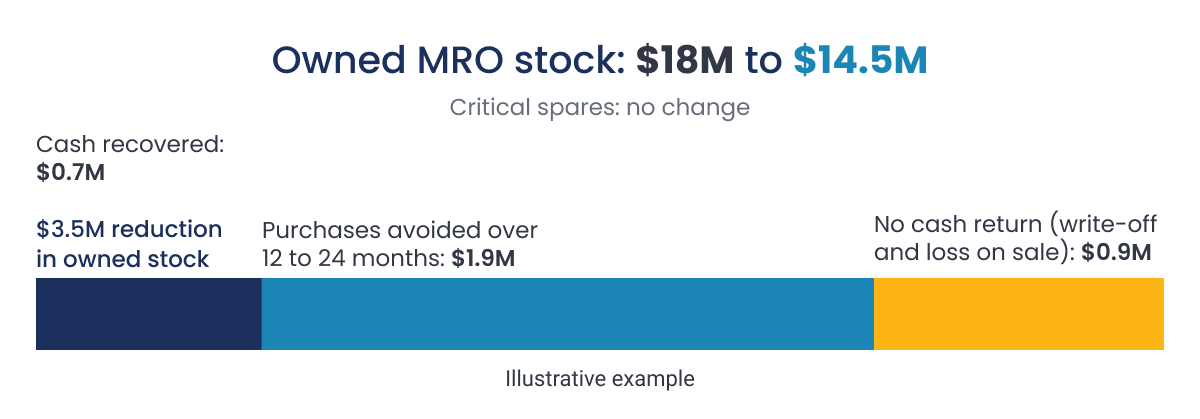
Once all actions are complete, the plant avoids about $0.7M to $0.9M a year in holding costs, while the stockout rate on planned jobs must not rise. The site stays above the 1.5% reference by design, because most of the remaining difference is critical spares.
Proof Point: How Indorama Ventures Raised Inventory Accuracy and Parts Availability
Indorama Ventures' Port Neches, Texas, site already ran SAP and IBM Maximo, but most frontline work, including storeroom transactions, was still on paper. After it deployed Innovapptive's Connected Worker Platform across maintenance, operations and storeroom work, two inventory measures changed sharply.
|
89.5% to 99.5% Inventory accuracy |
55% to 95% Parts availability |
For context, APQC's inventory accuracy benchmark, drawn from 8,660 organizations across industries, puts the median at 95%, with the bottom quartile at 92% and the top quartile at 98%. Indorama moved from below that bottom quartile to above the top quartile. These results show better records and parts readiness, not inventory removed. The wider deployment also contributed to $19M in realized EBITDA savings in 2025.
How Indorama Raised Parts Availability From 55% to 95%
See how the Indorama moved storeroom and maintenance work off paper while keeping SAP and IBM Maximo as the system of record.
MRO Inventory Best Practices for Keeping Stock Lean
The seven steps are a one-time cleanup. These MRO inventory management best practices are the routine habits that stop released stock from coming back:
- Tie every issue to a work order: Usage history then reflects real equipment demand.
- Scan at every movement: Barcode scans at receipt, issue, transfer and count remove typing errors and delays.
- Count critical parts more often: Cycle count vital spares and high-value lines more frequently than low-risk consumables.
- Check for duplicates before creating items: Search for an existing record before any new part number is approved.
- Link spares to equipment: A part with no equipment link cannot be graded for criticality or retired when the asset goes.
- Record local stock locations: Set up cabinets, cribs and vehicle stock as locations in the system, or close them.
- Return unused kit parts the same day: Parts left in staging quickly get lost.
- Let suppliers refill low-value supplies: Use supplier-managed or two-bin refills for high-turnover consumables such as fasteners, PPE and similar items.
- Revisit stocking policy when assets change: New or retired equipment should trigger a review of its linked parts.
Small teams should start by tying issues to work orders, scanning every movement and recording local stock, because every other practice depends on the record these protect.
How to Measure MRO Inventory Optimization: Four Numbers to Track
Stock value alone can make a weak program look strong, because value can fall while more planned jobs wait for parts. Track four numbers together each month:
| Measure | What it tells you | Healthy direction |
|---|---|---|
| MRO inventory accuracy | Whether the record matches the shelf | Aim for 100% on critical spares and 95% or better overall |
| Stockout rate on planned jobs | Whether the release was safe | Flat or falling while stock value falls |
| Slow-moving and obsolete stock value | How much capital is sitting idle | A falling share of total stocked value |
| Kitting completeness | Whether planned work is protected | Rising toward 100% |
Fix accuracy first, because the other three numbers are only as reliable as the record behind them. When you report to finance, show cash recovered, purchases avoided and holding cost avoided as separate lines, since they arrive at different times.
Choosing an MRO Stocking Model: Central, Satellite, VMI or Consignment
Choose a model for each group of parts by asking how fast the part must reach the job, and who should own it until it is used.
| Model | Best for | Effect on working capital | Main risk | What it needs |
|---|---|---|---|---|
| Central storeroom | Spares and high-value parts | Lowest total value, because stock is pooled | Slower response to remote units | Strong issue and delivery discipline |
| Satellite or point-of-use stores | High-use consumables close to the work | Slightly more stock, but faster jobs | Parts disappear from view if not tracked as system locations | Scanning at every location |
| Supplier-managed inventory (VMI) | Fasteners, PPE, filters | Stock held at supplier-set levels, usually still on your books | Price creep and dependence on one supplier | Service-level terms and regular audits |
| Consignment | High-value items with steady use | Stays on the supplier's books until you issue it | Stock still needs counting | Clear contract terms and an agreed settlement process |
| Industrial vending | PPE and small consumables | Lower use through controlled issue | Upfront cost and restocking service | Badge or work-order controls at the machine |
Multi-site plants should transfer parts before buying and share critical spares between nearby sites when transport time allows. Most plants combine several models.
Stop Planned Jobs From Waiting on Parts
Discover how leading MRO warehouses reserve, kit and stage parts before the weekly schedule locks.
Why MRO Inventory Records Stop Matching the Shelf
Most plants lose inventory accuracy not inside their systems but in the hours or days between a physical movement and the transaction that records it.
In most asset-intensive plants, the ERP or EAM system (SAP MM and PM, S/4HANA or IBM Maximo, or a CMMS at smaller sites) holds the item master, stock levels, reservations and valuation. The record is only as good as the transactions posted to it, and most accuracy is lost in the gap between the system and the shelf rather than inside the system. Five sources cause most of that loss:
- Parts taken during a night-shift breakdown with no issue recorded.
- Counts written on paper and entered days later.
- Direct-charge parts that arrive for one job and never get a bin.
- Unused kit parts put back on the shelf without being recorded.
- Local stock in cabinets and cribs that sits outside the system.
The fix is to record each movement where the work happens, tie it to a work order, and post it straight to the system of record, even without network coverage. That delay between work and record is a form of maintenance latency.
When you evaluate any tool for this, ask first: does it write each transaction back to your ERP, or create a second inventory someone must reconcile?
Close the Gap Between Your ERP and the Plant Floor
Learn how AI-powered execution platforms align spare parts with maintenance work and cut the delay between what happens and what gets recorded.
How Innovapptive Helps Plants Release MRO Working Capital Without Stockouts
Your stocking policy and valuation stay in SAP or IBM Maximo, where your planners set them. Innovapptive works as the industrial execution layer on top, helping plants optimize MRO inventory by keeping storeroom records accurate and parts ready for planned jobs.
- Accurate stock records: Innovapptive's warehouse inventory management software gives storeroom teams a native mobile app for barcode-verified receiving, putaway, picking, goods issue and cycle counting. Each transaction posts directly to SAP Inventory Management, Warehouse Management or Extended Warehouse Management on ECC or S/4HANA, and the app keeps working offline and syncs when the connection returns. This is what makes a trustworthy baseline audit and daily issue discipline realistic.
- Kitting for planned work: With Innovapptive's spare parts management software, parts are assigned to a kit when the work order is released, kit status is tracked on a live dashboard, and the kit is staged before dispatch, with stocked and non-stocked parts in one view. Planners see incomplete kits before the schedule is locked, not when the crew arrives.
- Scanning at every movement: The platform's warehouse barcode software adds multi-barcode scanning, on-screen material photos that reduce picking mistakes, label printing at receiving, and signature capture at goods issue, so every movement leaves an audit trail.
This focus on frontline warehouse execution is one reason Frost & Sullivan named Innovapptive its 2026 Company of the Year for global augmented connected worker platforms, highlighting Innovapptive's Warehouse Suite's spare parts management, barcoding and inventory tracking capabilities.
Ready to Release MRO Working Capital Without Stockouts?
See how Innovapptive’s mobile warehouse and spare parts apps post every receipt, issue and count to SAP, so stocking levels hold and planned jobs get complete kits.

Unlock Margins Hidden in Your Maintenance
Watch how leading manufacturers improve OEE, raise PM compliance and cut downtime through connected execution.
Request a Demo
2026 Company of the Year, Global Connected Worker Platforms
See why Frost & Sullivan recognized Innovapptive for closing the frontline execution gap.
Read the Report
- 18-11-2026
What Is MRO Inventory? Management & Optimization Guide
Most plants that struggle with MRO inventory face two problems at once: cash tied up in parts that...

- 17-11-2026
Mean Time Between Failures (MTBF): Formula and Benchmarks
Mean time between failures (MTBF) tells you how long a piece of equipment typically runs before it...

- 05-11-2026
Unplanned Maintenance: Definition, Types, Plant Examples
Unplanned maintenance is repair work that has to start as soon as a failure or defect appears. It...