
Challenge 1: Climate Action, Meeting Sustainability Demands
Mining activities carry a significant environmental footprint, and regulators, investors, and communities are demanding stricter standards and more sustainable practices. A recent study found that 40% of stream reaches in western watersheds are contaminated by mining activities, the kind of statistic that keeps environmental compliance at the top of the agenda.
The net-zero challenge: The industry-wide goal of net-zero emissions by 2050 requires major gains in operational efficiency and environmental responsibility. Mining companies must reduce their carbon footprint, optimize resource use, and embed sustainable practices across every site.
Challenges for miners:
- Balancing environmental regulations with production targets.
- Reducing energy consumption and greenhouse gas emissions.
- Implementing sustainable practices consistently across operations.
How connected worker solutions can help:
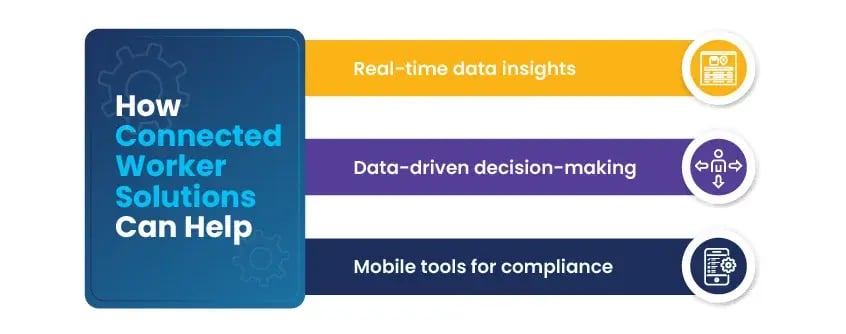
- Real-time data insights: Gain deeper visibility into operations and pinpoint the inefficiencies driving energy consumption and emissions.
- Data-driven decision-making: Use live operational data to optimize equipment performance, run preventive maintenance, and cut energy waste.
- Mobile tools for compliance: Equip the workforce with mobile apps that make it easy to execute and monitor environmental procedures, so sustainability standards are met and documented.
Challenge 2: Demand Uncertainty, Navigating a Shifting Market with Confidence
The mining industry operates in a dynamic market environment. The shift towards renewable energy sources is impacting the demand for certain minerals while creating opportunities for others. Additionally, technological advancements pose a threat of substitution, making it crucial for mining companies to adapt and forecast future needs effectively.
The Price Fluctuation Challenge: Fluctuating commodity prices and uncertain demand can significantly impact your revenue and profitability. Accurately forecasting future market trends is essential for making informed investment decisions, securing resources, and optimizing production strategies.
Challenges for Miners:
- Predicting future demand for specific minerals in a fluctuating market.
- Mitigating risks associated with price fluctuations.
- Identifying and capitalizing on emerging opportunities.
How Connected Worker Solutions Can Help:
- Real-time data collection and analysis: Gain insights into market trends and potential disruptions.
- Advanced analytics: Make data-driven decisions about resource allocation and production strategies.
- Scenario modeling: Simulate different market scenarios to prepare for potential changes.
Build a Resilient Mining Operation Prepared for Shifting Demands
Learn how connected worker technologies digitize workflows eliminating wasted labor hours and protecting your margins.
Challenge 3: Technology & Innovation, Embracing the Digital Future
Advancements in AI, data science, automation, and blockchain offer immense potential for the mining industries, improving efficiency, optimizing operations, and enhancing decision-making. However, successful integration and user adoption remain crucial challenges.
Challenges for Miners:
- Identifying and implementing relevant use cases for new technologies.
- Overcoming resistance to change from the workforce.
- Ensuring user adoption and maximizing the return on investment.
How Connected Worker Solutions Can Help:
- User-friendly mobile apps: Bridge the gap between technology and the workforce, facilitating adoption.
- Configurable digital work instructions: Deliver step-by-step guidance and training on new technologies.
- Pilot projects and user involvement: Foster smooth technology adoption by involving users and addressing their concerns.
Challenge 4: The Skills Gap, Bridging the Knowledge Divide
The mining industry faces a widening skills gap due to two key factors:
- The Great Crew Change: Experienced workers are retiring, taking valuable knowledge and expertise with them.
- The influx of a new generation: Younger workers entering the workforce often possess different skill sets and require targeted training to adapt to the demands of mining operations.
The Knowledge Transfer Challenge: Effectively transferring knowledge from experienced workers to the next generation is critical for ensuring the continuity of operations and maintaining high standards of safety and efficiency. Traditional training methods often struggle to keep pace with the evolving needs of the industry.
Challenges for Miners:
- Effectively transferring knowledge from experienced to new workers.
- Addressing the evolving skillset requirements of the industry.
- Attracting and retaining skilled workers in a competitive market.
How Connected Worker Solutions Can Help:
- Configurable digital work instructions: Capture and codify the knowledge of experienced workers for future generations.
- On-demand training materials: Provide accessible learning opportunities for new recruits and upskilling initiatives.
- Knowledge-sharing platforms: Facilitate collaboration and knowledge transfer between experienced and new workers.
Overcome the Industrial Skills Shortage with the AI Connected Worker Advantage
Discover how AI-powered connected worker tools capture tribal knowledge and deliver it instantly to next-generation technicians in the field.
Challenge 5: Operational Costs & Productivity, Optimizing Efficiency
Mining companies face increasing pressure on profit margins due to rising costs of materials, labor, and energy. Optimizing operational efficiency and maximizing productivity are crucial for maintaining profitability and competitiveness in a challenging market.
The Hidden Inefficiency: Frontline workers often rely on paper-based processes and manual data capture, leading to errors, delays, and inefficiencies. This disconnect between the workforce and digital technologies hinders your ability to gain real-time insights and optimize operations effectively.
Challenges for Miners:
- Reducing operational costs and streamlining processes.
- Improving data collection and communication for informed decision-making.
- Bridging the disconnect between frontline workers and digital technologies.
How Connected Worker Solutions Can Help:
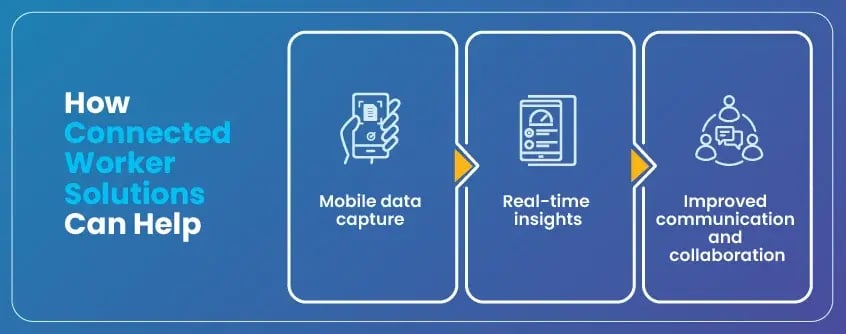
- Mobile data capture: Equip workers with mobile apps to eliminate manual data entry errors and streamline data collection.
- Real-time insights: Gain instant visibility into key performance indicators for faster problem-solving and improved decision-making.
- Improved communication and collaboration: Facilitate seamless communication between workers, supervisors, and management, enabling better coordination and faster response times.
Connected Worker Solutions: The Path to a Resilient, Sustainable Mining Operations
The challenges facing the mining industry are complex, but not insurmountable. Connected worker solutions offer a powerful tool to address these challenges and empower mining operations to achieve sustainability, efficiency, and long-term success. By equipping your workforce with the right tools and technologies, you can:
- Reduce your environmental footprint and contribute to a sustainable future.
- Navigate market uncertainty with confidence and make data-driven decisions.
- Embrace digital transformation and unlock the full potential of your workforce.
- Bridge the skills gap and ensure the continuity of knowledge and expertise.
- Optimize operational efficiency and maximize profitability.
Investing in connected worker solutions is not just about addressing current challenges; it's about building a resilient and sustainable future for your mining operations.
Drive Sustainable Mining Outcomes with a Digitized Frontline
Discover how leading mines leverage mobile platforms to minimize downtime and elevate site safety.
Future-Proofing Mining Operations with Innovapptive
Succeeding in today’s volatile commodity markets requires mining operations to achieve maximum asset reliability, uncompromised safety compliance, and peak workforce efficiency. Innovapptive’s mobile-first Connected Worker Platform eliminates the operational silos, data lag, and paper bottlenecks that often handicap heavy industrial environments.
Designed specifically to meet the rugged, demanding requirements of extraction and refining sites, our purpose-built Mining and Metals solutions empower frontline technicians with digital work instructions, offline-capable inspections, and real-time asset tracking. By seamlessly syncing field execution directly with enterprise systems like SAP and IBM Maximo, Innovapptive helps global mining enterprises systematically bridge the skills gap, minimize heavy equipment downtime, and build a safer, more resilient operation.
Two capabilities of Innovapptive's Connected Worker Platform are especially relevant to mining, where sites are remote, connectivity is unreliable, and every hour of downtime is expensive.
RapidSync Offline Mode: Full Productivity, Even Without Connectivity
Mine sites are some of the most connectivity-challenged environments in industry, underground, at the pit face, or miles from the nearest signal. RapidSync Offline Mode lets frontline workers keep working when the network doesn't. Teams can complete work orders, inspections, rounds, and data capture entirely offline, and the platform automatically syncs everything back once connectivity is restored, with no lost data and no duplicated effort.
WorkSmart AI: Turning Frontline Data Into Intelligent Action
Capturing frontline data is step one; acting on it intelligently is where the value compounds. WorkSmart AI applies AI to the connected worker experience, helping mining teams work faster, make better decisions, and get more out of the data their frontline generates every day.
Ready To Modernize Your Mining Operations?
Discover how easily field technicians can execute inspections, log safety hazards, and track assets, even in the most remote pockets of your mine site with zero connectivity.
Unlock Margins Hidden in your Maintenance
Watch how leading manufacturers improve OEE, increase PM compliance, and reduce downtime through connected execution.
- 21-10-2026
10 Best Work Instructions Software: Compared and Reviewed
Choosing work instructions software is about more than turning a PDF into guided steps on a tablet....
- 15-10-2026
Maintenance Digitalization: A Digital Transformation Guide
Maintenance digitalization is the shift from paper, spreadsheets and disconnected tools to...
- 12-10-2026
Manufacturing Skills Gap: What It Costs and How to Close It
A plant can have every role filled and still experience a manufacturing skills gap. Very often,...