
What Is a Connected Worker Platform?
A connected worker platform digitally links frontline workers, their tasks, and field data to back-office systems through mobile devices, IoT, and cloud software. For heavy industrial operations, this technology functions as an operational execution layer that sits directly between core systems of record like SAP or IBM Maximo and the workers executing tasks in the plant or field, ensuring field reality matches enterprise data.
It helps industrial teams execute work more consistently across operations, maintenance, and safety workflows. To explore how these digital systems transform frontline workflows fundamentally, read our comprehensive guide on what a connected worker is.
Build a Connected Worker Strategy That Scales
Learn how leading industrial teams connect frontline workers, enterprise systems, and plant-floor execution.
The Best Connected Worker Platforms at a Glance
The leading connected worker platforms for industrial enterprises comprise Innovapptive for AI Agent-powered frontline execution across SAP and IBM Maximo environments, SafetyCulture for inspection-centric compliance, Augmentir for skills management and digital work instructions, Tulip for no-code manufacturing applications, Poka for factory-floor knowledge management, Parsable for structured mobile work procedures, L2L for production dispatch, Librestream Onsight for augmented reality remote assistance, Workerbase for low-code workflow orchestration, and Sigga Technologies for targeted SAP mobile maintenance. Here is how they compare side by side.
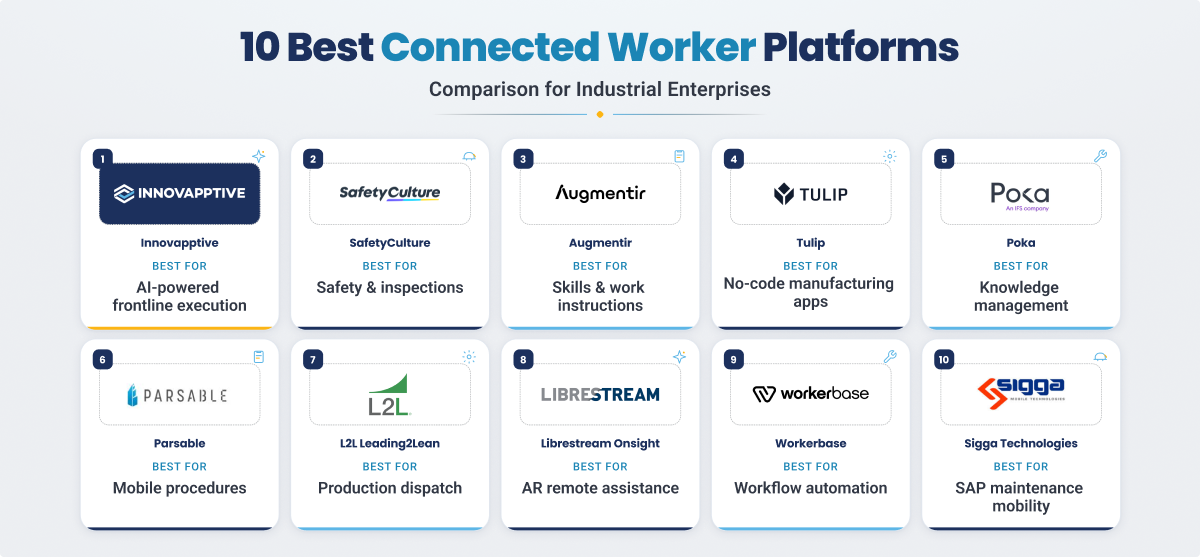
Top Connected Worker Platforms: Detailed Comparison Table
| Platform | Best For | Core Capabilities | ERP and CMMS Integration | Primary Industries | Deployment | Free Trial or Version | Pricing |
|---|---|---|---|---|---|---|---|
| Innovapptive | Asset-intensive enterprises needing AI-powered frontline execution | 15 purpose-built AI agents across digitization, troubleshooting, planning, RCA, safety, and insights; mobile work orders; operator rounds; digital inspections; work instructions; e-permits; inventory and warehouse | Native SAP and IBM Maximo, plus broader OT/OT and enterprise integrations | Oil and gas, chemicals, utilities, mining, manufacturing | Cloud with offline-first mobile | Demo / contact vendor | Contact vendor |
| SafetyCulture | Inspection-centric compliance and frontline safety | Digital inspections, checklists, safety alerts, training, analytics | Connector-based; verify ERP depth | Broad frontline operations, safety-led environments | Cloud and mobile | Free tier available | Published plans / contact vendor |
| Augmentir | Skills management and digital work instructions | Skills tracking, training, collaboration, work instructions, workflow support | Verify native ERP depth | Manufacturing and industrial frontline teams | Cloud and mobile | Demo | Contact vendor |
| Tulip | No-code manufacturing applications | No-code apps, edge connectivity, IoT, dynamic work instructions | Integrations available; confirm maintenance depth | Automotive, electronics, discrete manufacturing | Cloud / edge | Demo | Contact vendor |
| Poka | Factory-floor knowledge management | Skills and training workflows, knowledge capture, tasks, issue management | Verify ERP and CMMS depth | Manufacturing | Cloud and mobile | Demo | Contact vendor |
| Parsable | Structured mobile work procedures | Digital procedures, execution data, collaboration, mobile workflows | Pair with ERP for full lifecycle | Heavy industry, energy, manufacturing | Cloud and mobile | Demo | Contact vendor |
| L2L Leading2Lean | Production dispatch and floor coordination | Maintenance and production dispatch, downtime tracking, OEE, connected workforce workflows | Verify fit for distributed assets | Manufacturing | Cloud | Demo | Contact vendor |
| Librestream Onsight | Augmented reality remote assistance | Remote video, AR collaboration, AI assistant, field support | Specialized workflow fit; not full suite depth | Industrial field service and operations support | Cloud and mobile | Demo | Contact vendor |
| Workerbase | Low-code workflow orchestration | Low-code workflows, connectors, IoT and production data orchestration | Broad integration posture; verify maintenance depth | Production environments | Cloud | Demo | Contact vendor |
| Sigga Technologies | SAP-native maintenance mobility | SAP PM and EAM mobile work orders, warehouse and inventory mobility, offline field use | SAP-centric integration depth | Asset-intensive plants using SAP | Mobile and enterprise deployment | Demo | Contact vendor |
How We Evaluated These Connected Worker Platforms
The shortlist was evaluated against industrial and asset-intensive fit, ERP and CMMS integration depth, breadth of frontline workflows, offline and mobile performance, AI capability, deployment and scale, and proof in regulated or hazardous environments. Those criteria are more specific than generic feature checklists to address the rigid system-of-record constraints and severe field execution risks inherent to large-scale industrial operations.
- Industrial and Asset-Intensive Fit: Assessment of the platform's architectural capability to handle rugged, high-hazard, and capital-intensive environments such as oil refineries, chemical production lines, and heavy mining sites.
- ERP and CMMS Integration Depth: Measuring bidirectional data transfer speed and native connectivity to core systems of record, specifically prioritizing SAP and IBM Maximo integration stability.
- Breadth of Frontline Workflows: Evaluating suite coverage across critical operational actions, including preventative maintenance work orders, operator rounds, safety permits (LOTO/JHA), and inventory movements.
- Offline and Mobile Reliability: Testing the application's offline-first database synchronization stability when operating in remote locations devoid of cellular connectivity.
- AI and Innovation Capability: Analyzing advanced embedded feature sets including GenAI planning agents, automated work packaging, and computer vision for direct gauge reading and safety compliance checking.
- Regulatory Compliance and Security Proof: Verification of platform resilience within highly regulated manufacturing environments requiring stringent data logging and validated safety workflows.
Close the Industrial Execution Gap With AI
Discover how Industrial AI and connected worker technology can reduce execution latency by bringing intelligence closer to the frontline and turning insights into action.
How to Choose the Right Connected Worker Platform
The most critical principle when selecting a platform is to match the software architecture to your plant's operational reality rather than a generic software features sheet. In industrial environments, depth of execution and integration usually matters more than surface-level checklist breadth.
- Define the 12-to-24 Month Problem: Pinpoint whether the core bottleneck is mechanical downtime, safety compliance gaps, or sluggish data synchronization inside legacy ERP systems.
- Map Integration Realities Upfront: Mandate clear technical proof of bidirectional integration depth with existing corporate records (SAP, IBM Maximo) before assessing frontend layouts.
- Verify True Offline-First Usability: Ensure field applications store all data schemas locally on the device, allowing field technicians to complete rounds without continuous cellular coverage.
- Require Scenario-Based Demos: Require demos against real use cases, not canned workflows. Talk to reference customers at similar scale.
- Assess Regulated Manufacturing Compliance Fit: Validate that data tracking logs satisfy federal oversight mandates, aligned with recognized industrial standards such as established workplace safety management practices.
- Prioritize Modular Platforms Over Point Solutions: Favor a modular suite over a single-point tool when the roadmap spans maintenance, operations, and safety.
For asset-intensive enterprises, ERP integration depth is usually the deciding factor because it determines whether the platform can actually operationalize work rather than just digitize isolated tasks.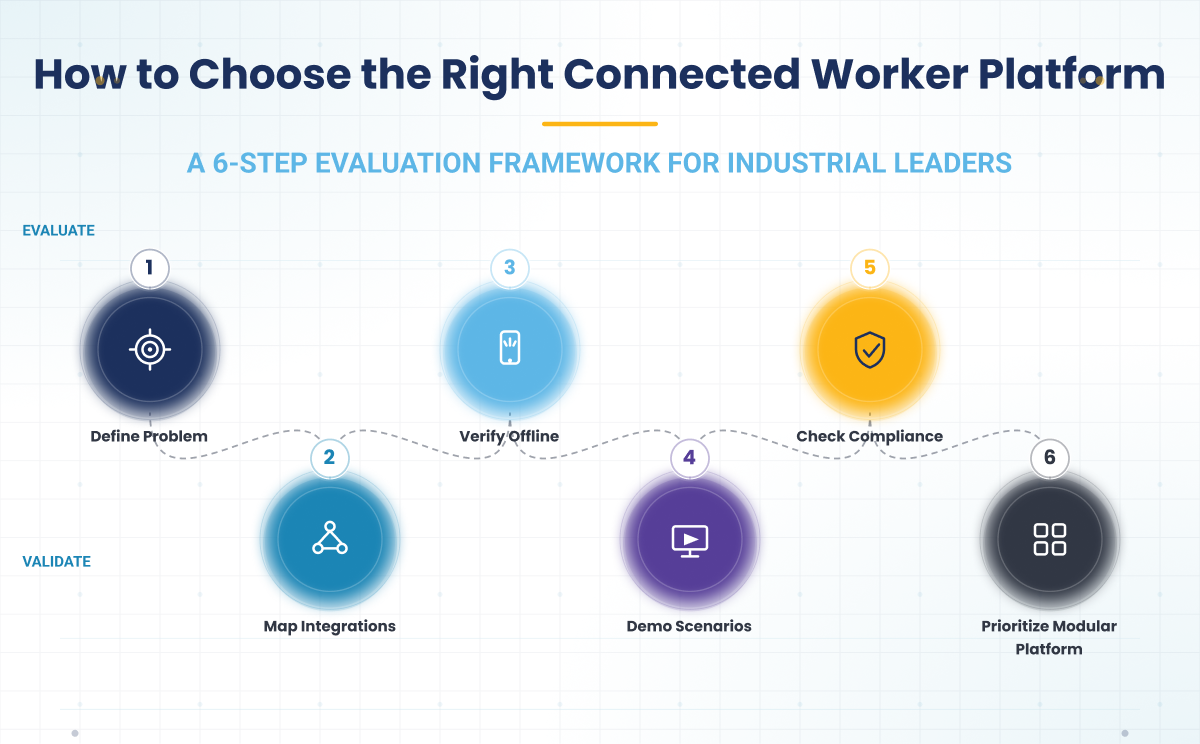
Why Enterprise Companies Choose Innovapptive
Innovapptive's position as a market leader is validated by consecutive Frost & Sullivan milestones: earning the 2026 Global Company of the Year Award for Augmented Connected Worker, End-to-End Platforms and being named a Leader in Connected Worker Platforms in the 2025 Frost Radar™. This recognition underscores the platform's unique positioning as an operational execution layer that sits above legacy CMMS tools to maximize asset uptime and frontline efficiency. Rather than delivering generic mobile forms, Innovapptive provides clear financial returns by tightly connecting plant-floor reality with corporate IT infrastructure.
The Ultimate Differentiator: Purpose-Built Agentic AI
A core operational differentiator recognized by analysts is Innovapptive's Frontline Operations AI Agent Suite. Rather than deploying general-purpose cloud chatbots that lack industrial context and fail during connectivity losses, Innovapptive delivers 15 purpose-built AI agents distributed across six distinct operational domains.
These agents run natively on a proprietary, hybrid Small Language Model (SLM) consisting of 3 to 8 billion parameters. This infrastructure delivers distinct operational advantages over legacy cloud platforms:
- Offline Edge Deployment: The SLM processes structured and unstructured data locally using optimized local compute, allowing critical AI workflows to remain fully operational at the edge when plant connectivity is entirely lost.
- Industrial Precision Calibration: The underlying models are trained explicitly on root cause analysis (RCA) data, OEM manuals, inspection logs, and SAP records. They are fine-tuned by Certified Maintenance & Reliability Professionals (CMRP) to yield 2 to 3 times higher precision than generic models.
- Role-Specific Task Automation: The portfolio provides targeted troubleshooting and planning agents for maintenance, authoring agents for operations, and automatic real-time personal protective equipment (PPE) and e-permit validation logic for safety teams.
Juan Francisco Dell'Era, Senior Research Analyst for Industrial Automation & Software at Frost & Sullivan, highlights this architectural edge:
Quantified Enterprise Proof: The Indorama Ventures Success"Innovapptive has taken an innovative approach to AI, developing one of the most extensive AI agent portfolios available. These agents assist manufacturers with their maintenance, operations, reliability, safety, and analytics needs."
This ecosystem of deep enterprise integration and advanced agentic AI delivers measurable financial impact for asset-intensive operators. As part of its corporate Olympus 2.0 program, global chemical manufacturing giant Indorama Ventures deployed Innovapptive's Connected Worker Platform at its Port Neches, Texas facility to eliminate value leakage. The single-site deployment achieved the following audited performance benchmarks within 12 months of rollout:
- Direct EBITDA Impact: Unlocked $29 million in realized annual maintenance savings and EBITDA impact during the 2025 fiscal year.
- Maintenance Backlog Reduction: Compressed long maintenance backlog cycles by 58%, reducing wait times from 24 weeks down to 10 weeks.
- Contractor & Overtime Optimization: Decreased reliance on external contractors by 38% (reducing headcount from 140 down to 87) and cut overtime in half from 24% down to 12%.
- MRO Inventory Precision: Improved parts tracking accuracy from a baseline of 89.5% up to a near-perfect 99.5%, releasing vital working capital through optimized spare parts management.
- Procedural Compliance: Increased active digital work instruction usage from less than 20% to over 85%, mitigating knowledge attrition risks across shifts.
Micah Mosley of Indorama Ventures Texas summarized the operational shift:
"This wasn't about digitizing forms. Innovapptive transformed how work gets done - every notification, permit, part, and technician is now connected in real time. That's how we reclaimed tens of millions in savings."
Following these clear site results, Indorama is scaling the software framework across its global manufacturing network, establishing a blueprint to capture an estimated $50 million to $80 million enterprise-wide cost take-out opportunity.
Cut Maintenance Waste With a Connected Worker Platform
See how Indorama used a Connected Worker Platform to move beyond reactive maintenance and turn frontline execution into a measurable EBITDA lever.
From Mobile Apps to Connected Worker Platforms: Understanding the Difference
For industrial enterprises, the question is not simply whether frontline workers have a mobile app. The bigger question is whether that technology can connect frontline execution with the enterprise systems, data, and workflows that keep the plant running.
Most solutions fall into three broad architectures: point solutions built primarily for mobile tasks, ERP extensions that bring selected enterprise processes to the field, and Connected Worker Platforms designed to connect frontline execution across maintenance, operations, safety, and inventory.
The differences become especially important when teams need to work offline, execute complex workflows, act on real-time data, and scale processes across multiple plants.
|
Capability |
Point Solution (Mobile App Only) |
ERP Extension |
Innovapptive Connected Worker Platform |
|
ERP Synchronization |
Manual data entry or basic API connections can create delays between field activity and enterprise records. |
Extends selected ERP processes to mobile users but can remain dependent on ERP transaction flows. |
Bidirectional integration connects frontline actions with SAP and EAM records in real time. |
|
Offline Capability |
Often limited or unavailable beyond basic mobile forms. |
May cache selected data but can have limitations with complex transactions and media in remote environments. |
Offline-first execution allows workers to complete critical workflows and automatically synchronize when connectivity returns. |
|
Frontline AI Support |
Typically focused on forms, data capture, or basic mobile workflows. |
AI capabilities may sit outside the actual frontline workflow or depend on cloud services. |
Purpose-built AI can support troubleshooting, root-cause analysis, planning, and frontline decision-making within the workflow. |
|
EHS & Safety Workflows |
Safety activities often require separate applications or disconnected processes. |
Safety workflows may be added to existing ERP processes but remain tied to the underlying system structure. |
Safety gates, permits, and compliance workflows can be embedded directly into frontline execution. |
|
Workflow Configuration |
Changes may require vendor development or custom coding. |
Often requires IT involvement for configuration and changes. |
No-code configuration enables operations teams to adapt workflows without lengthy development cycles. |
|
Multi-Site Scalability |
Separate site deployments can make standardization difficult. |
Centralized ERP governance can limit how quickly workflows adapt to individual plant requirements. |
Centralized enterprise scaling combined with role- and site-specific frontline workflows supports multi-plant operations. |
For asset-intensive enterprises, the distinction is ultimately about how much of the execution chain the technology can connect. A mobile app can digitize a task, and an ERP extension can bring selected transactions to the field. A Connected Worker Platform goes further by connecting workers, workflows, enterprise systems, and plant-floor data so work can be executed consistently across maintenance, operations, safety, and inventory.
That makes architecture an important consideration when evaluating Connected Worker technology, particularly for organizations running SAP or IBM Maximo across complex, distributed operations.
Ready To Close Your Insight-To-Action Gap With Connected Worker Execution?
Experience the Only Connected Worker Platform Built for $50M+ in Operational Savings.
Unlock Margins Hidden in your Maintenance
Watch how leading manufacturers improve OEE, increase PM compliance, and reduce downtime through connected execution.
- 05-10-2026
10 Best Shift Handover Software Platforms for Plant and Process Operations
Shift handover software can mean different things depending on the operating environment. Some...
- 29-09-2026
Best SAP Maintenance Planning & Scheduling Software 2026
Your maintenance work orders live in SAP Plant Maintenance (PM), while the working schedule lives...
- 28-09-2026
Best Work Order Software: Top 9 Platforms Compared
Selecting the best work order software is a different decision for a large industrial plant than...