
What Is Reliability Centered Maintenance?
Reliability-centered maintenance (RCM) is a systematic process for determining the maintenance tasks that best preserve the required functions of physical assets in their operating context. Rather than prescribing more maintenance, RCM prescribes the right maintenance: the task that is most technically feasible and cost-effective for each specific failure mode on each specific asset.
RCM traces its roots to commercial aviation in the 1960s and 1970s, when researchers at United Airlines found that more frequent overhauls were sometimes increasing failure rates rather than reducing them. Most components, it turned out, do not fail in a simple, age-related pattern. The 1978 Nowlan and Heap report for United Airlines formalized these findings. That work became the foundation of the SAE JA1011 standard, which is now the recognized benchmark for a valid RCM process across industries well beyond aviation.
RCM vs Preventive, Predictive, Reactive and Risk-Based Maintenance
Reliability centered maintenance is not another maintenance strategy. It is a decision-making framework that determines which maintenance strategy is most appropriate for each asset and failure mode. Preventive, predictive, reactive, and risk-based maintenance are the strategies RCM may recommend depending on an asset's function, operating context, and the consequences of failure.
|
Strategy |
Trigger |
Best Used When |
Cost & ROI Profile |
|---|---|---|---|
|
Preventive Maintenance |
Calendar / usage-based |
Predictable wear; manufacturer-specified intervals |
Moderate; low complexity |
|
Predictive Maintenance (PdM) |
Condition / data-triggered |
Critical assets where deterioration develops gradually |
Higher upfront; best long-term ROI on high-value assets |
|
Reactive / Run-to-Failure |
Post-failure repair |
Low-criticality, easily replaced assets with low failure consequences |
Low planning cost; high risk if misapplied |
|
Risk-Based Maintenance (RBM) |
Risk-prioritized scheduling |
Asset triage before committing to full RCM analysis |
Moderate; good first step for large asset populations |
|
Reliability Centered Maintenance (RCM) |
Failure-mode-driven decision framework |
Critical assets where safety, production, or compliance depend on reliable performance |
Higher analysis effort; optimized lifecycle cost |
What the Maintenance Mix Looks Like at Top-Performing Facilities
High-performing maintenance organizations do not rely on a single maintenance strategy. Instead, they balance preventive, predictive, and reactive maintenance based on asset criticality and business risk. According to the DOE Federal Energy Management Program (FEMP) Operations and Maintenance Best Practices Guide, organizations with mature maintenance programs typically achieve the following maintenance mix:
| Maintenance Type | Typical Share of Maintenance Activities |
|---|---|
| Reactive Maintenance | Less than 10% |
| Preventive Maintenance | 25% to 35% |
| Predictive Maintenance | 45% to 55% |
These percentages are benchmarks rather than universal targets. Every facility has different assets, operating conditions, and production priorities. A pharmaceutical plant, refinery, and food processing facility may all require different maintenance mixes.
The purpose of reliability centered maintenance is not to force every facility toward the same percentages. Instead, RCM helps determine which assets should receive predictive maintenance, which are better suited for preventive maintenance, and which low-risk assets can safely operate under a planned run-to-failure strategy.
Read More: The 80/20 Rule: Your Guide to Improving PM Ratios and Maintenance Effectiveness
Core Principles and Objectives of RCM
RCM decisions rest on a small number of governing principles. These principles explain why the seven-question SAE JA1011 framework in the next section is structured the way it is.
- Preserve required asset functions, not just equipment condition: Reliability centered maintenance focuses on preserving required system functions rather than maximizing equipment uptime or replacing parts on a schedule. A pump that is running but delivering 40% below its required flow rate has failed its function even if it has no broken parts.
- Evaluate assets in their operating contexts: The Nowlan and Heap research showed that most industrial components fail randomly or due to operating conditions, not simply because they age. Applying time-based overhauls to failure modes that do not follow an age-related pattern wastes resources and can introduce new failures.
- Focus on failure modes: Rather than treating every failure the same, RCM identifies the specific ways an asset can fail. Understanding individual failure modes allows organizations to select maintenance tasks that address the root cause instead of relying on generic maintenance schedules.
- Assess failure consequences: Not every failure has the same business impact. RCM evaluates whether a failure affects safety, environmental compliance, production, product quality, or operating costs. Maintenance priorities are based on these consequences rather than on equipment age alone.
- Select the most effective maintenance task: Once failure modes and consequences are understood, RCM identifies the most effective response. Depending on the situation, this could include preventive maintenance, predictive maintenance, failure-finding inspections, redesign, or planned corrective maintenance if the risk is acceptable.
Build Your Blueprint for the Future of Maintenance
Discover how to integrate artificial intelligence into your asset management strategy to eliminate field execution gaps, supercharge technician productivity, and maximize asset life.
The 7 Questions of Reliability Centered Maintenance (SAE JA1011 Framework)
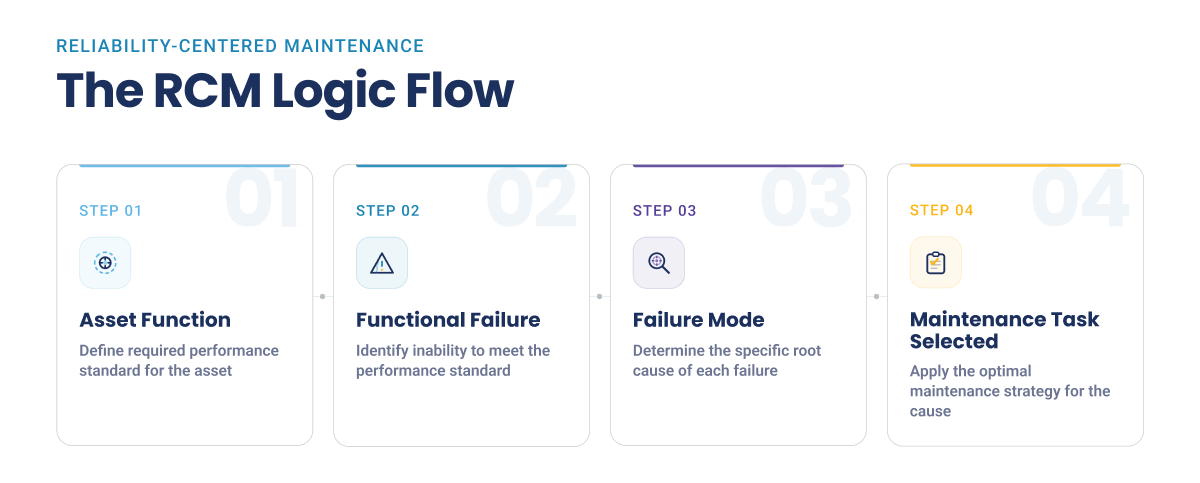
The SAE JA1011 standard defines reliability centered maintenance through seven key questions that must be answered for every asset and failure mode under review. These questions are sometimes called the seven-step RCM process or simply the RCM questions. All three terms describe the same SAE JA1011-defined decision logic.
The questions build on each other sequentially. You cannot properly answer question 5 without having worked through questions 1 through 4 first. Each layer of the analysis produces the input the next layer requires.
| # | RCM Question | What It Establishes |
|---|---|---|
| 1 | What is the asset's function, and what performance standard does it need to meet in its current operating context? | Asset function |
| 2 | In what ways can it fail to fulfill that function? | Functional failure |
| 3 | What causes each functional failure? | Failure mode |
| 4 | What happens when each failure mode occurs? | Failure effect |
| 5 | How does each failure mode matter, does it affect safety, environmental compliance, operations, or cost? | Failure consequence |
| 6 | What proactive maintenance task, if any, is technically feasible and worth doing? | Proactive task / on-condition task selection |
| 7 | What should be done if no suitable proactive task can be found? (default action or design-out) | Default action |
Each question feeds the one after it, so a weak answer early on undermines everything downstream. Here is what each establishes in practice:
- Function: Define what the asset must do and to what measurable standard in its actual operating context, not its nameplate rating.
- Functional failure: Identify every way it can fail to meet that standard, including partial failures such as reduced flow or pressure, not just complete breakdowns.
- Failure modes and FMEA: Pin down the specific causes behind each functional failure, such as impeller wear, cavitation, or seal degradation. FMEA is the structured method most programs use here; it produces the failure-mode list the rest of the analysis evaluates.
- Failure effects: Describe what actually happens when each mode occurs, what operators would observe, and how the failure progresses over time.
- Failure consequences: Classify each mode by impact, safety, environmental, operational, or economic, since the consequence is what drives task selection in the next step.
- Task selection: Choose the proactive task, on-condition, scheduled restoration, scheduled discard, or failure-finding, that is technically feasible and worth doing. If none qualifies, the analysis moves to question 7.
- Default action: The most frequently skipped question. Where no proactive task fits, the outcome is a deliberate run-to-failure decision for low-consequence modes or a design-out for severe ones. Both are planned, documented outputs, not gaps.
RCM and FMEA (Failure Mode and Effects Analysis)
FMEA lives inside question 3 of the SAE JA1011 framework, not alongside it as a competing method. Failure Mode and Effects Analysis (FMEA), and its extended form FMECA, is the structured method most RCM programs use to answer what causes each functional failure? It generates the list of failure modes that the rest of the RCM analysis then evaluates. Running FMEA without the surrounding RCM framework gives you a catalog of failure modes. Running RCM without a structured method for identifying failure modes gives you incomplete inputs. Both together is how the SAE JA1011 process is meant to work.
How to Implement an RCM Program: Step-by-Step
The seven questions in the previous section are what you ask about a single asset and its failure modes. The steps below are how you run the program across a facility. They are different things. The example below follows a natural gas centrifugal compressor at a chemical processing facility through all six steps to show how the process connects in practice.
.png?width=1200&height=458&name=rcm-implementation-roadmap%20(1).png)
- Prioritize critical assets: Before running any detailed analysis, rank your assets by consequence of failure. A criticality assessment, risk matrix, or production bottleneck map all work here. The compressor serving the main process train makes the list. A portable fan in the break room does not. Focus analysis time where failure consequences are highest.
- Define functions and performance standards: State exactly what the compressor needs to do: deliver 4,500 ACFM at a minimum discharge pressure of 85 PSIG, continuously, during a 24-hour production run. The performance standard must be specific and measurable. Without it, you cannot define what functional failure actually means in questions 1 and 2.
- Identify failure modes using FMEA: List every credible way the compressor could fail to meet that performance standard: fouled inlet filter reducing flow, seal degradation causing internal bypass, bearing failure from lubricant contamination, impeller erosion from entrained solids. This is the FMEA step from question 3, applied in practice. Field input from maintenance technicians is essential here.
- Assess failure consequences: For each failure mode, determine what category of consequence it produces: safety, environmental, operational, economic, or hidden. A catastrophic seal failure releasing flammable gas is a safety consequence. A slow-developing flow reduction that degrades throughput only is an operational one. The consequence type drives the task selection in step 5.
- Select the maintenance strategy per failure mode: For seal degradation on this compressor, an on-condition task using vibration and temperature trending is technically feasible and provides sufficient lead time. For the fouled inlet filter, a scheduled inspection triggered by differential pressure readings makes more sense. For a minor, easily replaced bearing type with low consequence, a conservative scheduled discard interval is the practical default. Each failure mode gets its own justified decision.
- Implement in the CMMS or EAM and establish a review cycle: Task selections become scheduled work orders with defined intervals, instructions, and skills requirements inside the CMMS or EAM. Review critical asset analyses annually at minimum, and immediately after any major failure, process change, or equipment modification. An RCM program that does not have a structured review cycle produces increasingly stale decisions as conditions and failure histories evolve. RCM is a continuous reliability improvement process, not a one-time maintenance study.
Reliability Centered Maintenance Example: Centrifugal Pump
The following example walks through the SAE JA1011 seven-question framework applied to a single failure mode on a centrifugal process pump. This is a simplified illustration designed to show how the questions connect in practice, not a complete FMEA output. A real analysis would cover all credible failure modes for this asset, not just one.
| RCM Element | Applied Example |
|---|---|
| Asset | Centrifugal process pump |
| Function | Deliver 500 GPM of cooling water continuously at minimum 45 PSI discharge pressure |
| Functional Failure | Flow drops below 500 GPM or discharge pressure falls below 45 PSI |
| Failure Mode | Bearing wear from lubricant contamination |
| Failure Effect | Increasing vibration and heat buildup; flow degrades progressively |
| Failure Consequence | Operational: production slowdown on the downstream heat exchanger; no immediate safety risk |
| Maintenance Decision | On-condition task: monthly vibration analysis + quarterly lubrication check. Scheduled replacement only if vibration trend crosses defined alert threshold. |
| Default Action (if no task found) | Not applicable here, vibration monitoring is feasible. If it were not, a conservative scheduled discard interval would be the fallback. |
The key point this example illustrates: RCM does not recommend replacing bearings every six months because that is what the service manual says. It recommends monthly vibration monitoring because that is what the failure mode, the time between a detectable potential failure and functional failure, allows. The task is matched to the failure mode, the operating context, and the consequence. That is the difference between RCM and a standard preventive maintenance schedule.
Which Assets and Industries Get the Most Value from RCM
RCM analysis is time-intensive. It pays off where failure consequences justify the investment. The asset categories that align with RCM analysis are:
- Safety and compliance critical systems: Pressure relief devices, fire suppression, emergency shutdown systems, and protective relays where a hidden function failure can have catastrophic consequences.
- Production bottleneck assets: Any asset whose failure directly halts or severely reduces output: main compressors, reactor feed pumps, primary heat exchangers, or critical blowers in a process plant.
- High cost or long lead equipment: Assets where repair or replacement costs are high enough, or lead times long enough, that early detection has clear economic value.
- Assets prone to repeat failures: Assets with a documented history of repeat failures where the root cause has never been resolved through standard maintenance.
- Assets with hidden failures: Backup generators, standby pumps, protective relays, and emergency systems that only reveal their failure when called into service during an abnormal event.
Oil and gas, chemicals, petrochemicals, and utilities operations tend to get the fastest return on RCM investment because they combine high-consequence failure modes with significant safety and regulatory exposure. Manufacturing facilities focused on OEE improvement are a close second, particularly where production bottleneck assets are well-defined. RCM is generally not suitable for low-critical, easily replaceable assets with low failure consequences.
Technology and Tools That Support RCM
When question 6 identifies the appropriate response to a failure mode, the next decision is which monitoring technology to use. The selection depends on the failure mode characteristics, the P-F interval (potential to functional failure interval) available, and the criticality of the asset.
| Technology | What It Detects |
|---|---|
| Vibration Analysis | Detects imbalance, misalignment, bearing wear, and looseness in rotating equipment |
| Infrared Thermography | Identifies heat buildup from friction, electrical faults, or insulation breakdown |
| Acoustic / Ultrasonic Monitoring | Picks up high-frequency sounds from leak paths, valve defects, and early bearing degradation |
| Oil Analysis | Checks lubricant condition and detects early-stage metal wear particles in gearboxes and turbines |
| Corona Detection | Monitors partial discharge in high-voltage electrical assets before insulation failure occurs |
Read More: The Future is Now: How AI in Maintenance is Transforming Reliability
Building the Right Team and Organizational Readiness for RCM
RCM programs fail more often on the organizational side than on the analytical side. Two factors account for most of it.
First, scope has to match capacity. Leadership must set the program's boundaries up front: which assets, which sites, how many analysis sessions per quarter, and what technology investment is available. A facility-wide rollout run by one engineer with no CMMS integration budget produces analysis nobody implements. Start with one high-criticality asset family, prove it, then expand.
Second, RCM analysis is cross-functional by design. The seven-question process cannot be completed by reliability engineers alone. It needs:
- Reliability engineers: Lead the failure mode analysis and task selection logic.
- Maintenance technicians: Contribute field-level knowledge about how assets actually behave and fail in practice, including failure modes that are not in the asset's data record.
- Operations staff: Define the functional context and performance standards in question 1, since operations owns the process the asset serves.
- OT-IT or digital execution role: Translate the completed RCM output into scheduled, trackable work inside the CMMS or EAM. This is the role most programs leave out, and it is the one that determines whether the analysis stays as a document or becomes actual maintenance activity on the floor.
The analysis phase of RCM, done well, takes weeks to months per asset family. The execution gap that follows, getting those task selections into work orders that technicians actually receive, follow, and complete, often goes unaddressed. Staffing for the execution handoff is not optional.
Future-Proof Your Frontline Execution
Discover how the next generation of asset management is moving beyond static data entry. Learn how 15 autonomous AI agents are actively bridging the gap between complex reliability strategies and hands-on fieldwork to maximize technician efficiency and asset uptime.
Maintenance Task Types Used Within RCM
Question 6 of the SAE JA1011 framework produces one of four task-type outcomes. These are not competing philosophies; they are outputs of the RCM decision logic applied to specific failure modes and their consequences.
- Time-based / Periodic Maintenance: Work performed at a fixed interval regardless of condition. Appropriate for failure modes with a clear and consistent age-related deterioration pattern, or where condition monitoring is not feasible.
- Condition-Based Maintenance (CBM): Work triggered when a monitored parameter crosses a defined threshold. Appropriate where the failure mode develops gradually enough that monitoring provides actionable lead time.
- Predictive Maintenance (PdM): A subset of CBM that uses sensor data and analytical models to forecast when a failure is likely to occur, allowing more precise scheduling. Requires reliable monitoring technology and historical failure data.
- Run-to-Failure: A deliberate decision to let an asset fail before repair, appropriate where the failure mode has no safety or major production consequence, the cost of failure and repair is low, and a functional spare is available or repair is quick.
Reliability Centered Maintenance vs Total Productive Maintenance (TPM)
RCM and TPM both aim to reduce unplanned failures, but they address the problem from different directions. Confusing them, or treating one as a substitute for the other, is one of the more common planning errors in industrial maintenance strategy.
RCM is an asset-by-asset decision framework. It determines what maintenance task is most appropriate for each failure mode on each asset based on consequences and operating context. Total Productive Maintenance (TPM) is a plant-wide organizational program built around operator equipment ownership, autonomous maintenance, 5S discipline, and continuous improvement. RCM decides what the right task is. TPM changes how the entire workforce engages with equipment care across every shift and every team.
| RCM | TPM | |
|---|---|---|
| Core focus | Asset-by-asset decision logic: which task, for which failure mode, on which asset | Plant-wide culture program: operator ownership, 5S, autonomous maintenance |
| Who drives it | Reliability engineers, maintenance techs, cross-functional analysis team | Operators, supervisors, and continuous-improvement teams across the facility |
| Primary goal | Select the right maintenance task for each failure mode and criticality level | Eliminate losses through operator involvement and proactive daily care |
| Scope | Asset-level: one system or machine family at a time | Facility-wide: all equipment, all shifts, all teams |
| Output | Documented maintenance task selection per failure mode, fed into the CMMS or EAM | OEE improvements, reduced breakdowns, and stronger operator-equipment ownership |
Most mature industrial maintenance programs run both. RCM provides the analytical backbone that determines task selection for critical assets. TPM provides the operational discipline that keeps operators, supervisors, and maintenance teams engaged in preventing failures every day. They are complementary, not competing.
Benefits, Challenges and Real-World Impact of RCM
RCM delivers real operational improvements for facilities that implement it with the right scope and organizational commitment. It also demands significant upfront investment in analysis time and cross-functional team participation. Both sides are worth understanding before committing to a program.
Benefits of RCM
- Reduced unplanned downtime: By targeting the actual root causes of failures instead of relying on generic calendar schedules, organizations are able to prevent unexpected breakdowns before they happen.
- Lower total maintenance cost: Cutting out pointless, time-based tasks on non-critical machinery saves labor and spare parts. This shifts the maintenance budgets to where it is actually required and necessary.
- Longer asset life: Predictive maintenance catches wear and tear early. This allows organizations to fix minor issues before they cause major, cascading damage that ruins the machine or forces an expensive total rebuild.
- Improved safety and compliance: RCM uncovers hidden flaws in backup systems, emergency shutdowns, and safety valves before an accident happens, ensuring organizations proactively find the failure.
- More effective use of maintenance team time: Technicians stop blindly working through a mountain of generic checklists. Instead, they can focus their skills on high-priority assets where their work provides the biggest impact.
Challenges with RCM
- High upfront effort: Analyzing even a single critical asset requires dozens of man-hours, making a full plant rollout a months-long commitment. Teams often burn out early if they underestimate the initial workload.
- Cross-functional teamwork is mandatory: Reliability engineers cannot do RCM analysis in a vacuum. It requires active input from the operators and floor technicians who know the machines best, which demands strong leadership support and a shift in company culture.
- Poor data quality impacts analysis: If the historical CMMS data is messy, missing, or incomplete, RCM analysis becomes guesswork. Enterprises need a solid baseline history of failures to accurately identify and predict failure modes.
- Requires continuous review: Machinery ages, operating conditions shift, and new failure patterns emerge over time. Without a dedicated process to continuously review and update the RCM strategy, the analysis goes stale within a few years.
- The execution gap: This is the biggest hurdle. Programs rarely fail because the engineering logic was wrong, they fail because the new strategy gets trapped in a spreadsheet or database and never reaches the technician in the field as a clear, doable work order.
Real-World Impact: Indorama Ventures
Indorama Ventures, deployed Innovapptive's Connected Worker Platform at its Port Neches, Texas facility as part of a broader reliability-driven transformation program. The site was running SAP PM and IBM Maximo, yet frontline execution remained paper-based and reactive. Maintenance backlogs ran to 24 weeks. The PM-to-CM ratio sat below 50%. Inventory accuracy was 89.5%, driving excess capital tied up in spare parts.
Innovapptive's connected worker platform connected OT field execution directly to the existing SAP and Maximo systems through mobile-first work orders, digital operator rounds, and real-time inventory management. Within 12 months of deployment, the results were measurable across every reliability metric that RCM programs are designed to move:
| Metric | Outcome |
|---|---|
| Realized EBITDA savings | $29M in 2025 |
| Estimated cost takeout opportunity | $50M annual run-rate at Port Neches |
| Maintenance backlog | Reduced 58%: from 24 weeks to 10 weeks |
| Contractor headcount | Reduced 38%: from 140 to 87 |
| Overtime | Reduced 50%: from 24% to 12% |
| PM-to-CM ratio | Moved from 45% to 80% |
| Inventory accuracy | Improved from 89.5% to 99.5% |
| Parts availability | Improved from 55% to 95% |
| Work instruction adoption | Increased from under 20% to 85% |
These results show what closing the execution gap actually delivers. The shift to an 80% planned maintenance ratio did not come from better reliability analysis; it came from every work order reaching the technician in the field, executed with digital instructions and fed back into the system of record.
See the Full Indorama Ventures Case Study
How a $15.4B chemical manufacturer achieved $29M EBITDA savings, 58% backlog reduction, and a PM-to-CM ratio shift from 45% to 80%, by closing the gap between RCM strategy and frontline execution.
Reliability Centered Maintenance, CMMS and the Execution Gap
Completing a rigorous reliability analysis is a massive milestone, but it is also where many programs silently fail. This disconnect between a finalized strategy and actual floor activity is known as the maintenance execution gap. Most RCM initiatives stall not because the engineering data or failure mode analyses are incorrect, but because those strategies never make the leap from a digital planning tool into a technician’s daily routine.
To bridge this, organizations must look into their system of record. A CMMS or EAM and reliability centered maintenance program must work together seamlessly. The CMMS/EAM is the repository where the raw outputs of an RCM study, defining which assets require specific tasks, at what intervals, and with what spare parts, become scheduled, trackable work orders and permanent asset history records. Without this step, your RCM analysis is just an expensive document.
Why the CMMS Alone Can't Close the Gap
Despite having a robust CMMS or EAM system, the maintenance execution gap often persists. This is because a system of record is fundamentally designed to track and record work, not dynamically guide the person doing it. On the shop floor, the gap typically looks like this:
- Siloed data: RCM recommendations remain buried inside deep EAM menus or static spreadsheets instead of being translated into active field assignments.
- Friction in the field: Work orders generated by a CMMS often lack the granular, step-by-step instructions or safety protocols technicians need at the asset face.
- Manual paper based processes: Inspection findings and calibration data are frequently written on paper forms, delaying critical data entry and causing reliability teams to lose visibility into actual asset health.
- Tribal knowledge dominance: When system procedures are too difficult to access on the move, technicians default to memory, bypassing the optimized RCM strategy entirely.
Closing this gap requires an operational layer that sits directly between your enterprise software and your frontline workforce.
Ready to Bridge the RCM Execution Gap?
Don't let your reliability strategy get trapped in a spreadsheet or buried deep inside your EAM system. See how Innovapptive sits above SAP or IBM Maximo to put actionable work orders, digital checklists, and clear instructions straight into the hands of your field technicians
How Connected Worker Platforms Strengthen RCM Execution
An RCM program produces a set of carefully reasoned maintenance task selections. A connected worker platform is what makes those task selections real. It is the layer between the CMMS and the frontline worker that determines whether the analysis becomes executed maintenance work or stays as a document.
Platforms like Innovapptive are not a CMMS replacement. Instead, Innovapptive acts as a mobile connected-worker execution layer that sits above enterprise EAM systems like SAP or IBM Maximo. It takes the RCM and CMMS outputs and transforms them into dynamic, mobile-first work orders, guided digital instructions, and offline-capable checklists.
Each capability in the platform addresses a specific gap that RCM programs routinely fail to close on their own.
- Connected Worker Platform: The core layer that unifies OT field execution with enterprise systems. Task selections enter the CMMS as work orders, reach the technician's mobile device, and feed completion data back into the system of record, the closed loop that turns analysis into an operational program.
- WorkSmart AI: AI-assisted execution that surfaces the right procedure, checklist, and asset history at the point of work, so technicians run on-condition inspections with failure history in hand rather than back at the office.
- RapidSync Offline Mode: Critical assets often sit where connectivity is poor, remote compressor stations, subsea platforms, underground mines. Technicians can receive, execute, and complete work orders offline, syncing failure data back to the CMMS once connectivity returns.
- Smart Trigger: When a monitored parameter crosses its defined threshold, a work order is automatically created, assigned, and dispatched, no manual step, turning condition-based decisions into automated field responses.
- Smart Analytics: Real-time visibility into completion rates, failure trends, PM compliance, and backlog aging, giving engineers the data to confirm which task selections are working and where the next review cycle should focus.
- Collaboration Engine: RCM is cross-functional by design. The Collaboration Engine extends that into execution, connecting field workers, supervisors, and reliability teams in real time on work progress, failure patterns, and permits, so data no longer stays siloed in field notebooks.
- Mobile Maintenance: Where work orders meet the technician: digital instructions, safety checklists, and permit-to-work workflows on a mobile device, matched to the specific asset and failure mode. Completion data, parts, time, and observed conditions flow back to SAP or Maximo automatically.
Together, these capabilities close the execution gap that most RCM programs leave open: between a justified maintenance task selection and a technician in the field who receives it, executes it with the right instructions, and generates a failure history that makes the next analysis cycle more accurate than the last.
Ready To Turn Your RCM Strategy Into Scheduled, Trackable Frontline Work?
Innovapptive connects RCM-derived maintenance plans to the frontline through mobile work orders, digital instructions, and real-time tracking, on SAP, in the field, even offline.

Unlock Margins Hidden in your Maintenance
Watch how leading manufacturers improve OEE, increase PM compliance, and reduce downtime through connected execution.

- 21-10-2026
10 Best Work Instructions Software: Compared and Reviewed
Choosing work instructions software is about more than turning a PDF into guided steps on a tablet....

- 15-10-2026
Maintenance Digitalization: A Digital Transformation Guide
Maintenance digitalization is the shift from paper, spreadsheets and disconnected tools to...

- 12-10-2026
Manufacturing Skills Gap: What It Costs and How to Close It
A plant can have every role filled and still experience a manufacturing skills gap. Very often,...