
Why Overtime Is Rising in Asset-Intensive Industries
Overtime stays high in asset-intensive industries because maintenance is more often reactive than planned, and reactive work is costly in labor hours. The pattern is persistent, with average weekly overtime in manufacturing holding near 3 hours per production worker for years. That steady level points to five structural causes: reactive maintenance, unplanned equipment failure, poor work planning, delayed approvals, and disconnected frontline workflows. When a critical asset fails on a Thursday afternoon, the repair cannot wait for the next planned window, so it becomes an overnight call-out or a Saturday shift on top of an already full schedule.
Five operational causes drive most of that overtime in asset-intensive plants:
- Reactive maintenance: When crews fix equipment only after it breaks, failures dictate the schedule instead of the plan. A single unplanned outage can consume a weekend of labor that was never budgeted.
- Unplanned equipment failure: Aging assets with thin condition data often fail suddenly, forcing emergency response that always costs more hours than planned work.
- Poor work planning: When planners build schedules without confirming parts, permits, and labor capacity, jobs run long and spill into overtime the moment anything stalls.
- Delayed approvals: A work order or permit that waits hours for a signature pushes execution to the end of the shift, and finishing the job means paying overtime to close it out.
- Disconnected frontline workflows: Paper travelers, radio call-outs, and undocumented tribal knowledge create delays that planners cannot see until the shift is already over.
The last two causes are the ones most overtime discussions miss. Overtime most often is not a staffing problem. They are data and execution problems and addressing these enables organizations to reduce overtime cost.
The Hidden Cost of Manufacturing Overtime
The cost of overtime goes far beyond the extra pay on the timesheet. Maintenance can account for a significant portion of a plant's operating costs, so money lost to avoidable overtime eats directly into operating margin. The wage premium is the most visible cost of overtime, but it is the smallest layer of the real total. When overtime becomes routine, four costs stack up:
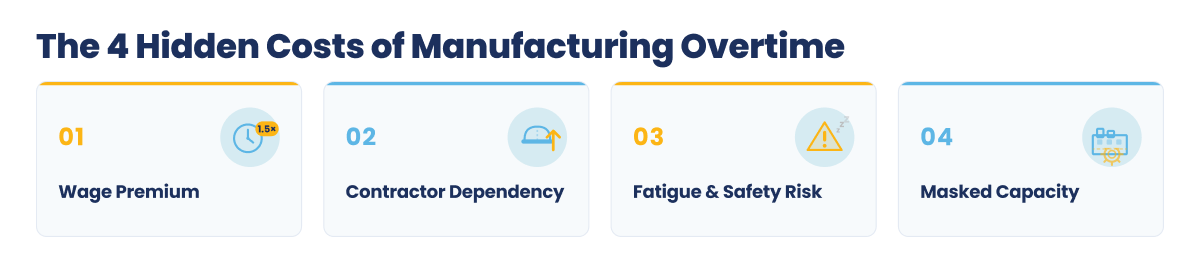
- Wage premium: Most manufacturing overtime is paid at one and a half times the base rate, so every reactive hour costs 50 percent more than the same work done on a planned shift. At an average of 3.2 overtime hours per week, a single production worker logs more than 160 premium-rate hours a year, which adds up to a large, recurring cost across a full plant.
- Contractor dependency: When a plant cannot cover its workload with planned internal hours, it fills the gap with contractors. Regular contractor spending is a reliable signal that overtime and unplanned labor have become structural rather than occasional, and it steadily increases the maintenance budget year after year.
- Fatigue and safety risk: Long and extended shifts degrade performance and raise the chance of error and injury. The NIOSH review of overtime and extended work shifts links long hours to higher rates of illness and injury, so the true cost of overtime includes incident risk, not just payroll.
- Masked capacity: Overtime hides the cost of breakdowns, backlog, and material shortages instead of fixing them. When a plant absorbs every disruption with extra hours, the underlying problems never surface on a report, so leadership keeps paying for symptoms while the root causes stay invisible.
Also, read: 8 Proven Strategies that Reduce Maintenance Costs
11 Ways to Reduce Overtime in Asset-Intensive Operations
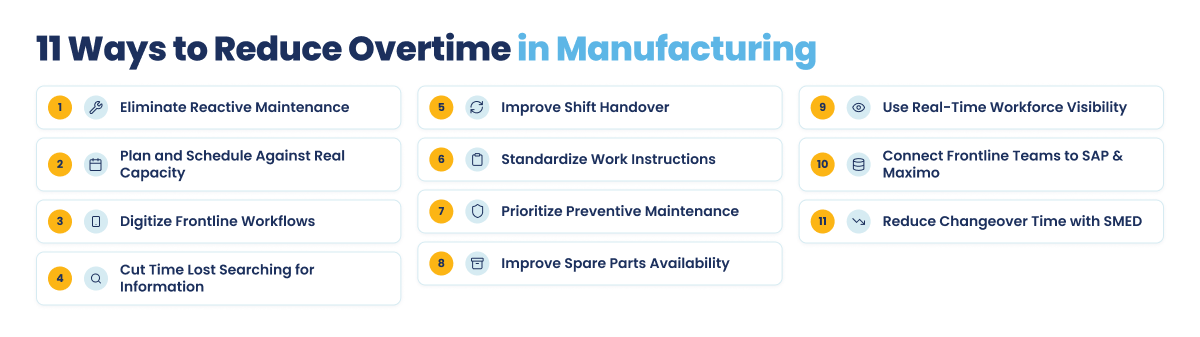
Sustainable overtime reduction comes from connected execution, where planning, parts, procedures, and real-time status all work off the same information. Each one of these eleven strategies removes a root cause of unplanned labor hours by fixing how maintenance and frontline work actually gets executed. That distinction matters because capping hours or rebalancing shifts does nothing about the breakdown, the missing part, or the stale work order that created the overtime in the first place. The goal of these strategies is to convert unplanned, premium-rate work into planned, standard-hours work.
1. Eliminate Reactive Maintenance
Reactive maintenance means repairing an asset only after it fails, and it is the single largest driver of unplanned overtime in asset-intensive plants. Every unexpected failure turns planned, standard-hours work into overnight call-outs and weekend shifts. The fix is to convert failures into predictable, scheduled work using structured methods.
- Root Cause Analysis (RCA), often run as a structured 5-Why analysis, identifies why an asset actually failed rather than just treating the symptom, so the same failure stops recurring.
- Failure Modes and Effects Analysis (FMEA) maps how and why an asset is likely to fail before it does, letting teams intervene during planned windows.
- As recurring failures move into the planned schedule, the emergency hours that inflate overtime steadily disappear.
Also, read: Reliability Centered Maintenance (RCM): Complete Guide
2. Improve Maintenance Planning and Scheduling
Overtime often traces back to an unrealistic schedule, one built on optimistic assumptions instead of proven capacity. When planners schedule more work than the crew can realistically complete, every job that slips pushes into overtime by default.
- Build maintenance planning and scheduling on proven capacity, so the plan only includes work that can be executed with parts, permits, and labor confirmed in advance.
- Watch the maintenance backlog as the leading indicator; a growing backlog warns that reactive work is crowding out planned work and overtime is about to rise.
- Manage backlog deliberately rather than absorbing it with extra hours, which keeps the schedule realistic and prevents last-minute compression.
3. Digitize Frontline Workflows
Paper-based execution is invisible to planners until the shift is already over, and that blind spot is where overtime hides. When technicians work from paper travelers, radio call-outs, and tribal knowledge, delays and rework build up with no real-time signal to the people who could reprioritize.
- A Connected Worker Platform puts work orders, procedures, permits, and asset history on a mobile device at the point of work.
- Technicians stop walking back to a control room for the next instruction, and planners see status as it changes.
- Problems surface while there is still time to act on them within the shift, removing the hidden lag between the field and leadership.
Take a self-guided tour of the Connected Worker Platform and watch work orders, instructions, and data come together at the point of work.
Take Product Tour
4. Reduce Time Lost Searching for Information
A large share of every maintenance shift is lost not to doing work but to finding what is needed to start it. Technicians search for the right work order, procedure, permit, asset history, and specification sheet, often across separate systems or filing cabinets.
- Industry benchmarks for wrench time, the share of a shift spent working on the asset rather than preparing to, commonly sit around 25 to 35 percent, while world-class operations reach 60 to 70 percent.
- Delivering everything a technician needs on a mobile device at the point of work reclaims those lost hours.
- When planned work finishes inside the shift, the overtime that used to cover the overflow stops accruing.
5. Improve Shift Handover Communication
Information lost at shift change creates duplicated and delayed work that becomes overtime on the next shift. When handover happens verbally or through a handwritten log, the incoming crew inherits missing context and rediscovers problems the outgoing shift already understood.
- Structured, digital handover carries full context forward automatically: which job stalled, why, what was already tried, and what still needs a part or a permit.
- Innovapptive's automated shift handover software generates a complete summary of open work, status, and blockers so the next shift starts informed rather than guessing.
- Fewer restarts mean fewer hours spent recovering ground that was already covered.
6. Standardize Work Instructions
Instruction variability drives rework, and rework is one of the most consistent sources of overtime. When two technicians perform the same task differently because the procedure lives in memory or an outdated binder, quality slips and jobs get redone.
- Standard work instructions and digital SOPs solve the surface problem, but the real gain comes from going one layer deeper.
- Interactive, asset-specific digital work instructions on mobile guide the technician through the exact steps for that equipment, with photos and required checks built in.
- Confirming each step as it is completed prevents the errors that force a job to be redone, keeping work inside the planned shift.
7. Prioritize Preventive Maintenance
Shifting the balance from reactive to Preventive Maintenance (PM), executed through mobile maintenance on the plant floor, reduces the emergency work that generates overtime. Predictive Maintenance (PdM) extends the benefit by using condition data to act before failure.
- Track the PM to CM ratio, the proportion of planned preventive work against reactive corrective work.
- As that ratio improves, unplanned failures fall and so do the overtime hours they create.
Read more: How to Improve PM Ratio and CM Ratio: 80/20 Guide
8. Improve Spare Parts Availability
Parts unavailability at the point of work forces a job to stall mid-shift, and a stalled job finishes on overtime or slips to the next shift. The common failure is that planners cannot confirm the right parts are staged and ready, so a technician arrives at the asset only to discover a missing component.
- Combine real-time inventory visibility with kitting and staging, which means gathering and positioning every part a job needs before the work begins.
- When parts are confirmed and staged ahead of the job, work proceeds without interruption and finishes on schedule.
- The problem is rarely total stock; it is knowing, before the shift starts, that this job has what it needs.
9. Use Real-Time Workforce Visibility
Planners without live visibility over-allocate labor hours, and that hedge is a hidden, avoidable cost. When a scheduler cannot see who is available, which jobs are running long, and what is already done, the safe default is to schedule extra hours as a buffer against uncertainty.
- Real-time workforce and job status data, often captured through digital operator rounds, removes the guesswork.
- With live visibility, planners can reallocate work, pull tasks forward, and confirm the plan is on track without adding precautionary overtime.
- Much overtime is not driven by actual demand at all; it is driven by planning around blind spots.
10. Connect Frontline Teams with SAP and Enterprise Systems
The gap between what SAP PM or IBM Maximo shows and what actually happens in the field is itself a major source of overtime. Enterprise systems plan the work, but if the plan reaches the frontline as a printout and results return hours later through manual entry, execution drifts out of sync with the system of record.
- Jobs get delayed, duplicated, or closed late, and the correction runs on overtime.
- An integration manager provides real-time, two-way mobile access that connects frontline teams directly to SAP and Maximo.
- When the system of record and the shop floor share the same live information, delay-driven overtime is largely eliminated.
11. Reduce Changeover Time with SMED
A long changeover is lost production time. When a switchover between runs drags on, the work it displaces gets pushed to the end of the shift and into overtime. Single-Minute Exchange of Die (SMED) shrinks that transition time.
- Prepare everything the changeover needs before the current run ends, so tools, materials, and instructions are staged and ready the moment the line stops.
- Keep the steps in a digital checklist on a mobile device rather than in one operator's memory, so the process is repeatable.
- Real-time coordination between the outgoing and incoming crews keeps the handoff tight, recovering hours that would otherwise be paid back as overtime.
Turn These 11 Maintenance Strategies Into an AI-Powered Maintenance Plan
Get the AI blueprint for building predictive, low-overtime maintenance operations.
Why Connected Frontline Operations Are Key to Sustainable Overtime Reduction
Fixing one root cause without fixing the others just moves the overtime elsewhere. A plant can build a perfect preventive maintenance schedule and still lose the shift to a missing part, a stale work order, or an approval that never came through. Each fix relieves one pressure point, but the hours reappear at the next unaddressed gap, because the causes are connected even when the solutions are not. Sustainable overtime reduction depends on closing every gap at once, on one platform, rather than adding another point tool that solves a single problem and creates new handoffs.
This is where a connected worker platform makes the difference. When SAP integration keeps the field aligned with the system of record, mobile maintenance puts the full job in the technician's hands, digital work instructions standardize execution, and planners and crews work from the same live status, the 11 overtime reduction strategies stop competing and start reinforcing each other:
- A confirmed part shows up because inventory and the work order live in the same flow.
- A clean handover happens because the platform already knows the state of every open job.
- Approvals move faster because they are digital and routed automatically.
Each fix compounds the others, and the unplanned, premium-rate hours that used to absorb every disruption steadily fall.
This connected worker model specially holds up for asset-intensive operations as most frontline execution occurs at remote sites where connectivity is poor, so offline capability matters as much as integration. Further, AI-guided maintenance helps technicians troubleshoot faster and turns field data into recommended actions, resolving problems before they consume a shift. No single capability eliminates overtime on its own. What works is a connected system that fixes planning, parts, procedures, approvals, and visibility together.
Reducing the Insight-to-Execution Gap is the Key to Eliminating Overtime
Underneath all of the overtime reduction strategies is a single problem that it aims to fix: the insight-to-execution gap. Execution gap is the gap between what enterprise systems, sensors, and dashboards already know and what the frontline actually does about it. A predicted failure, a flagged inspection, or a scheduled work order has little value if it sits inside a system while the crew works from paper and memory. Overtime is one of the clearest symptoms of this gap, because insight that does not turn into timely action becomes work done later, at a premium. Closing the insight-to-execution gap is what a connected frontline model does: it carries enterprise insight all the way to the point of work, so the plan becomes completed work inside the shift.
Meet the 15 AI Agents Behind Connected Operations
See how purpose-built AI agents run maintenance, safety, and operations from end to end.
KPIs to Measure Overtime Reduction Success
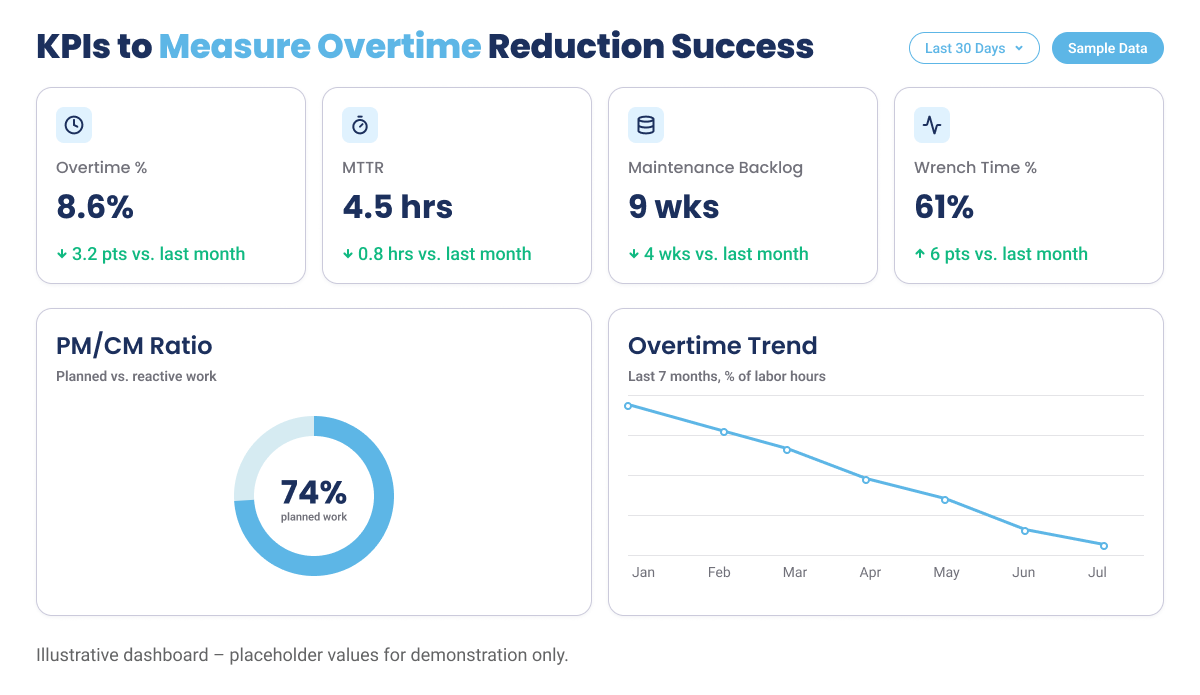
Overtime percentage alone is a lagging indicator. The table below defines the metrics maintenance leaders should track as they help predict overtime in advance:
| KPI | What it measures | Why it correlates with overtime |
|---|---|---|
| Overtime as % of total labor hours | Overtime hours divided by total hours worked in a period. | The direct outcome metric. Useful for tracking results, but it reports the problem after the fact rather than predicting it. |
| PM/CM ratio | The proportion of planned preventive maintenance to reactive corrective maintenance. | A low ratio means reactive work dominates, and reactive work is the leading source of unplanned overtime. |
| Mean Time Between Failures (MTBF) | Average operating time between one failure and the next. | Shorter MTBF means more frequent failures, and more failures mean more emergency hours. |
| Mean Time to Repair (MTTR) | Average time to repair a failed asset and return it to service. | Longer repairs extend downtime and push recovery work into overtime and the next shift. |
| Overall Equipment Effectiveness (OEE) | A composite of availability, performance, and quality for an asset. | Low availability from unplanned downtime is a direct precursor to the shift-extending breakdowns that drive overtime. |
| Maintenance backlog | Outstanding planned work, usually measured in weeks. | A rising backlog signals that reactive work is crowding out planned work, with overtime absorbing the overflow. |
| Wrench time % | The share of a shift spent performing work versus preparing for it. | Low wrench time means hours are lost to searching and waiting, so more jobs slip into overtime to finish. |
| Contractor spend or headcount | The cost or number of external labor used to cover workload. | Chronic contractor reliance is a proxy for structural overtime and unplanned labor demand. |
Tracking the right KPIs only helps if the data behind them is current. Metrics kept in manual spreadsheets are often weeks out of date by the time anyone reviews them, which turns even a leading indicator into a lagging one. Real-time dashboards, fed by connected frontline execution, let a maintenance leader see backlog, PM to CM ratio, and MTTR change as they happen, so the team can act on a warning sign before it becomes a weekend of overtime.
Case Study: How Indorama Ventures Reduced Overtime and Contractor Reliance
Indorama Ventures, a global chemical manufacturer with $15.4 billion in revenue, shows what happens to overtime when a plant fixes execution instead of capping hours. At its Port Neches, Texas site, the company deployed Innovapptive's Connected Worker Platform to connect frontline execution with its existing SAP PM and IBM Maximo systems.
The outcomes line up directly with the causes of overtime described in this guide:
| Result at Port Neches | Outcome |
|---|---|
| Overtime | Reduced by half, from 24% to 12% of labor hours |
| Maintenance backlog | Reduced 58%, from 24 weeks to 10 weeks |
| Contractor headcount | Reduced 38% from 140 headcount to 87 |
| Realized EBITDA savings (2025) | $29 million |
As the Indorama Ventures case study shows, the site did not lower overtime by limiting hours. It lowered overtime by removing the reasons the hours were needed in the first place. A 58 percent cut in maintenance backlog meant far less reactive work spilling into evenings and weekends, and a 38 percent reduction in contractor headcount meant the plant no longer had to buy back capacity it was losing to poor execution. With frontline teams connected to SAP and Maximo in real time, planned work got done as planned, and overtime fell by half as a result.
Indoramma Reduces Maintenance Overtime by 50%
Read the full story behind $29M in maintenance savings and a 58% backlog cut at Port Neches.
How Innovapptive Helps Reduce Overtime Across Asset-Intensive Operations
The results at Indorama came from the Innovapptive Connected Worker Platform, the system that puts the 11 strategies above on one connected foundation instead of a stack of separate tools. Four capabilities do most of the work behind lower overtime:
- WorkSmart AI guides technicians through troubleshooting and turns field data into recommended actions, so reactive problems are resolved before they run into overtime.
- RapidSync Offline Mode keeps work orders, instructions, and asset data available at remote sites and in areas with poor connectivity, so execution never stalls waiting for a signal.
- Smart Analytics tracks the KPIs on live dashboards, so leaders can act on a warning sign before it turns into overtime.
- Collaboration Engine keeps planners and crews on the same live status and carries full context across shift handovers, so jobs do not restart or slip into the next shift.
Recognized for its enterprise AI capabilities, Innovapptive was named a Leader in Frost and Sullivan's 2025 Frost Radar for augmented connected worker platforms, with the analysis highlighting an extensive roster of AI agents spanning maintenance, operations, safety, and reliability. Across oil and gas, chemicals, mining, utilities, and heavy manufacturing, the platform turns fewer breakdowns, faster jobs, and cleaner handovers into steadily fewer overtime hours.
Stop Losing Shifts to Overtime
See how Innovapptive cuts backlog, contractor spend, and maintenance overtime in your operation.
References

Unlock Margins Hidden in your Maintenance
Watch how leading manufacturers improve OEE, increase PM compliance, and reduce downtime through connected execution.

- 05-10-2026
10 Best Shift Handover Software Platforms for Plant and Process Operations
Shift handover software can mean different things depending on the operating environment. Some...

- 29-09-2026
Best SAP Maintenance Planning & Scheduling Software 2026
Your maintenance work orders live in SAP Plant Maintenance (PM), while the working schedule lives...
- 28-09-2026
Best Work Order Software: Top 9 Platforms Compared
Selecting the best work order software is a different decision for a large industrial plant than...