
The 10 Best Shift Handover Software Platforms
The ten platforms below take four broad approaches.
- Enterprise process platforms built for continuous operations, with a link into the plant historian and the maintenance system.
- Maintenance-led tools that keep the handover inside the work order stream.
- EHS-led tools, treating the handover mainly as a safety and risk record.
- Digital logbooks that modernize the paper book for a single site.
The right fit depends on how your plant operates and which system of record it runs on, so each entry explains where a platform is strongest and where another approach may suit you better.
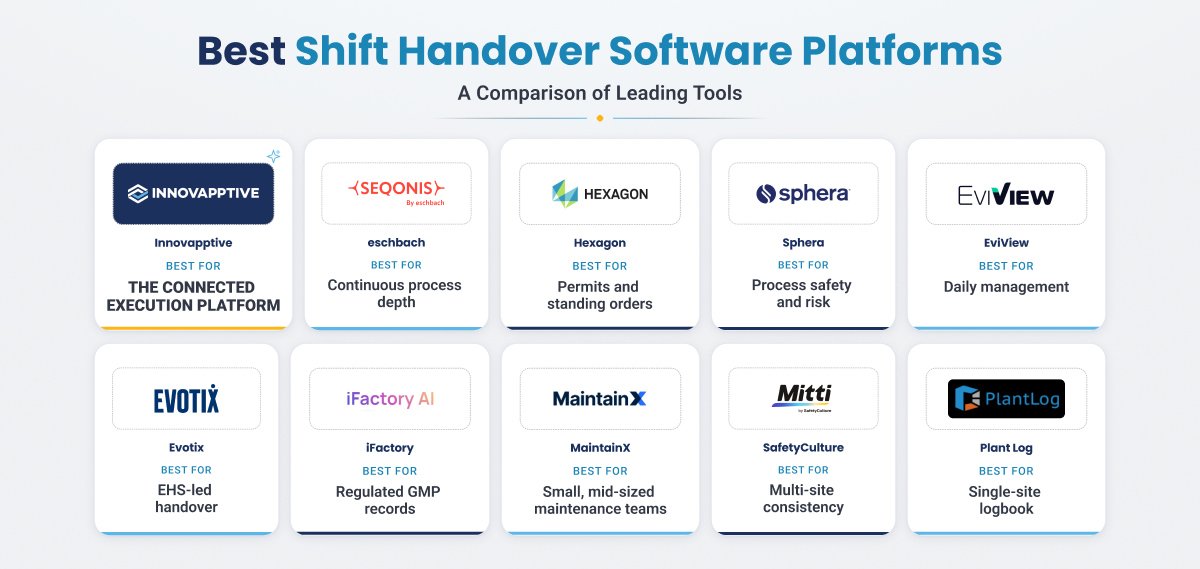
Shift handover software at a glance
The table below gives a quick overview on where each platform fits before the detailed entries. It compares the broad selectors most teams screen on first: who the platform is built for, how it deploys, offline sync capability, and how deep its compliance support runs.
|
Platform |
Best fit |
Deployment |
ERP/EAM write-back |
Offline capture |
Compliance |
|
Innovapptive |
Enterprise, asset-heavy plants on SAP, Maximo, or Oracle |
Enterprise |
Yes |
Yes |
High: PSM and audit-ready records |
|
eschbach Seqonis |
Continuous process |
Enterprise |
Partial |
Partial |
GMP, Part 11 |
|
Hexagon j5 |
Refineries and utilities with permits and standing orders |
Enterprise |
Partial |
Partial |
PSM, permits |
|
Sphera |
Process-safety-led plants |
Enterprise |
Partial |
Partial |
PSM-led |
|
EviView |
Manufacturing and pharma running daily management |
Mid to enterprise |
Partial |
Partial |
GMP-capable |
|
Evotix |
EHS-led handover tied to isolations and permits |
Mid to enterprise |
Partial |
Partial |
EHS, incident |
|
iFactory |
GMP and regulated plants |
Mid to enterprise |
Partial |
Partial |
Part 11, ALCOA+ |
|
MaintainX |
Maintenance-led teams |
Mid-market |
Partial |
Yes |
Audit log |
|
Mitti (formerly SafetyCulture) |
Standardized, checklist-driven handover across sites |
Mid-market |
No |
Yes |
Checklist trail |
|
Plant Log |
Single sites replacing a paper logbook |
Single site |
No |
Limited |
Basic trail |
1. Innovapptive: Shift handover connected to SAP, Maximo, and Oracle execution
Innovapptive Shift Handover Software takes a connected execution approach to shift handover. The platform sits on top of SAP S/4HANA, SAP Plant Maintenance, IBM Maximo, or Oracle EAM, so the handover can stay connected to the system already used to manage enterprise maintenance. The shift record can be built from readings and operator rounds captured during the shift, while unresolved issues and out-of-range conditions are carried forward as exceptions becoming work orders in the system the plant already runs. Beyond the maintenance system, it also connects with plant-floor systems and historians, including OSI PI and IP21, bringing process and equipment data into the same connected workflow.
The broader platform architecture has also received independent recognition. Frost & Sullivan named Innovapptive a Leader in the 2025 Frost Radar for Augmented Connected Worker Platforms, highlighting its enterprise-grade integrations and end-to-end platform capabilities. In 2026, Innovapptive was named Company of the Year for Global Connected Worker Platforms by Frost & Sullivan with the recognition covering its end-to-end execution and enterprise connectivity.
|
What stands out
|
Limitations and considerations
|
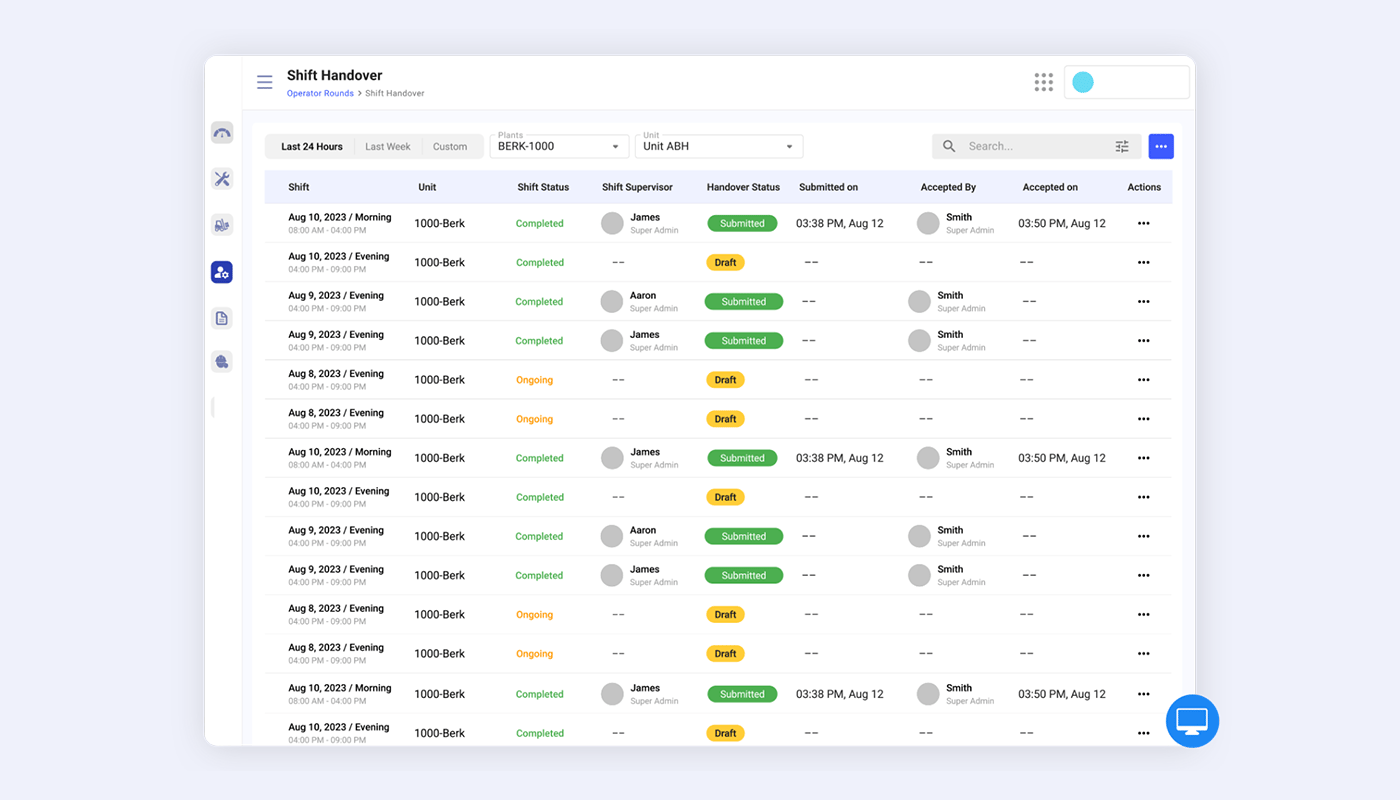
Best fit for: Enterprise, asset-heavy plants on SAP, Maximo, or Oracle that want carried-over exceptions to become tracked work.
Consider another approach when: You run a single site and need a light digital logbook without enterprise integration.
2. eschbach Seqonis: Continuous process and chemicals with historian depth
eschbach Seqonis, formerly Shiftconnector, is an enterprise process platform for continuous operations in chemicals and pharma. Its focus is bringing live plant context into the handover, so the incoming control room sees real readings and trends rather than a summary. It is built for regulated, around-the-clock plants where process continuity is the main concern.
|
What stands out
|
Limitations and considerations
|
Best fit for: Continuous process and chemical plants that want the handover tied to live process data.
Consider another approach when: Your first requirement is maintenance work order write back rather than process context.
3. Hexagon j5: Refineries and utilities carrying permits and standing orders
Hexagon j5 Shift Handover is part of Hexagon's shift operations management offering and is designed for environments where a handover carries live operating state as well as instructions that remain active across the shift boundary. Its approach is particularly relevant when permits, standing orders, and operating instructions need to remain visible to the incoming crew.
|
What stands out
|
Limitations and considerations
|
Best fit for: Refineries and utilities that carry permits and standing orders through the handover.
Consider another approach when: You need a lightweight logbook for one site.
4. Sphera: process-safety-led operations under OSHA PSM
Sphera approaches shift handover from a process safety and operational risk perspective. Its operations logbook and shift handover capability sits within a broader control-of-work and process-safety environment, making it relevant for plants where safety-critical information, permits, and operating records need to remain connected.
|
What stands out
|
Limitations and considerations
|
Best fit for: Process-safety-led plants that want the handover tied to risk and PSM.
Consider another approach when: Your priority is turning handover exceptions into maintenance work.
5. EviView: manufacturing and pharma running daily management with downtime analytics
EviView combines shift handover with daily management and operational performance visibility. That can make it useful for manufacturing and pharmaceutical environments where teams want the shift record to connect with downtime tracking, team huddles, and production performance discussions.
|
What stands out
|
Limitations and considerations
|
Best fit for: Manufacturing and pharma sites that want handover tied to daily management and downtime.
Consider another approach when: Your first requirement is exception write-back into SAP or Maximo.
6. Evotix: EHS-led handover tied to isolations, permits, and incidents
Evotix is an EHS platform, and it approaches the handover through health, safety, and environment. The handover connects to isolations, permits to work, and incident records rather than to a maintenance backlog. For sites where the handover's main job is carrying safety-critical status and open risk items to the next crew, this works. Buyers who need the handover to drive maintenance execution should weigh that against its safety focus.
|
What stands out
|
Limitations and considerations
|
Best fit for: Safety-driven plants that want the handover linked to isolations, permits, and incidents.
Consider another approach when: You need the handover to create maintenance work in an EAM.
7. iFactory: GMP plants that need signed, immutable handover records
iFactory's shift logbook is designed for regulated manufacturing environments where electronic records, signatures, timestamps, and data integrity are central requirements. This makes it relevant to pharmaceutical and other GMP environments where the handover record needs to stand up to review as part of the site's controlled operating process.
|
What stands out
|
Limitations and considerations
|
Best fit for: GMP and regulated plants that need attributable, immutable handover records.
Consider another approach when: You want a fast, flexible logbook without validation overhead.
8. MaintainX: Mid-sized maintenance-led teams that want handover in the work order stream
MaintainX is a mobile-first CMMS with shift handover use cases that fit teams whose primary concern is maintenance status, open work orders, and the work the next crew needs to pick up. Keeping those activities in the same maintenance environment can reduce the need to move between systems. Its emphasis is maintenance rather than deep process-historian depth.
|
What stands out
|
Limitations and considerations
|
Best fit for: Maintenance-led teams that want handover inside the CMMS they already use.
Consider another approach when: You need historian depth or exception write-back into an enterprise EAM.
9. Mitti (by SafetyCulture): Standardized, checklist-driven handover across many sites
Mitti, by SafetyCulture, takes a checklist and inspection-led approach to operational handover. Its strength is standardization: teams can use structured templates and consistent sign-off across sites and crews, making it useful when the primary objective is to replace inconsistent paper processes with a repeatable digital workflow.
|
What stands out
|
Limitations and considerations
|
Best fit for: Multi-site operations that want consistent, checklist-driven handover.
Consider another approach when: A single continuous process plant needs historian links and maintenance write-back.
10. Plant Log: Single sites replacing a paper logbook
Plant Log is a focused digital logbook for sites that want a straightforward way to replace handwritten shift records. Its value is primarily in making entries legible, searchable, and easier to retain than a paper record, without requiring the broader scope of an enterprise operations platform.
|
What stands out
|
Limitations and considerations
|
Best fit for: Single sites that want a clean digital logbook fast.
Consider another approach when: You need integration, write-back, or process depth across multiple sites.
Detailed Shift Handover Software Comparison:
The capability matrix below goes a level deeper, comparing each platform across the seven capabilities that separate a connected handover from a digital notepad.
| Platform | Primary category | Structured template | Acknowledgment | Carried-over tracking | ERP/EAM write-back | Historian or production link | Offline capture | Audit trail |
|---|---|---|---|---|---|---|---|---|
| Innovapptive | Connected worker | Yes | Yes | Yes | Yes | Yes | Yes | Yes |
| eschbach Seqonis | Enterprise process | Yes | Yes | Yes | Partial | Yes | Partial | Yes |
| Hexagon j5 | Enterprise process | Yes | Yes | Yes | Partial | Yes | Partial | Yes |
| Sphera | Process safety | Yes | Yes | Yes | Partial | Partial | Partial | Yes |
| EviView | Daily management | Yes | Yes | Yes | Partial | Partial | Partial | Yes |
| Evotix | EHS | Yes | Yes | Yes | Partial | No | Partial | Yes |
| iFactory | GMP manufacturing | Yes | Yes | Yes | Partial | Partial | Partial | Yes |
| MaintainX | CMMS | Yes | Yes | Partial | Partial | No | Yes | Yes |
| Mitti (by SafetyCulture) | Inspection, operations | Yes | Yes | Partial | No | No | Yes | Yes |
| Plant Log | Digital logbook | Partial | Partial | Partial | No | No | Partial | Partial |
See How A Connected Shift Handover Works End to End
Get the shift handover solution brief for a clear view of how capture, acknowledgment, and exception write-back fit together on the plant floor.
How We Evaluated These Shift Handover Platforms
The capability matrix above rates each platform on eight attributes. Here is what each one means.
- Primary category: The platform's core design focus, such as connected worker, enterprise process, process safety, EHS, CMMS, or digital logbook.
- Structured template: Whether the platform captures the same defined fields every shift rather than relying on free text.
- Acknowledgement: Whether the incoming technician formally confirms receipt of the handover with an identity and a timestamp.
- Carried-over tracking: Whether unresolved issues stay visible across shifts until they are closed.
- ERP or EAM write-back: Whether an exception can post back into SAP, Maximo, or Oracle as tracked work order.
- Historian or production link: Whether the handover can draw on live process and production data.
- Offline capture: Whether the full handover can be recorded offline and synced when the device reconnects.
- Audit trail: Whether the platform keeps a complete, timestamped, attributable record.
Benefits of Shift Handover Software
The value of digital shift handover is not the log itself. It is the continuity it creates between one crew and the next. In asset-heavy plants, that continuity can help teams act on issues sooner and reduce the amount of operational context that has to be reconstructed at every shift change.
1. Preserve critical context across shifts
A structured shift record keeps readings, incidents, open issues, actions, and unit status together. The incoming crew can start with the current operating picture instead of piecing it together from verbal updates, paper notes, and separate systems.
2. Carried-over issue visibility
An unresolved condition can remain open across multiple shifts. A digital handover gives those items a persistent place in the workflow, making it easier for the next crew to see what remains outstanding and what requires follow-up.
3. Connects insight with action
A handover becomes more useful when an exception can move into the process that owns the work. Where integration is available, a maintenance issue can become a tracked notification or work order rather than remaining only as a line in the shift log.
4. Reduce manual handover effort
When the log builds from readings and mobile capture during the shift, crews spend less time writing up notes at the end of it. The handover meeting becomes a review of exceptions rather than a rebuild of the whole shift from memory.
5. Strengthen traceability and audit readiness
Digital handovers retain timestamps, acknowledgments, supporting evidence, and a searchable history. That provides clearer traceability for operational review, audits, and incident follow-up. For regulated plants, that trail is often a compliance requirement rather than a convenience.
Key Features to Look for in Shift Handover Software
The right platform should do more than digitize the logbook. The question that separates the options is what happens to the information after it is captured: does it stay a note, or does it become visible, tracked, and connected to the systems that act on it? Seven capabilities decide that.
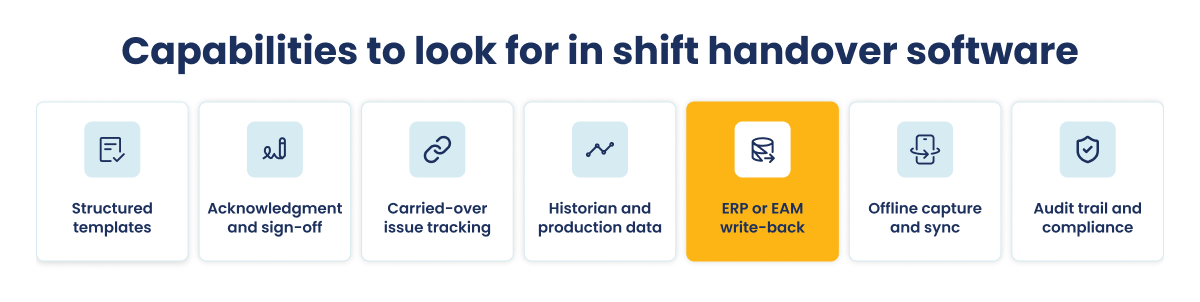
- Structured handover templates: A defined template helps crews capture the same operational information every shift, including readings, open issues, permits, actions, and carry-over items. This improves consistency and makes handovers easier to review.
- Acknowledgment and sign-off: The incoming supervisor or operator should be able to confirm receipt of the handover with a clear identity and timestamp. The objective is a recorded transfer of responsibility, not simply the delivery of a report.
- Persistent carried-over issue tracking: Issues that remain unresolved should stay visible beyond a single shift. Look for a carried-over register or similar workflow that keeps an exception open until it is addressed or formally closed.
- Process historian and production-data integration: For continuous operations, historian and production data can add important operating context. Rather than relying on manually entered summaries, teams can use actual readings and trends as part of the handover record.
- ERP or EAM integration and work-order write-back: Integration should be assessed in both directions. This is the capability that separates a record from an action. Most platforms can read data in; fewer can write an exception back out as a tracked work order in SAP, Maximo, or Oracle. Read-in keeps the handover informed; write-back is what turns a carried-over exception into work the maintenance system owns and schedules.
- Offline mobile capture and sync: Plant connectivity can vary by area, site, and device environment. Offline support allows operators to capture information without an active connection and synchronize it when connectivity returns.
- Audit trail, reporting, and compliance support: A complete, attributable, timestamped record supports OSHA process safety duties and, in regulated plants, data-integrity standards such as electronic signature under 21 CFR Part 11. Confirm the record meets the standard your plant is held to.
The Hidden Cost of a Handover That Lives on Paper
Discover how automated shift handovers improve safety and efficiency in continuous operations, and what it takes to get there.
How to Choose Shift Handover Software for Your Plant
The same shift handover process does not look identical across every plant. The right capabilities depend on what information must cross the shift boundary, which system owns the follow-up work, and what conditions the frontline team works in. Use the operating profile below to narrow the capabilities that matter most.
Continuous process operations
In a continuous plant, the handover carries live process state, open permits, and isolations, not just job status. The deciding capability is historian and production-data integration as it helps the incoming crew understand what happened during the previous shift. Platforms built specifically for this include Hexagon j5, eschbach Seqonis, and Sphera. If the plant also runs SAP or Maximo and wants carried-over exceptions to become tracked work, Innovapptive belongs on the same shortlist, weighted on integration and execution alongside process depth. The main trade-off across all of them is implementation length, which is measured in months.
Regulated operations under GMP or Part 11
In a regulated plant, the record itself is the deliverable, and it has to be attributable, timestamped, and immutable. The deciding capabilities are electronic signature and data integrity under ALCOA+ (attributable, legible, contemporaneous, original, and accurate, extended by complete, consistent, enduring, and available). iFactory, eschbach Seqonis, and Sphera all fit here. Where the handover also needs to create tracked maintenance work in an enterprise system, Innovapptive is worth weighing alongside them. The trade-off is between configurability and validation burden: the more you can change, the more you have to validate.
Maintenance-led operations on SAP, Maximo, or Oracle
When maintenance drives the plant, the handover pays off if a carried-over exception becomes a tracked work order in the system of record. The deciding capabilities are write-back depth and offline capture. Innovapptive keeps the handover close to the work order for asset-heavy sites on SAP, Maximo, or Oracle, while MaintainX is lighter and faster to roll out for smaller, maintenance-led teams. Match the platform to the system of record you already run.
Single-site operations digitizing a paper log
Some sites have a narrower objective: replace the paper logbook with a clear, searchable digital record. In that case, a focused digital logbook or checklist platform may be sufficient. The key is to match the software scope to the site's operational needs rather than adopting integration depth that the site will not use. A digital logbook such as Plant Log or Mitti are well tuned for single sites.
The most common and most expensive mistake plants can make is focusing on good to have features while neglecting the must-have features. One practical filter is connectivity. If operators work in low-connectivity areas or zones where network availability is inconsistent, confirm offline capture before evaluating less critical differences. From there, assess integration and compliance requirements based on the plant's actual operating model.
Turn Frontline Insight Into Measurable Output
See how industrial AI and connected execution close the gap between what the plant knows and what the plant does
How Innovapptive Helps Connect Shift Handover to Frontline Execution
Innovapptive concentrates on the step most platforms leave open: turning a handover exception into tracked work in the system the plant already runs. The goal is not to create another system of record, but to connect frontline capture and handover with the enterprise platforms already used by the plant. The flow is straightforward:
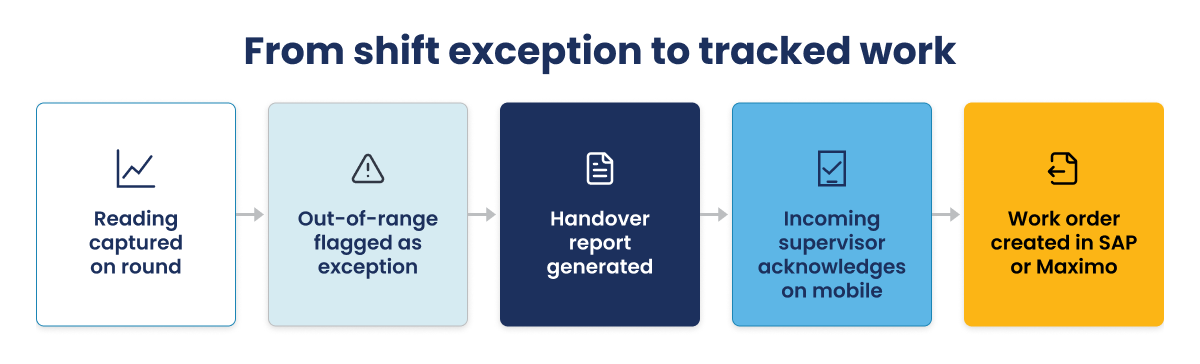
- Capture during the shift: Operators leverage operator rounds software to record rounds, readings, issues, actions, and supporting information on mobile, online or offline.
- Build the shift record: Captured data feeds the configured shift log so the handover reflects the work and conditions observed during the shift.
- Surface exceptions: Out-of-range readings and unresolved issues are flagged and carried forward for the next crew.
- Acknowledge the handover: The incoming supervisor or operator can review and acknowledge the handover on mobile with an identity and timestamp.
- Connect exceptions to enterprise work: Open exceptions posts to SAP or Maximo as tracked notifications or work orders.
- Synchronize offline activity: Mobile capture can continue offline, with RapidSync synchronizing information when connectivity is restored.
- Connect shift information with the wider plant: Through Integration Manager, the platform connects with enterprise and plant-floor systems, allowing the handover to work with operational data beyond the shift log itself.
Innovapptive is not a standalone logbook, and it does not replace your EAM. It is an execution layer on top of SAP, Maximo, or Oracle, which is why a carried-over exception ends up as tracked work in the system you already run. This is the distinction that matters for asset-heavy operations.
Customer result: Indorama Ventures
At its Port Neches, Texas site, Indorama Ventures connected shift handover with operator rounds, maintenance, and inventory on the Innovapptive Connected Worker Platform. The customer reported the following results as part of its broader program:
|
Metric |
Before |
After |
|---|---|---|
|
Maintenance backlog |
24 weeks |
10 weeks |
|
Overtime |
24% |
12% |
|
Contractors on site |
140 |
87 |
|
45% |
80% |
|
|
Parts availability |
55% |
95% |
|
89.5% |
99.5% |
What the numbers show is the pattern Innovapptive is built around: when shift handover is connected to the enterprise system, a problem noticed on one shift becomes tracked work the next crew can act on, rather than a note that fades. For asset-heavy plants already running SAP, Maximo, or Oracle, that connection is where a digital handover starts to pay back.
How Indorama Ventures Connected Shift Handover to Execution
Discover how one site connected operator rounds, maintenance, and inventory, and what changed as a result.
Turning Shift Handover Into Action
The best shift handover platform is the one that matches how your plant runs: its operating model, its system of record, and how connected its floor needs to be. For a single site, a clean digital logbook may be enough. For asset-heavy, multi-site operations on SAP, Maximo, or Oracle, the bigger gain comes from connecting the handover to the systems that act on it, so a carried-over exception becomes tracked work rather than a note. Decide what has to happen to an exception after someone notices it, and let that answer shape the shortlist.
See An Open Exception Become A Tracked Work Order
Bring a real handover scenario and we will show you how it moves from operator round to tracked work, on your systems of record.

Unlock Margins Hidden in your Maintenance
Watch how leading manufacturers improve OEE, increase PM compliance, and reduce downtime through connected execution.

- 23-10-2026
Maintenance Planning and Scheduling: The Ultimate Guide
A mechanical crew reaches a boiler feed water pump at 7 a.m. to change a bearing, then waits three...
- 21-10-2026
10 Best Work Instructions Software: Compared and Reviewed
Choosing work instructions software is about more than turning a PDF into guided steps on a tablet....

- 15-10-2026
Maintenance Digitalization: A Digital Transformation Guide
Maintenance digitalization is the shift from paper, spreadsheets and disconnected tools to...