
What Is Unplanned Maintenance?
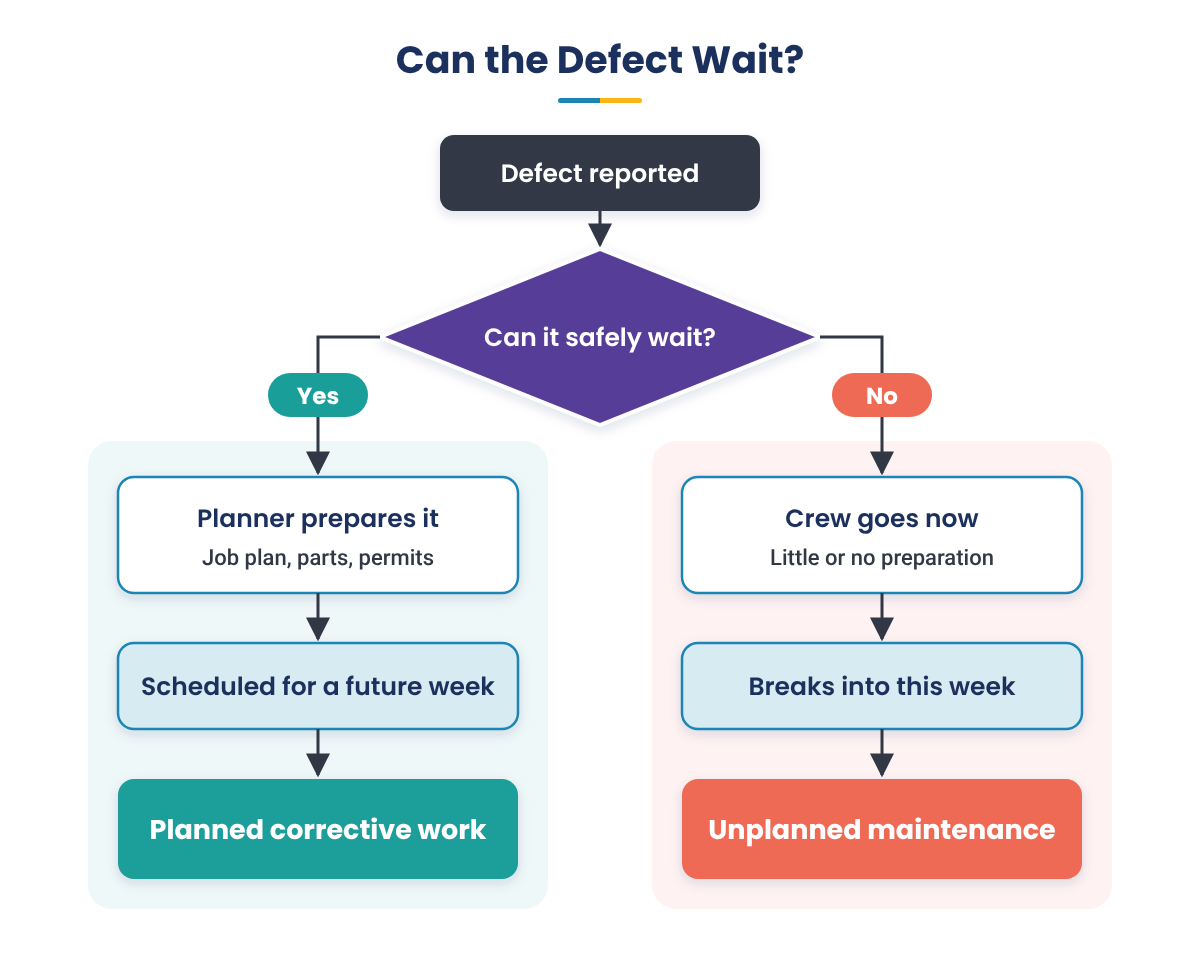
Unplanned maintenance is repair or corrective work triggered by a failure or defect that cannot wait for a job plan, parts or permits. It starts before normal preparation and interrupts work already scheduled for the week.
In simple terms, the asset may have stopped or may still be operating with an urgent defect, and the team needs to act on it right away. The International Electrotechnical Vocabulary (IEC 60050-192) lists unplanned maintenance and unscheduled maintenance as the same term and defines it as corrective maintenance that cannot be deferred.
However, a defect does not automatically make a repair unplanned. Unplanned maintenance does not include:
- If the defect can safely wait, it goes to a planner, gets a job plan, parts and permits, and joins a future weekly schedule as planned corrective work. The IEC vocabulary calls this deferred maintenance.
- Planned work that runs long is still planned. An overrun is a planning accuracy problem.
- A deliberate run-to-failure decision. Choosing to let a low-risk asset fail is a planned strategy. When the spare, job plan and isolation steps are prepared in advance, the repair it leads to is planned work as well.
Plants also call this work reactive, break-in or emergency work. These terms overlap but are not identical, and describe different aspects of the response.
3 Types of Unplanned Maintenance, With Examples
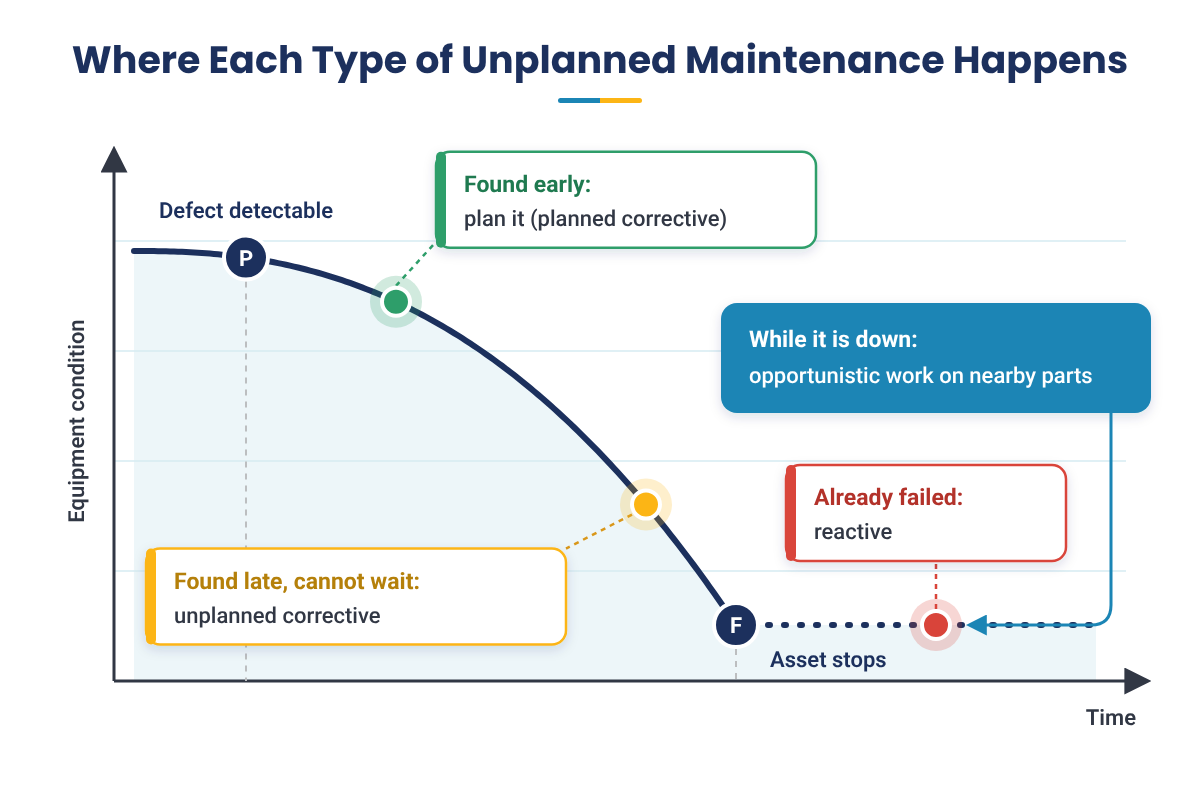
Unplanned maintenance can be categorized into three types based on the trigger: reactive maintenance after a failure, unplanned corrective maintenance on a defect that cannot wait, and opportunistic work during an unplanned stop. Emergency maintenance is not a fourth type. It is the most urgent level of the first two, used when safety, the environment or a major production loss are at risk.
1. Reactive Maintenance After a Breakdown
Reactive maintenance is repair work done after an asset stops performing its function, so the work starts from a failure instead of a warning.
Typical triggers: A trip, a stopped line or a leak that forces a shutdown.
Example: At a refinery, charge pump P-201A loses its mechanical seal during the night shift. Operations moves the duty to the installed spare, P-201B, and a call-out crew isolates the failed pump.
This is the most expensive way to find a failure. The job starts with no plan, no staged parts and no agreed window, and P-201B now runs with no backup. Once an asset has fully stopped, the work is also called breakdown maintenance.
2. Unplanned Corrective Maintenance
Unplanned corrective maintenance fixes a defect on an asset that is still running but cannot safely wait for a job plan. This is because waiting would risk a failure, a safety event or off-spec product.
Typical triggers: A reading outside its limits, an operator report or a quality deviation.
Example: A lab sample at a chemical plant shows product contamination. The source is a leaking tube in a heat exchanger, and the exchanger has to come out of service this shift.
Had the same tube leak been found weeks earlier, the repair could have been planned for a set window. That is why routine inspections in a preventive maintenance program matter: they find defects like this one while there is still time to plan the repair.
3. Opportunistic Maintenance
Opportunistic maintenance is extra work done on an asset, or on the equipment around it, while it is already down for an unplanned repair. The stop has already cost production time, so the crew uses the access instead of wasting it.
Typical triggers: A breakdown, trip or unplanned shutdown that has already isolated the asset, giving the crew safe access to nearby components with open work orders.
Example: A mining crew replaces a seized idler on an overland conveyor. While the belt is stopped and isolated, they also replace worn pulley lagging that was in the backlog for next month.
This only pays off when the open work orders for that asset are ready, with parts already in stores. Plants that keep a ready backlog, meaning jobs that are already planned and kitted, for each critical asset get the most from opportunistic maintenance.
How Unplanned, Breakdown, Emergency and Corrective Maintenance Relate
Unplanned maintenance is not the same as breakdown maintenance. Breakdown maintenance is the part of unplanned work that starts after an asset has fully stopped. Unplanned work also covers urgent fixes on running assets and opportunistic work during a stop.
| Term | What it means | How it relates to unplanned maintenance |
|---|---|---|
| Reactive maintenance | Work done in response to a failure or problem | The most common everyday name for unplanned work, and its largest type |
| Breakdown maintenance | Repair after an asset has fully stopped | A subset of unplanned work that does not cover urgent fixes on running assets |
| Emergency maintenance | Work that must start immediately because of a safety, environmental or major production risk | The most urgent level of unplanned work, not a separate type |
| Corrective maintenance | Any work that restores function after a fault is found (IEC 60050-192) | Unplanned when it cannot wait; planned when it is deferred and prepared first |
| Break-in work | Work added to the weekly schedule after the schedule has been locked | The scheduler's name for unplanned work, counted against scheduled hours |
| Unscheduled maintenance | A synonym of unplanned maintenance in the IEC vocabulary | In many planning teams it means planned work with no date yet (explained below) |
| Run-to-failure | A deliberate decision to let a low-consequence asset fail | A planned strategy; its repairs count as planned work when the response is prepared in advance |
CMMS and ERP systems like SAP PM and IBM Maximo do not use these words. They label the same work with priority codes and work types, which is why the coding rules further down matter.
Build a Maintenance Program That Plans More and Reacts Less
Download The Future of Maintenance: An Effective AI Blueprint for a practical view of how AI can help maintenance teams move more of their work from reactive to planned.
Unplanned Maintenance Examples From Industrial Plants
The seven unplanned maintenance examples below come from process and heavy industry. Each one shows how the problem was found and what planned work it pushed aside.
Illustrative examples
| Industry | What happened | Type | How it was found | Safety or production impact | What it displaced |
|---|---|---|---|---|---|
| Refining | Charge pump mechanical seal leaks | Reactive | Gas detector alarm and operator rounds | Hydrocarbon release, so it is handled at emergency priority; spare pump runs with no backup | A night call-out and the next day's planned jobs |
| Chemicals | A leaking heat exchanger tube contaminates product | Unplanned corrective | Lab sample out of specification | Off-spec product held for testing; exchanger out of service | A planned exchanger cleaning |
| Mining | An overland conveyor idler seizes and the belt tracks off | Reactive | Belt sway switch trip | Six-hour stop on ore haulage | Two planned PMs on the same conveyor |
| Power generation | Boiler feed pump vibration jumps above alarm | Unplanned corrective | Vibration alarm in the control room | Unit runs at reduced load until repaired | The week's planned work on the cooling water system |
| Metals | A hydraulic hose bursts on a rolling mill | Reactive | Operator sees the spray | Fire and injection injury risk, so it is handled at emergency priority | The mill's production plan for the shift and a planned roll change |
| Food and beverage | Ammonia refrigeration compressor trips on high discharge temperature | Reactive | Alarm and temperature log | Product temperature risk in cold storage | An afternoon of planned work |
| Water and wastewater | A lift station pump fails during a storm | Reactive | SCADA high-level alarm | Overflow risk until the pump is back | The crew's planned valve exercising route |
In most plants, the daily maintenance report captures the repair itself. The displaced work in the last column rarely gets tracked, yet that is where much of the cost lands: in overtime, in late PMs and in a weekly schedule the crew can no longer complete.
How One Breakdown Ripples Through a Week of Planned Work
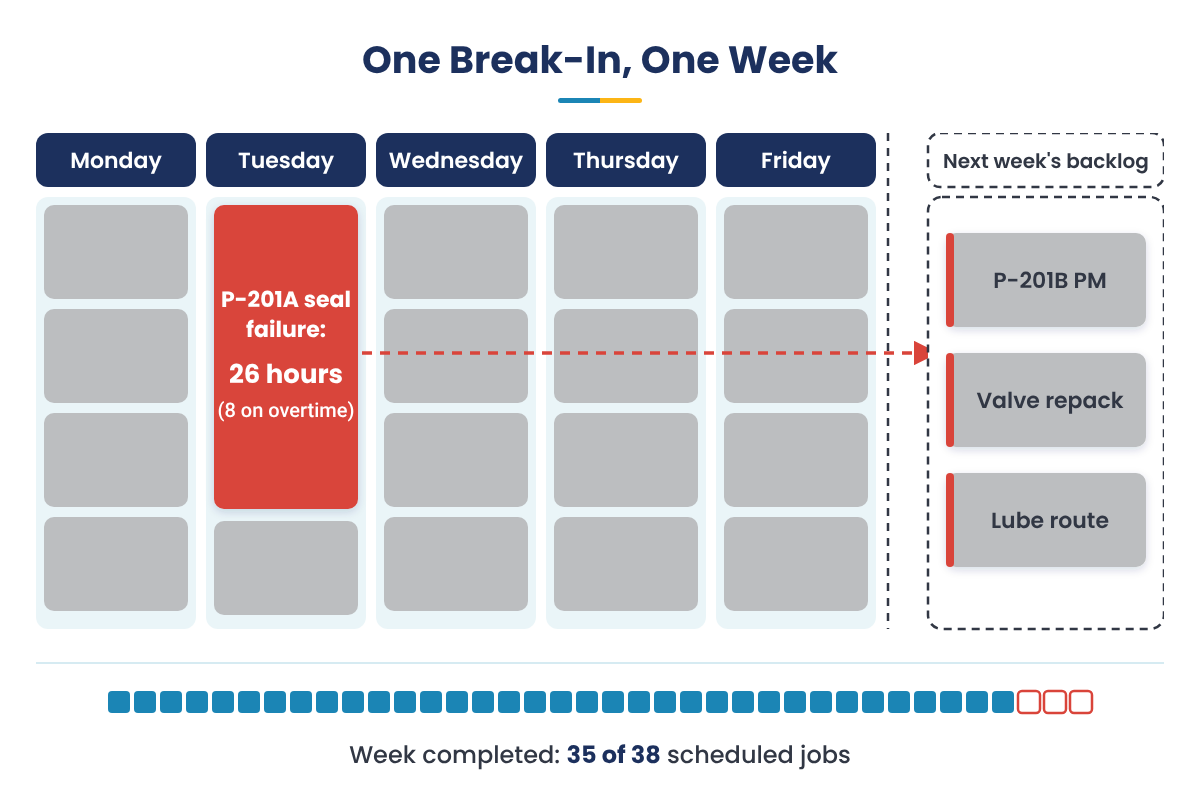
A single breakdown rarely costs only its own repair hours, because the technicians who fix it were already booked for other jobs. The illustrative example below follows the P-201A seal failure through one week, starting with these assumptions.
| Assumption | Value |
|---|---|
| Crew size | 10 technicians |
| Regular shift hours available (no overtime) | 400 hours |
| Locked weekly schedule | 400 hours across 38 jobs |
| Failure | P-201A seal failure on Tuesday night |
| Backup | Installed spare P-201B takes the duty |
| Item | Hours or count | Where it lands |
|---|---|---|
| Night call-out to isolate and make the pump safe | 8 overtime hours | Overtime budget |
| Seal replacement on day shift, including the wait for an expedited seal kit | 18 regular shift hours | Taken from the locked schedule |
| Planned jobs displaced: P-201B vibration route and PM, a control valve repack, a lube route | 3 jobs, 18 hours | Moved to next week's backlog |
| Expedited seal kit | 1 rush order | Parts premium |
- The week closes with 35 of 38 scheduled jobs done. P-201B is now the only running pump, and its own PM is a week late.
- If unplanned work takes 20% of the crew's time, about 80 of the 400 weekly hours behave like this every week.
Displaced jobs do not disappear. They join the maintenance backlog, where they compete with next week's planned work and, in many plants, push the next round of PMs past their due dates.
Planned vs Unplanned Maintenance: Key Differences
The difference between planned and unplanned maintenance is whether a job plan existed before the work started. Planned work is prepared first and then placed on the schedule. Unplanned work starts from the failure and gets organized along the way.
| Dimension | Planned maintenance | Unplanned maintenance |
|---|---|---|
| Trigger | A calendar interval, meter reading, condition limit or approved backlog job | A failure, or a defect that cannot wait |
| Job plan | Scope, steps and labor estimate prepared before work starts | Scope worked out at the asset |
| Parts and tools | Reserved or kitted (gathered and staged for the job) before release | Found, borrowed or rush-ordered during the job |
| Permits and isolation | Identified in the job plan and arranged in advance | Arranged under time pressure |
| Timing | Placed on the weekly schedule, often in a low-impact window agreed with operations | Interrupts the schedule, often off-shift |
| Labor | Regular shift hours, with crews sequenced in advance | Call-outs, overtime and contractor backfill |
| Production impact | A planned window | A stop or reduced rate whenever the failure happens |
| Record quality | Hours and parts confirmed against the plan | Malfunction times and failure codes often missing; Innovapptive diagnostics commonly find a malfunction start time on only about a quarter of notifications |
Plants track the split between the two as planned maintenance percentage, which has its own formula and industry targets.
How to Tell Planned From Unplanned Work in Your Work Orders
Sort every job with two questions asked before it starts: did a job plan exist, and was the job on the locked weekly schedule?
- Work that started without a job plan is unplanned, however small the job.
- Work that entered the weekly schedule after it was locked is break-in work. Give every break-in a reason code so you can see what keeps causing them.
- Corrective work that was deferred, planned and then scheduled is planned work, even though a defect started it.
- A defect found during a PM and fixed on the spot is opportunistic work. The same defect written up and planned for later is planned corrective work.
- A repair on an asset you chose to run to failure is planned work when its job plan, spare and isolation steps were prepared in advance. Tag it as run-to-failure so it stays visible in reliability reviews. If nothing was prepared, count the repair as unplanned.
In SAP PM, a malfunction report notification with the breakdown indicator set and a high priority usually marks unplanned work. Maximo teams often use an emergency work type. Neither field tells you whether a job plan existed, so add a simple two-question flag when the notification or order is created.
Many plants report against the 80/20 rule, which counts all corrective work together. A separate break-in flag on the work order shows how much of that corrective work actually disrupted the weekly schedule.
How Much of Your Week Goes to Break-In Work?
A Margin Walkthrough is a no-cost, on-site diagnostic. Our team reads your own SAP or Maximo work orders to show how much planned work gets displaced each week and where it shows up in overtime, contractor spend and rush parts.
Unplanned vs Unscheduled Maintenance: Are They the Same?
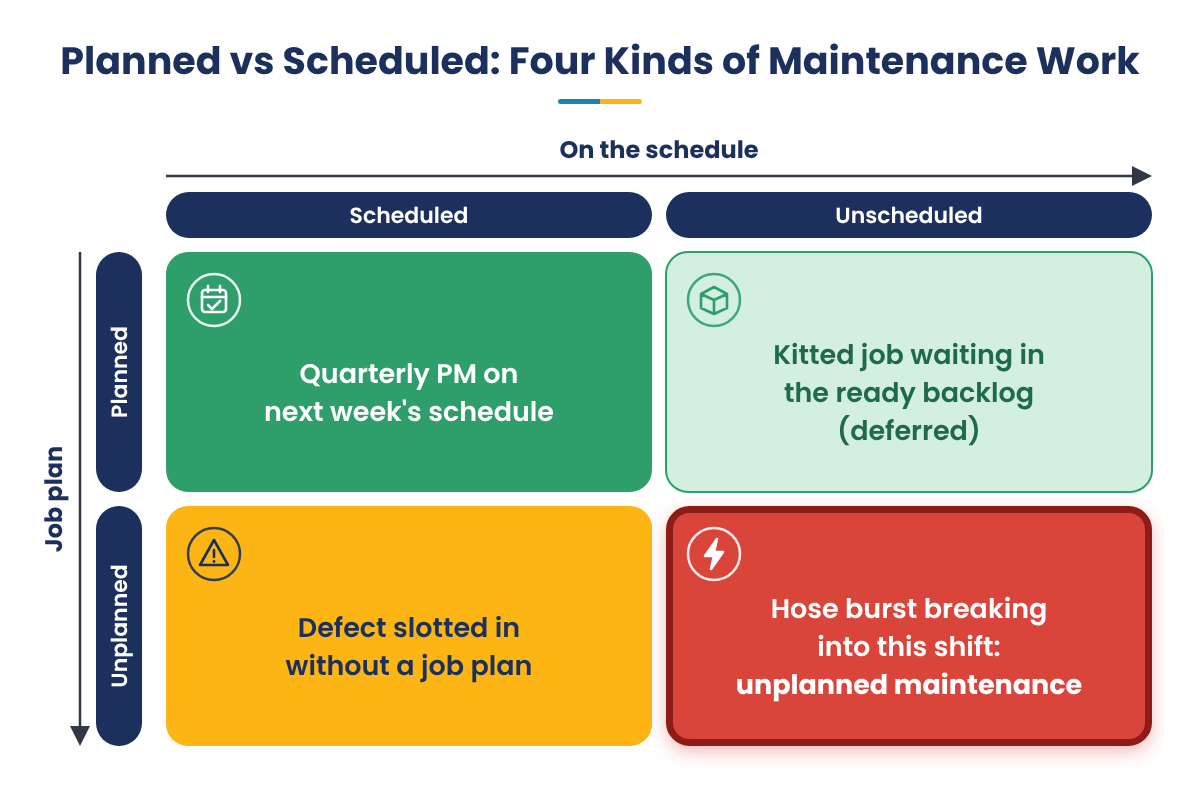
IEC 60050-192 treats unscheduled and unplanned maintenance as equivalent terms for corrective work that cannot be deferred. However, many maintenance planning teams use the words differently. For them, planned means a job plan exists and scheduled means a date and crew are assigned. So unscheduled describes planned work that is still waiting for a date.
Other sources define the term in other ways again, so the word unscheduled on its own is not a reliable way to classify work. The practical fix is to ask two independent questions: does a job plan exist, and has a date and crew been assigned?
These two questions create four work categories:
| Scheduled: date and crew assigned | Unscheduled: no date yet | |
|---|---|---|
| Planned: job plan ready | A quarterly PM on a boiler feed pump, on next week's locked schedule | A fully kitted exchanger cleaning waiting in the ready backlog for an outage window |
| Unplanned: no job plan | A defect from operator rounds placed on next week's schedule without a job plan | A burst hydraulic hose on a rolling mill that has to be fixed this shift |
The bottom-right cell is true unplanned maintenance. It has no job plan and no date, and it breaks into this week, so track it as break-in work. The top-right cell is planned work waiting for the right window, which the IEC vocabulary calls deferred maintenance (IEC 60050-192). That wait is healthy when it is a deliberate choice. The bottom-left cell needs attention, because a job scheduled without a plan often stalls on a missing part or permit. Send it through planning first.
What Causes Unplanned Maintenance in Industrial Plants?
Most unplanned maintenance traces back to seven causes, and five of them are execution problems rather than equipment problems. The table pairs each cause with what it looks like on the floor and what prevents it.
| Cause | What it looks like in the plant | What the maintenance manager can change |
|---|---|---|
| Inspection coverage gaps | A failure mode has no inspection or maintenance task at all | Map critical failure modes to tasks and add what is missing |
| Missed or ineffective PM | PMs are overdue, or the interval no longer matches how hard the asset works, such as a lube route set for clean service on a pump now in dirty service | Protect PMs on the locked schedule and adjust intervals through preventive maintenance optimization |
| Early warnings not acted on | An operator hears the noise, a reading moves out of range or a notification is raised, but it does not reach maintenance in time or waits days for a decision | Record findings at the asset when they are seen and review new notifications daily |
| Operating conditions | Overloads, fast starts, running dry, poor lubrication or improper operating practice | Clear operating limits, operator training and lubrication standards that match the duty |
| Repeat failures | A repair restores function without removing the cause, and the asset fails again within weeks | Run root cause analysis on every repeat failure |
| Design or material defects | The same part fails across similar equipment | An engineering change on the problem asset |
| Known defects left waiting | A defect is deferred with no job plan or review date, or waits for parts, people or a permit, and gets worse until it cannot wait | Plan and kit deferred work, set a review date based on how fast the defect is worsening, and stock critical spares |
The first three causes explain why the same warning can end as planned work at one plant and as an emergency call-out at another. Innovapptive's maintenance latency diagnostics in chemicals, refining, mining and consumer goods plants commonly found a median of about nine days from notification to scheduled work. For a defect that is already getting worse, nine days is often enough time to fail.
See How Industrial AI Helps Teams Act on Early Warnings
Industrial AI in Action explains how frontline execution platforms make sure what operators see becomes work that gets planned and done
When Unplanned Maintenance Is the Right Call
Unplanned maintenance is the right call when the failure is low-consequence, inexpensive and quick to correct, and prevention costs more than the risk. Consider five conditions:
- Low consequence: no unacceptable safety, environmental, production or product-quality impact.
- Low repair cost: the component is cheap, readily replaceable and quick to restore.
- Redundancy or bypass: an installed spare or approved bypass can carry the duty safely.
- No useful warning: the failure mode has no detectable sign that a reasonable inspection could identify in time.
- A failure history that supports it: the asset runs for years between failures, so routine checks would cost more than the occasional repair.
Never choose run-to-failure where people or the environment could be harmed. Even when failure is accepted, plan the response: document isolation, define replacement steps, keep the spare and identify required skills. Tag repairs for reliability analysis. Review the decision when the record changes. If a run-to-failure asset starts failing more often, that is the signal to run root cause analysis or add it to the PM program.
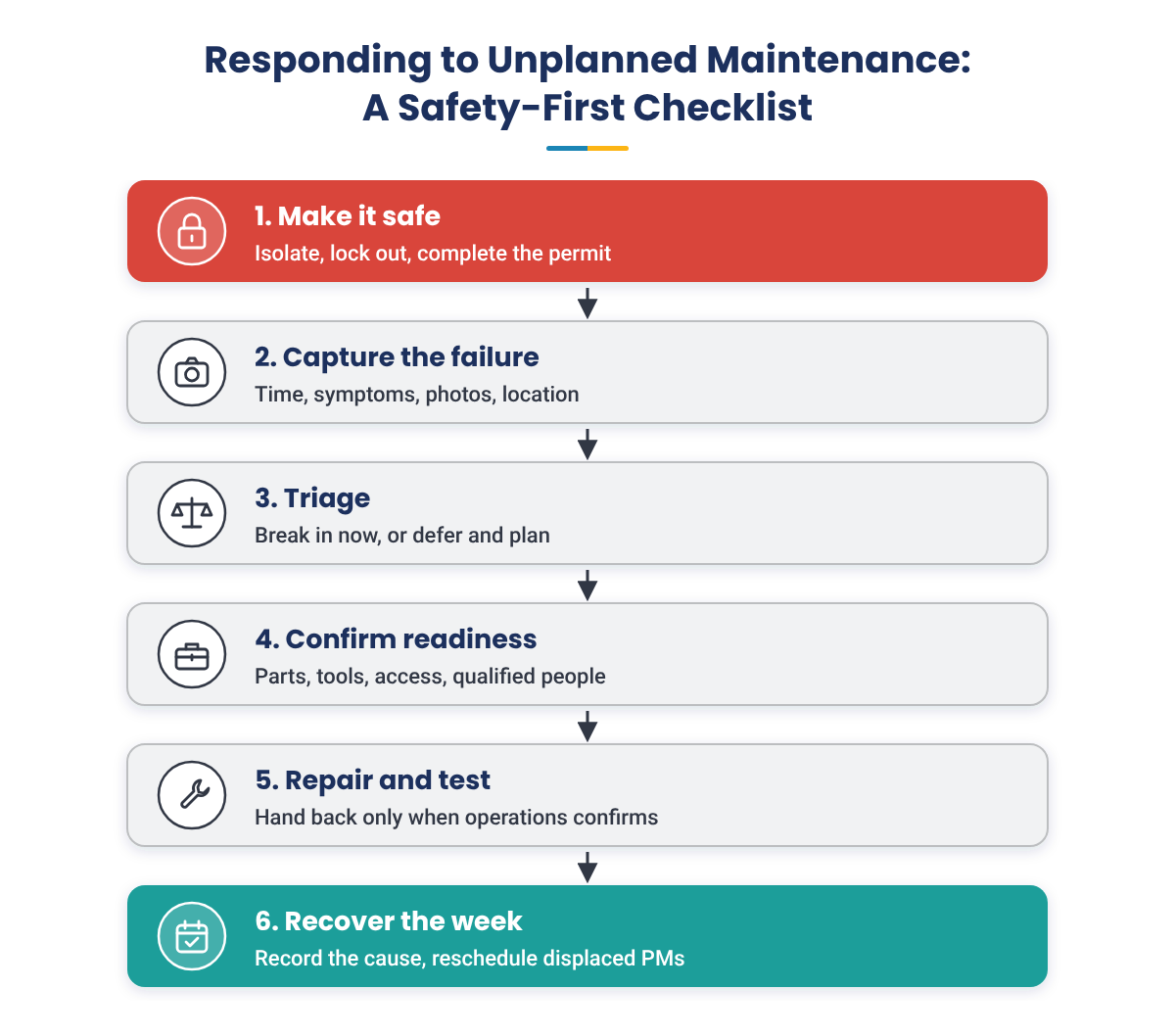
Responding to Unplanned Maintenance: A Safety-First Checklist
Unplanned work carries more safety risk than planned work, because isolation and permits get arranged under time pressure and often off-shift. So the response starts with making the asset safe, and only then moves to the repair.
- Make it safe: Stop the asset, identify energy sources and follow site lockout/tagout procedures. Complete the required permit to work and verify isolation. OSHA's control of hazardous energy (lockout/tagout) standard sets the US requirements for this step.
- Capture the failure in real time: Raise the notification at the asset with the malfunction start time, symptoms, photos, and the equipment and functional location.
- Triage against criticality: Decide whether the job has to break into this week's schedule or can be made safe, deferred and planned. Defer whatever can safely wait.
- Confirm readiness: Check parts, tools, access, skills and required certifications. A repair that stalls halfway for a missing seal kit uses more crew hours than one that starts an hour later with everything on hand.
- Diagnose, repair and test with operations: Follow a structured maintenance troubleshooting approach, then confirm with operations that the asset does its job before handing it back.
- Close out and recover the week: Record failure codes, cause, parts and hours, and flag repeat failures for root cause analysis. The planner then reschedules the jobs the break-in pushed aside, starting with safety-critical PMs and PMs on any asset now running without a backup.
How Much Unplanned Maintenance Is Normal in a Plant?
In a well-run plant, unplanned work takes no more than about 20% of maintenance labor hours, and high performers keep break-in work under 15% of scheduled hours.
The 80/20 rule behind the PM ratio caps corrective and breakdown work combined at 20% of labor hours, so 20% is a ceiling for unplanned work, not a target. For contrast, NIST's survey of US manufacturers found that 45.7% of machinery maintenance was reactive. The survey covered discrete manufacturers, not oil, gas or chemical plants, so use it as a general reference point.
Each figure below measures something slightly different, so check what it measures before comparing it with your plant.
| Metric | What it measures |
|---|---|
| Reactive maintenance share | Labor hours on reactive work as a share of total maintenance hours |
| Unplanned work share | Labor hours on work that started without a job plan, as a share of total maintenance labor hours |
| Break-in work share | Hours of work added to the weekly schedule after it was locked, as a share of the hours on that schedule |
| Planned maintenance percentage | Share of maintenance labor hours spent on planned work |
| Level | Figure | Measured against | Source |
|---|---|---|---|
| Reactive footing | 45.7% reactive | Machinery maintenance in US discrete manufacturing | NIST survey average |
| Baseline | 20% or less corrective and breakdown work | Maintenance labor hours | The 80/20 rule |
| World class | 85% or more planned | Maintenance labor hours | Innovapptive planned maintenance percentage guide |
| High performing | Under 15% break-in work | Hours on the locked weekly schedule | Innovapptive Margin Walkthrough benchmark |
| Warning sign | Close to 0% unplanned | Any of the above | Usually miscoded work orders, not a perfect plant |
Use these numbers as guides, and measure your own plant with the coding rules above.
Where Unplanned Work Shows Up in the Maintenance Budget
Unplanned work rarely appears as one budget line. Its impact is spread across four areas:
- Labor and overtime: call-outs, shift extensions and catch-up work. Innovapptive diagnostics have observed overtime above 15%, compared with a healthy benchmark of 5% or less.
- Contractors: external crews brought in to complete planned work displaced by break-ins.
- Parts: rush orders, freight premiums and extra stock held as insurance against future failures.
- Lost production: stops or derates that can affect output, quality and customer lead times.
Innovapptive diagnostics have observed reactive orders costing five to six times as much as planned orders. These are diagnostic observations, not industry averages. NIST adds that the manufacturers relying most on reactive maintenance had 3.3 times more downtime and 16 times more defects than those relying on it least.
Indorama Ventures: From Reactive to Planned at Port Neches
Indorama Ventures, a $15.4 billion chemical producer, shows what this shift can look like at a single site. Within 12 months of deploying Innovapptive's Connected Worker Platform at its Port Neches, Texas site, the PM-to-CM ratio rose from 45% to 80%. Over the same period, maintenance overtime fell from 24% to 12% and contractor headcount fell from 140 to 87.
The site also cut its maintenance backlog by 58%, from 24 weeks to 10, and delivered $19M in realized EBITDA savings in 2025. Indorama has since identified a further $50M opportunity across the enterprise. These are the results of one deployment, not industry benchmarks.
How Plants Shift Work From Unplanned to Planned
Plants that cut unplanned work make progress in three areas, each closing a different route from planned work to urgent work.
| Area | What it addresses |
|---|---|
| Earlier detection | Operator rounds, inspections and condition-based maintenance find defects while there is still time to plan the repair. |
| Planning and schedule protection | A locked weekly schedule with a measured break-in allowance keeps overdue planned work from becoming urgent work. This is the core of maintenance planning and scheduling. |
| Execution readiness | Parts, permits, isolation and qualified people are confirmed before work starts, so planned jobs finish on time instead of stalling and slipping. |
Together, these are the practical steps in moving a program from reactive to proactive maintenance.
From 140 Contractors to 87 at One Chemical Site
Indorama Ventures’ Port Neches site shifted maintenance from reactive to planned and cut its backlog by 58%. See what changed and how the team made it stick.
How Innovapptive Helps Maintenance Teams Reduce Unplanned Maintenance
Innovapptive helps maintenance teams act on problems while there is still time to plan the work. Its mobile maintenance software runs on top of SAP PM, IBM Maximo or Oracle, which remain the system of record, so technicians, planners and supervisors work from the same live data. The goal is to shorten the time between a problem being seen and the right work being done, because that delay is where most unplanned work and its cost begin.
Innovapptive works alongside condition monitoring and asset performance tools rather than replacing them. When those tools or an operator flag a problem, Innovapptive’s connected worker platform makes sure it turns into the right work, done safely and recorded properly. It changes four things that drive unplanned work:
- Findings get recorded when they are seen: WorkSmartAI turns a photo, voice note or short prompt into a structured notification or work order in Innovapptive's work order software, with the equipment and functional location detected. It works offline, and RapidSync posts the record to the ERP within minutes once the device reconnects.
- Early catches reach planning in time: Readings from operator rounds software post against the equipment record, and out-of-limit readings or repeat exceptions become ERP notifications automatically.
- Urgent jobs start safe and ready: A configurable risk matrix sets priority from consequence and likelihood. With electronic permit to work software, permits, isolation and PPE travel with the work order. Jobs are released only when permit, parts and isolation are confirmed, with work instructions at each step.
- Every repair leaves a usable record: Each closure posts labor, parts, cause and technical completion back to the ERP. Asset 360, opened with a QR scan, shows runtime, downtime, failure trends and prior work order history at the asset, so repeat failures are hard to miss.
This execution-first approach is one reason Frost & Sullivan named Innovapptive its 2026 Company of the Year in Global Augmented Connected Worker Platforms.
Turn Floor Findings Into Planned Work on the ERP You Already Run
Innovapptive adds the mobile execution layer your ERP is missing, from defect capture to permits to close-out. Want the details first? Grab the solution brief.

Unlock Margins Hidden in Your Maintenance
Watch how leading manufacturers improve OEE, raise PM compliance and cut downtime through connected execution.
Request a Demo
2026 Company of the Year, Global Connected Worker Platforms
See why Frost & Sullivan recognized Innovapptive for closing the frontline execution gap.
Read the Report
- 05-11-2026
Unplanned Maintenance: Definition, Types, Plant Examples
Unplanned maintenance is repair work that has to start as soon as a failure or defect appears. It...

- 30-10-2026
Schedule Compliance: Formula, the 85% Benchmark and Fixes
Schedule compliance measures how much of a committed maintenance schedule gets completed as...

- 27-10-2026
Best Industrial Inspection Software: 11 Platforms Compared
Inspection software encompasses a broad market with its functionality varying widely. Repair shops...