
What Is Unplanned Downtime in Manufacturing?
Unplanned downtime in manufacturing refers to any unexpected stoppage of production equipment or processes that occurs without scheduling or preparation. It is caused by equipment failure, operator error, sensor malfunction, or supply chain interruption.
Planned vs Unplanned Downtime
Unlike planned downtime, which is scheduled to allow for routine maintenance, upgrades, or inspections, unplanned downtime occurs without warning and catches operations teams off guard.
| Type | Definition | Example |
|---|---|---|
| Planned Downtime | Scheduled production stoppages for maintenance or upgrades | Scheduled preventive maintenance window on a Saturday night |
| Unplanned Downtime | Unexpected stoppages due to failure or error | CNC machine spindle failure mid-shift |
Why the Cost of Unplanned Downtime in Manufacturing Is So High
Unplanned downtime is expensive because it triggers a chain reaction of costs, not a single loss. When a production line stops unexpectedly, five cost drivers activate simultaneously.
| Cost Driver | What Happens | Why It Compounds | Example Impact |
|---|---|---|---|
| Lost Production Revenue | Output stops immediately, units not produced cannot be recovered | Every minute of stoppage is permanent revenue loss at full margin rate | A line producing $15,000/hour in margin loses $3,750 in 15 minutes |
| Labor Inefficiency | Workers remain on the clock but cannot produce | Overtime to recover lost output multiplies the original labor cost 1.5x to 2x | 20 idle workers at $75/hour fully loaded = $1,500/hour in unproductive labor |
| Emergency Repair Cost | Unplanned repairs require rush parts, after-hours labor, and expedited shipping | Emergency maintenance costs 3x to 5x more than the same repair on a schedule | A $2,000 planned repair becomes a $6,000 to $10,000 emergency repair |
| Product Waste and Scrap | Mid-cycle stoppages destroy in-process materials and batches | Entire production runs can be lost in food, pharma, or molding operations | A pharmaceutical batch worth $50,000 scrapped due to process interruption |
| Supply Chain Penalties | Downstream customers on JIT schedules miss deliveries | Late delivery penalties and expedited freight extend the cost for weeks | $10,000 late delivery penalty + $3,500 expedited freight = $13,500 additional cost |
Empower your Frontline to Improve your Bottomline
Discover how leading manufacturers equip frontline teams with digital workflows, real-time visibility, and faster issue resolution to reduce downtime.
What is the average downtime cost per hour in manufacturing?
The average cost of downtime in manufacturing varies significantly depending on the industry, facility size, level of automation, and production value per hour. Industry research consistently places hourly downtime costs in the tens to hundreds of thousands of dollars for large manufacturers.
| Industry | Typical Downtime Cost Range (per hour) | Key Cost Driver |
|---|---|---|
| Automotive Assembly | $22,000 to $50,000+ | High unit value, tight JIT schedules |
| Semiconductor / Electronics | $30,000 to $100,000+ | Precision equipment, cleanroom protocols |
| Food & Beverage | $10,000 to $30,000 | Perishable inventory, compliance risk |
| Heavy Industrial / Steel | $8,000 to $20,000 | Energy cost, restart time |
| Small-Mid Size Manufacturing | $2,000 to $10,000 | Labor-to-output ratio, margins |
| Chemicals / Oil & Gas | $15,000 to $40,000 | Safety shutdown protocols, regulatory risk |
Sources: Aberdeen Group (2019); IndustryWeek (2021); Siemens Digital Industries (2020); LNS Research
What are the consequences of Unplanned Downtime
Unplanned downtime creates consequences that reach far beyond the maintenance team or a single production line. While lost output and repair costs are the most visible impacts, the true cost of manufacturing downtime includes idle labor, overtime, material waste, delayed shipments, customer penalties, and disrupted schedules. What appears to be a short equipment failure can quickly escalate into a much larger operational and financial problem.
Lost Production Revenue
Every hour of unplanned downtime represents output that cannot be recaptured. In high-volume operations, the production value lost in a single shift can exceed a week's worth of maintenance budget. For facilities operating near capacity, this lost throughput directly impacts monthly revenue targets.
Labor Inefficiency and Overtime
Workers do not stop being paid when equipment stops. Idle labor during downtime events adds direct cost, and the overtime required afterward to recover production multiplies it. A 2-hour unplanned stoppage can easily generate 4 to 6 hours of overtime pay across a full shift crew.
Equipment Repair and Emergency Maintenance
Unplanned failures typically require emergency repair responses, which carry premium costs. Rush spare parts, after-hours technician callouts, and expedited shipping for components all inflate repair budgets far beyond planned maintenance costs. Research from Plant Engineering shows emergency maintenance can cost 3x to 5x more than the same repair performed on a schedule.
Product Waste and Scrap
Abrupt equipment stoppages mid-cycle frequently result in scrapped materials, incomplete units, or batches that fail quality inspection due to process interruption. In industries like food processing, pharmaceuticals, or injection molding, an entire production run can be lost when a line stops unexpectedly.
Supply Chain Disruption and Customer Penalties
Downstream customers on just-in-time schedules are immediately affected when a supplier's production line stops. Late delivery penalties, expedited freight charges to recover schedules, and reputational damage with customers are real financial consequences that extend the cost of a single downtime event for weeks or months.
Only 7.1% of manufacturers achieve world-class OEE. Find out why?
The State of Digital Manufacturing 2025 report covers OEE gaps, digital adoption trends, and what leading manufacturers are doing differently.
How to Calculate the Cost of Downtime in Manufacturing
Unplanned downtime cost is measured by combining lost production revenue, idle labor, maintenance and repair spend, overhead absorption, scrap or rework, and delivery or supply chain penalties. Multiply these costs by the duration of the disruption to calculate the cost of downtime.
Formula:
Manufacturing finance experts and operations consultants use variations of the following formula to calculate total downtime cost.
This formula provides a comprehensive view of downtime impact by including costs that many manufacturers overlook when they calculate only direct production loss.
How to Estimate Total Downtime Impact
Follow these steps to calculate your facility's downtime cost:
- Calculate production value per hour: Multiply your production rate (units/hour) by your unit profit margin.
- Determine labor cost per hour: Add up the fully-loaded hourly cost of all workers idled during the stoppage.
- Add overhead cost per hour: Divide your monthly fixed facility costs by total production hours to get hourly overhead.
- Multiply by downtime duration: Add the three hourly costs together and multiply by the total hours of downtime.
- Add one-time costs: Include emergency repair costs, scrap/waste costs, and any supply chain penalties.
Most manufacturers find that their true downtime cost is 2x to 4x higher than their initial estimate when all cost layers are included.
What Each Variable Means
| Variable | Definition | How to Calculate |
|---|---|---|
| Production Value per Hour | Revenue or contribution margin of output per hour at normal rate | Unit price × units per hour × contribution margin % |
| Labor Cost per Hour | Fully-loaded cost of all workers idled by the stoppage | Headcount × (wage + benefits + overhead) per hour |
| Overhead per Hour | Fixed facility costs continuing during the stoppage | Monthly fixed overhead ÷ total production hours |
| Repair Cost | Emergency maintenance: parts, technician time, logistics | Get from maintenance records or emergency vendor invoice |
| Scrap / Waste Cost | Value of in-process materials or units destroyed at failure | Bill of materials cost × units scrapped |
| Supply Chain Penalties | Late delivery charges, expedited freight, customer chargebacks | Review customer contracts for penalty clauses |
Now that you understand the formula and its variables, let us apply it to a real manufacturing scenario to see how each cost layer contributes to the total downtime cost.
Worked Example: Packaging Line Downtime Cost
The following calculation uses a mid-sized consumer goods packaging line as the example scenario.
| Variable | Value | Notes |
|---|---|---|
| Production Value per Hour | $18,000 | 1,200 units/hr × $15 average unit margin |
| Labor Cost per Hour | $2,400 | 32 workers × $75/hr fully loaded |
| Overhead per Hour | $900 | Energy, depreciation, facility |
| Downtime Duration | 2.5 hours | Failure to full restart |
| Repair Cost (emergency) | $4,200 | Parts + after-hours technician |
| Scrap/Waste Cost | $1,800 | In-process units lost at failure point |
| Supply Chain Penalty | $3,500 | Late delivery charge from retailer |
| TOTAL DOWNTIME COST | $62,750 | Full cost of a 2.5-hour stoppage |
Hidden Downtime Costs Can Significantly Impact Margins
See how manufacturers reduce emergency maintenance, labor inefficiencies, and lost production through connected operations.
What are the Common Causes of Unplanned Downtime in Manufacturing
The five most common causes of unplanned downtime in manufacturing are:
- Equipment failure: Mechanical or electrical components reach end of service life without early warning.
- Reactive maintenance culture: Repairs happen only after failure - no proactive monitoring i.e. teams only respond after failure occurs.
- Sensor or control system errors: IIoT or SCADA malfunctions that cause unexpected process stops.
- Operator error: Incorrect machine setup, wrong tooling, or missed inspection steps.
- Supply chain interruptions: Missing raw materials or critical parts that halt the production line.
- Poor Team Communication: Maintenance and production teams lack integrated workflows.
How Leading Manufacturers Reduce Downtime
The manufacturers achieving the lowest unplanned downtime rates share a common operating model. They move from reactive to proactive maintenance, supported by connected digital systems that give maintenance and production teams real-time visibility into asset health.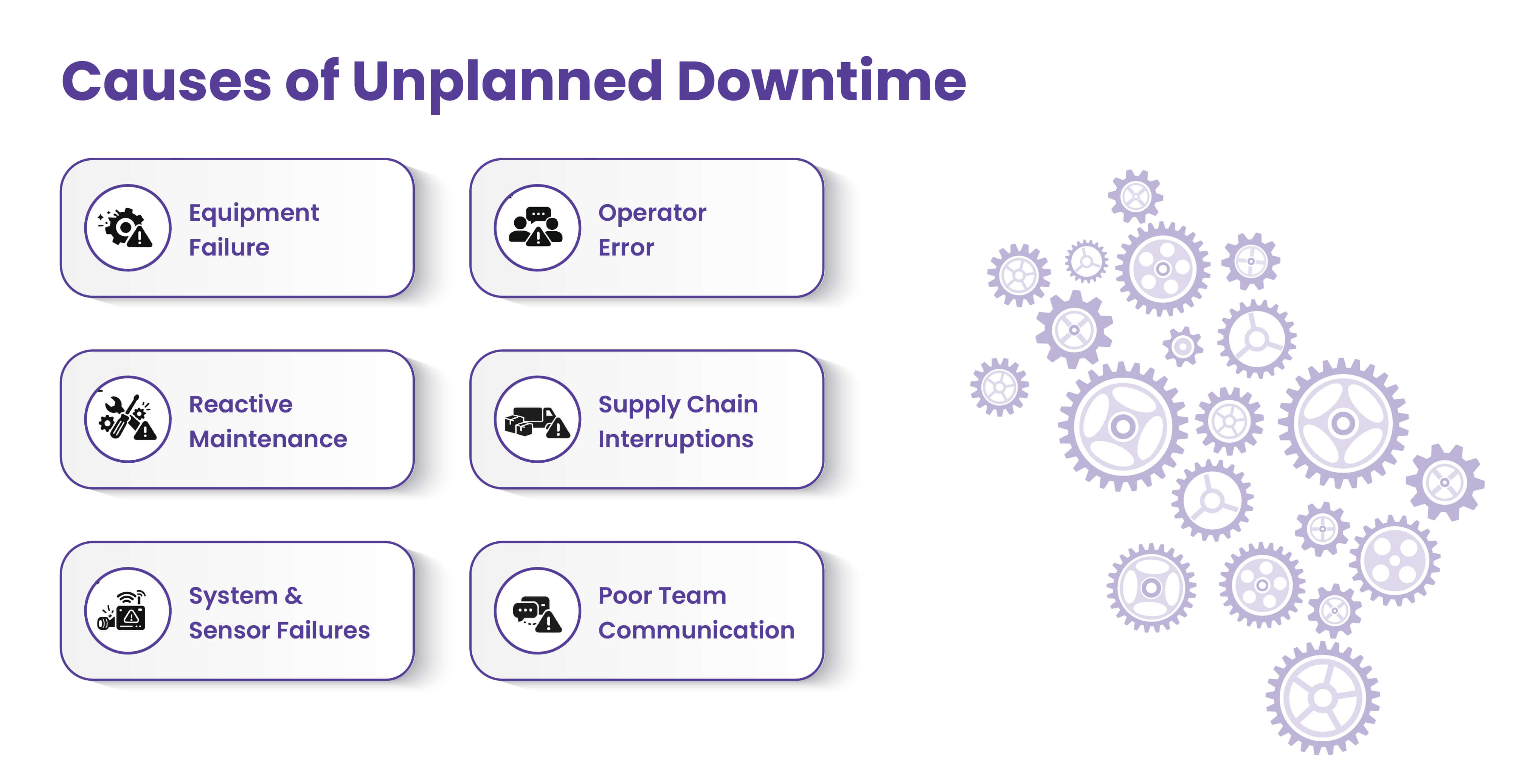
Detect Failures Early with Predictive Maintenance
Predictive maintenance uses data analytics, machine learning, and sensor data to identify early warning signs of equipment failure, before a breakdown occurs. Rather than waiting for failure or performing unnecessary scheduled maintenance, teams intervene at exactly the right moment. According to Deloitte Insights, predictive maintenance can reduce unplanned downtime by 30 to 50 percent and lower maintenance costs by 10 to 25 percent.
Monitor Asset Health in Real Time
Industrial IoT sensors continuously monitor key asset parameters (vibration, temperature, pressure, and cycle count) and feed data to monitoring dashboards. When readings deviate from normal operating ranges, the monitoring system sends instant mobile alerts to maintenance technicians and reliability engineers with the equipment ID, parameter reading, and deviation severity. This allows maintenance teams to investigate and act before failure occurs. McKinsey & Company research found that real-time monitoring programs can reduce maintenance costs by up to 25 percent and reduce unplanned breakdown events by up to 70 percent when combined with predictive maintenance and proactive intervention protocols. These results represent best-in-class implementations with mature data analytics capabilities.
Digitize Maintenance Workflows to Reduce MTTR
Paper-based and spreadsheet-driven maintenance processes are a silent driver of downtime. Digital maintenance management systems (CMMS) ensure work orders are dispatched instantly, spare parts availability is tracked in real time, and repair histories are accessible to every technician. Faster response and better-informed repairs directly reduce mean time to repair (MTTR). Industry benchmarks show that facilities using digital maintenance workflows typically achieve 20 to 40 percent lower MTTR compared to facilities using paper-based processes.
Empower Frontline Teams with Connected Worker Tools
Connected worker platforms equip frontline maintenance and production teams with mobile tools for reporting equipment issues, accessing repair procedures, escalating alerts, and logging maintenance activity in real time. When a machine operator can immediately flag an anomaly through a digital workflow instead of waiting to find a supervisor, response times shrink significantly. LNS Research (2023) found that facilities using connected worker platforms reduced average incident-to-response time by 34% compared to facilities using manual communication processes.
How Reducing Downtime Improves Manufacturing Profitability
Every percentage point improvement in equipment availability translates directly to financial performance. Reducing unplanned downtime delivers compounding operational and financial benefits:
- Higher asset utilization: Equipment that runs longer produces more output from the same capital investment, improving return on assets (ROA) without additional capital expenditure.
- Improved production throughput: Consistent availability means more units produced per shift, enabling facilities to meet demand growth without capacity expansion.
- Lower maintenance costs: Moving from reactive to proactive maintenance reduces emergency repair expenses, spare parts waste, and after-hours labor premiums.
- Stronger supply chain reliability: Predictable production performance allows manufacturers to meet delivery commitments consistently, reducing penalties and strengthening customer relationships.
- Better workforce efficiency: When production runs without interruption, labor resources are deployed productively rather than idling during stoppages or absorbing overtime to recover lost output.
Facilities that invest in reducing unplanned downtime consistently outperform industry peers on total production cost per unit, customer satisfaction metrics, and equipment asset life. Operational improvement and financial improvement go hand in hand.
Key Takeaways
- Unplanned downtime costs manufacturers between $2,000 and $50,000+ per hour depending on industry, facility size, and production value.
- The true cost of downtime is typically 2x to 4x higher than direct production loss alone when hidden costs (labor, repairs, scrap, penalties) are included.
- Calculate downtime cost using the formula: (Lost Production Value per Hour + Labor Cost per Hour + Overhead Cost per Hour) × Downtime Duration + Repair Cost + Scrap Cost + Supply Chain Penalties.
- Leading manufacturers reduce downtime by 30 to 50 percent through predictive maintenance, real-time monitoring, and digital workflows.
- Track downtime impact using four key metrics: OEE (equipment effectiveness), MTTR (repair time), MTBF (time between failures), and production throughput.
- Moving from reactive to proactive maintenance delivers compounding benefits including higher asset utilization, lower maintenance costs, and stronger supply chain reliability.
How Indorama Ventures Achieved $50M in Maintenance Savings
See how a global manufacturer transformed maintenance operations, improved execution, and unlocked significant cost savings with Innovapptive.
Conclusion
Unplanned downtime is more than a maintenance issue. It is a direct threat to production output, operating margins, delivery performance, and customer satisfaction. Manufacturers that continue to rely on reactive processes often absorb hidden costs through lost throughput, overtime labor, emergency repairs, and supply chain disruption.
The most effective manufacturers and operations teams take a proactive approach by combining predictive maintenance, real-time asset monitoring, digital workflows, and connected frontline teams. Reducing downtime not only lowers costs but also improves asset utilization, workforce productivity, and overall plant performance.
Innovapptive eliminates unplanned downtime by closing the industrial insight-to-action gap with an AI-powered Connected Worker Execution Platform. It integrates real-time SCADA and historian data with ERP systems like SAP to detect micro-anomalies, predict failures, and trigger dynamic rounds and autonomous work orders. By removing execution latency across operations, safety, and shift management, it enables an autonomous maintenance culture where workers act on real-time AI guidance-turning predictive insights into frontline execution that maximizes asset availability and protects throughput.
Ready to Reduce Unplanned Downtime?
Modernize maintenance workflows, connect frontline teams, and improve uptime with an AI-powered connected worker platform.

Unlock Margins Hidden in your Maintenance
Watch how leading manufacturers improve OEE, increase PM compliance, and reduce downtime through connected execution.

- 12-10-2026
Manufacturing Skills Gap: What It Costs and How to Close It
A plant can have every role filled and still experience a manufacturing skills gap. Very often,...

- 05-10-2026
10 Best Shift Handover Software Platforms for Plant and Process Operations
Shift handover software can mean different things depending on the operating environment. Some...

- 29-09-2026
Best SAP Maintenance Planning & Scheduling Software 2026
Your maintenance work orders live in SAP Plant Maintenance (PM), while the working schedule lives...