
What Is OEE (Overall Equipment Effectiveness)?
Overall Equipment Effectiveness (OEE) is a manufacturing productivity metric used to measure how efficiently equipment is running compared to its full potential.
It originated as part of Total Productive Maintenance (TPM) initiatives in Japan during the 1960s and is now widely used to identify and eliminate production losses across manufacturing operations.
In plain terms, OEE tells you what percentage of your planned production time is truly productive. A score of 100% means your equipment ran the entire planned shift, at maximum rated speed, and produced zero defective parts. Anything below that number represents waste - wasted time, wasted capacity, or wasted materials.
What Does OEE Actually Measure?
OEE breaks equipment effectiveness into three core dimensions, each reflecting a different type of production loss:
- Availability: Is the machine actually running when it's supposed to, or losing time due to breakdowns, setups, or waiting?
- Performance: When it is running, is it operating at full speed, or slowing down due to minor stops and inefficiencies?
- Quality: Of everything produced, how much is actually good the first time, without scrap or rework?
Together, these three factors give you a complete view of where your equipment is losing effectiveness, whether through downtime, reduced speed, or quality losses.
Why OEE Matters in Manufacturing Operations
Understanding OEE is one thing. Understanding why it matters is what separates manufacturers who continuously improve from those who accept underperformance as a cost of doing business.
Consider what happens when OEE is low. A plant with a 55% OEE score is operating at roughly half of its theoretical capacity. That means the capital invested in that equipment, the labor paid to run it, and the floor space dedicated to it are all working at half efficiency. The hidden costs compound: unplanned downtime triggers emergency maintenance, slow cycles extend lead times and strain customer commitments, and defects generate scrap costs and rework labor.
OEE matters because it connects equipment performance directly to business outcomes:
- Downtime reduction: Tracking OEE reveals whether downtime is driven by equipment failures, long changeovers, or material shortages - enabling targeted interventions.
- Capacity and throughput: A 10-percentage-point OEE improvement on a bottleneck machine can unlock significant additional production capacity without capital investment.
- Cost per unit: Higher OEE means more good parts produced per hour, directly lowering your cost per unit.
- Reliability and delivery: Predictable equipment performance leads to more consistent output, improving on-time delivery rates.
- Maintenance prioritization: OEE data helps maintenance teams identify which machines need attention first and why.
In short, OEE is not just a number to report - it is a diagnostic tool that guides where to focus improvement energy for maximum operational impact. More importantly, it helps teams prioritize where to act, whether the biggest loss is downtime, speed, or quality.
OEE Formula and How to Calculate OEE
To calculate OEE, multiply Availability × Performance × Quality. This gives one percentage score that shows how efficiently your equipment is operating.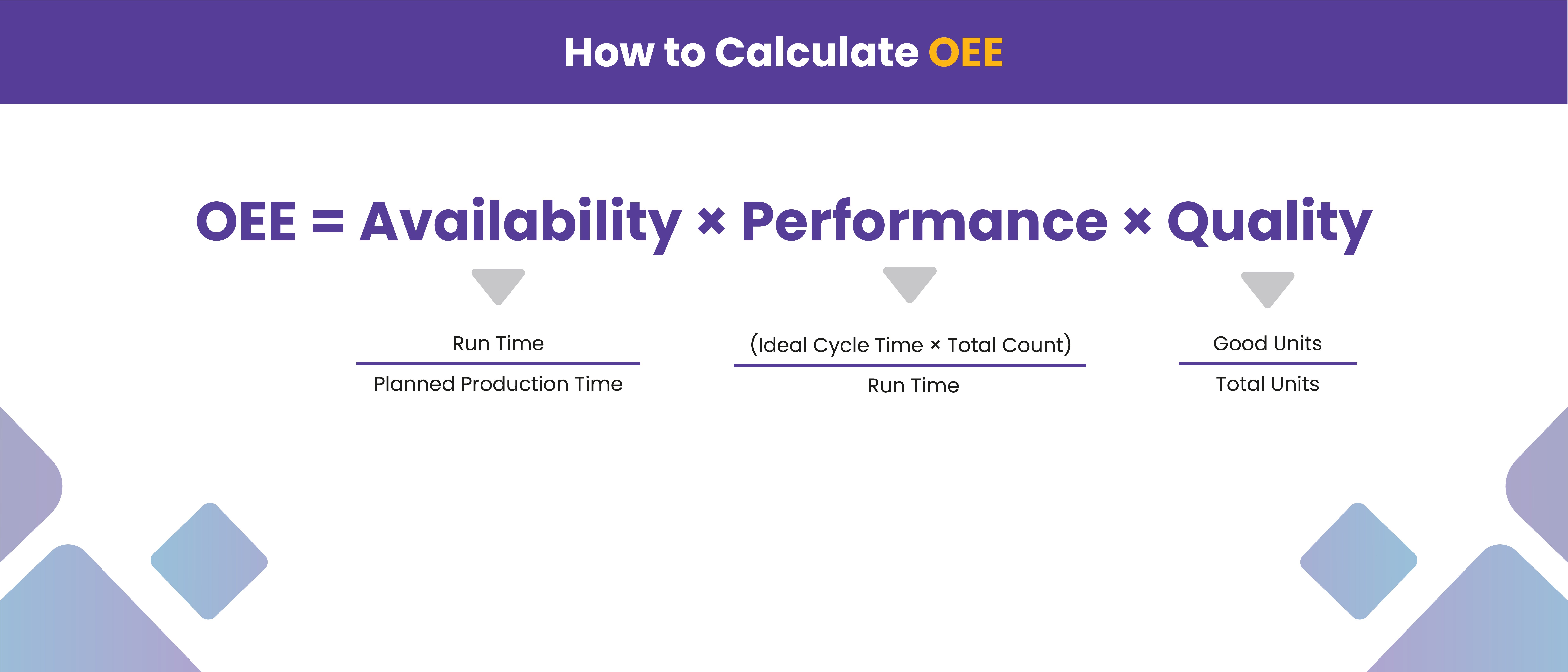
Each of the three components captures a different category of production loss. Let us examine each one in detail.
Availability - Are You Running When You Should Be?
Availability measures the proportion of planned production time that the equipment was actually operational. It accounts for all events that cause the machine to stop when it was scheduled to run - primarily unplanned breakdowns and planned stops such as changeovers, setups, and adjustments.
Run Time equals Planned Production Time minus all Downtime. If a machine was scheduled to run for 480 minutes but experienced 60 minutes of downtime, the Run Time is 420 minutes and the Availability is 87.5%.
Downtime losses include:
- Unplanned breakdowns and equipment failures
- Planned maintenance performed during production hours
- Tooling changes and setups
- Waiting for materials, operators, or instructions
Performance - Are You Running at Full Speed?
Performance shows whether the machine is running at its expected speed or losing output due to slow cycles and small interruptions. This category covers everything that causes the equipment to operate below its rated speed, including minor stoppages and slow cycles that individually seem insignificant but collectively account for substantial lost output.
If the ideal cycle time is 1 part per minute, the machine ran for 420 minutes, but only produced 350 parts, Performance is (1 × 350) ÷ 420 = 83.3%.
Performance losses include:
- Reduced speed operation due to worn tooling, material variation, or operator decisions
- Minor stoppages (jams, sensor faults, brief interruptions under 5 minutes)
- Equipment not accelerating to full speed after a stop
Quality - Are You Producing Good Parts?
Quality measures the proportion of total output that meets specifications on the first pass - with no rework or scrap. Any unit that requires rework or is scrapped represents not only a quality loss but also wasted machine time, materials, and labor.
If the machine produced 350 parts and 325 met quality specifications, Quality is 325 ÷ 350 = 92.9%.
Quality losses include:
- Scrap parts that cannot be reworked
- Reworked parts that required additional labor to meet specification
- Startup rejects - defective parts produced during equipment warm-up
OEE Calculation Example (Real Manufacturing Scenario)
Let us work through a complete, real-world OEE calculation using a single production shift.
Scenario: An automotive components plant runs an 8-hour (480-minute) shift on a CNC machining cell. The ideal cycle time is 1 part per minute.
| Factor | Value | Notes |
|---|---|---|
| Planned Production Time | 480 minutes | Full 8-hour shift |
| Downtime | 60 minutes | 45 min breakdown + 15 min changeover |
| Run Time | 420 minutes | 480 − 60 |
| Ideal Cycle Time | 1 part / minute | Machine rated capacity |
| Total Parts Produced | 350 parts | Actual output |
| Defective Parts | 25 parts | Scrap + rework |
| Good Parts | 325 parts | First-pass quality output |
Step-by-step calculation:
- Availability = 420 ÷ 480 = 87.5%
- Performance = (1 × 350) ÷ 420 = 83.3%
- Quality = 325 ÷ 350 = 92.9%
- OEE = 87.5% × 83.3% × 92.9% = 67.7%
This 67.7% OEE score means that only about two-thirds of the shift's potential output was realized as good, first-pass production. The remaining 32.3% represents recoverable losses - a significant improvement opportunity hiding in plain sight.
Only 7.1% of manufacturers achieve world-class OEE. Find out why?
The State of Digital Manufacturing 2025 report covers OEE gaps, digital adoption trends, and what leading manufacturers are doing differently.
What Is a Good OEE Score? (Benchmarks Explained)
OEE benchmarks provide a reference point for interpreting your score and prioritizing improvement efforts. The widely accepted industry benchmarks are:
| OEE Score | Classification | Interpretation |
|---|---|---|
| 100% | Perfect | Theoretical maximum - not a realistic target |
| 85% and above | World Class | Benchmark for best-in-class discrete manufacturers |
| 60% – 84% | Typical | Average for most manufacturing operations; improvement is possible |
| 40% – 59% | Low | Significant losses present; urgent improvement action required |
| Below 40% | Critical | Severe systemic issues; immediate diagnostic focus needed |
These benchmarks vary by industry, product mix, and process complexity. What matters more is consistent improvement over time rather than hitting a fixed universal number.
The Real Reasons Behind Low OEE: Understanding the Six Big Losses
A low Overall Equipment Effectiveness score is a symptom, not the cause itself. To improve OEE sustainably, manufacturers must identify the specific losses reducing Availability, Performance, and Quality.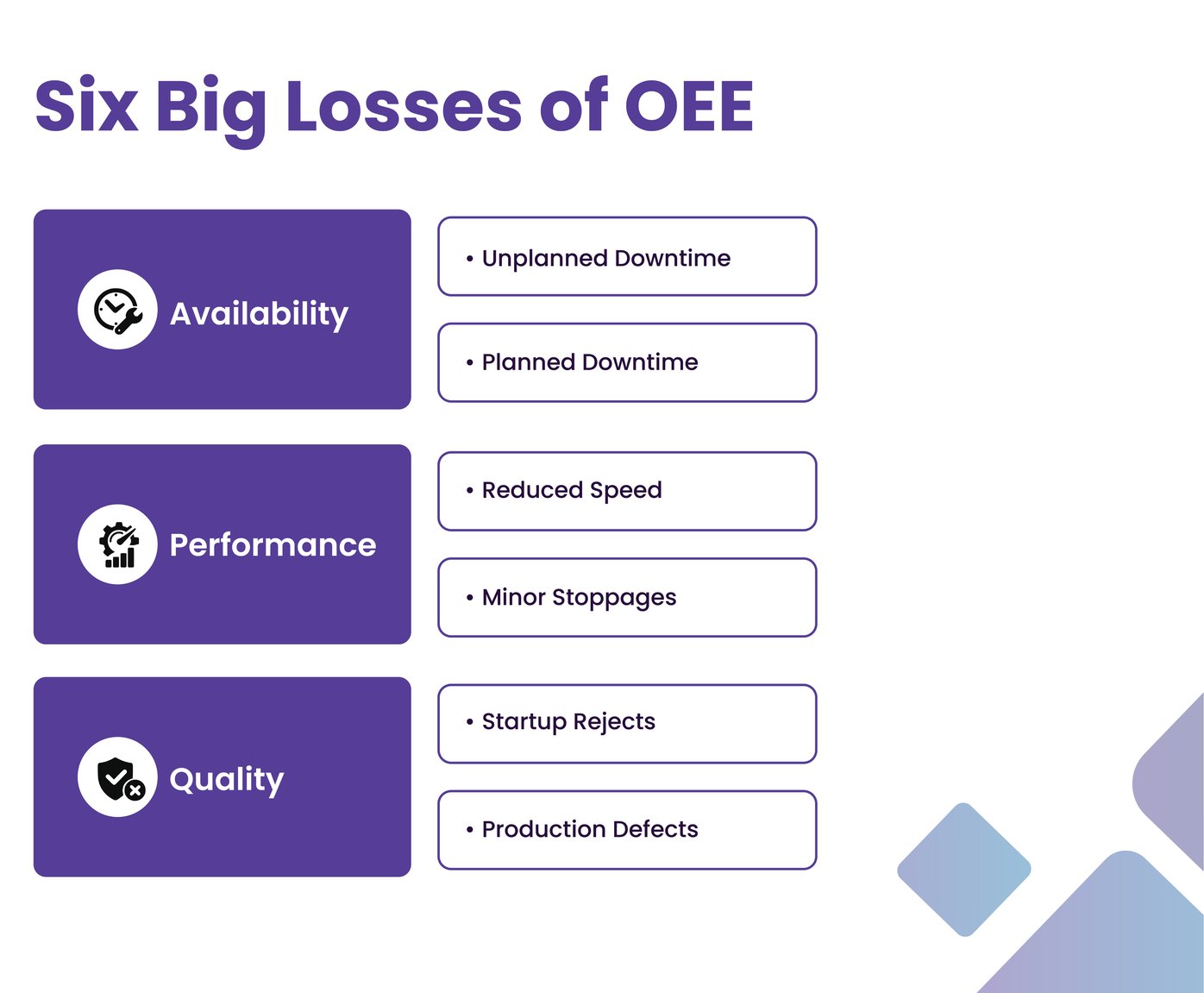 This is exactly why OEE was designed around the Six Big Losses - six categories of manufacturing inefficiency that prevent equipment from reaching full productive potential.
| OEE Component | Loss Category | Typical Causes |
|---|---|---|
| Availability | Unplanned Downtime | Equipment breakdowns, unexpected failures, emergency maintenance |
| Availability | Planned Downtime | Changeovers, setups, tooling changes, shift handovers |
| Performance | Reduced Speed | Worn tooling, material variation, operator-set speed reductions |
| Performance | Minor Stoppages | Jams, sensor faults, misfeeds, brief interruptions under 5 minutes |
| Quality | Startup Rejects | Defective parts produced during equipment warm-up and calibration |
| Quality | Production Defects | Scrap and rework during steady-state production |
Availability Losses: Downtime and Failures
Unplanned downtime is often the most painful OEE drain because production stops immediately while schedules slip and maintenance teams react.
Common root causes include:
- Deferred preventive maintenance
- Lack of condition monitoring
- Poor spare parts availability
- Inadequate operator troubleshooting skills
- Long changeover or setup processes
Performance Losses: Slow Cycles and Hidden Capacity Loss
Performance losses are frequently underestimated because the machine appears to be running. But equipment operating at 80% speed quietly erodes capacity every hour.
Typical causes include:
- Worn tooling or dies
- Raw material inconsistency
- Frequent minor stoppages
- Conservative operator speed settings
- Aging equipment performance decline
Quality Losses: Scrap, Rework, and Startup Waste
Quality losses are especially expensive because they waste both production time and material.
Common drivers include:
- Process parameters drifting out of spec
- Weak Statistical Process Control (SPC)
- Poor First Article Inspection during changeovers
- Startup instability after shutdowns
- Environmental variation such as temperature or humidity
Each loss category requires a different improvement strategy. A chronic breakdown issue needs reliability engineering, while startup scrap may require tighter changeover controls. Until you know which losses are hurting OEE most, improvement efforts often miss the real problem.
How to Improve OEE in Manufacturing
Improving OEE is not a one-time project - it is a continuous operational discipline. The most effective improvement programs address all three OEE components simultaneously through structured strategies tied to maintenance, process, and people.
Reduce Equipment Downtime (Improve Availability)
The single most impactful step to improving Availability is shifting from reactive to proactive maintenance. When maintenance is purely reactive - fix it when it breaks - downtime is unpredictable, extended, and expensive. A planned maintenance stop of 30 minutes is vastly preferable to an unplanned failure that shuts the line for four hours.
Practical steps to reduce downtime:
- Implement Preventive Maintenance (PM) schedules based on manufacturer recommendations and historical failure patterns
- Adopt condition-based monitoring - vibration analysis, thermal imaging, and oil analysis detect degradation before failure occurs
- Standardize changeover procedures to minimize planned stop duration
- Audit your spare parts inventory against your most critical assets to eliminate stockout-driven downtime extensions
- Track Mean Time Between Failures (MTBF) and Mean Time To Repair (MTTR) to identify chronic failure patterns and repair bottlenecks
Strengthen Maintenance Strategies - TPM and Autonomous Maintenance
Two structured frameworks deliver proven, sustained OEE improvement at the maintenance and operator level:
Total Productive Maintenance (TPM) is a plant-wide approach that involves everyone - from operators to senior leadership - in maintaining and improving equipment. Rather than treating maintenance as the exclusive domain of the maintenance department, TPM distributes ownership across the organization. TPM addresses all Six Big Losses that reduce OEE, providing a systematic framework for attacking each one. For a deeper understanding of the TPM framework and how it maps to OEE improvement, see our guide on Total Productive Maintenance.
Autonomous Maintenance is one of the eight pillars of TPM and is particularly powerful for OEE improvement. In an Autonomous Maintenance program, machine operators take responsibility for basic equipment care - daily inspections, cleaning, lubrication, and minor adjustments - rather than waiting for the maintenance team. This approach catches developing problems early, reduces unexpected breakdowns, and builds operator ownership of equipment health. Learn more in our Autonomous Maintenance guide.
Optimize Production Processes (Improve Performance)
Closing the performance gap requires understanding exactly where and why speed losses occur. This demands data - not anecdotes.
- Define and document the Ideal Cycle Time for every product on every machine; this becomes the baseline against which actual performance is compared
- Analyze downtime and micro-stoppage data to identify patterns - a specific machine, shift, or operator associated with disproportionate performance losses
- Apply 5 Why analysis to recurring performance losses to reach root causes rather than treating symptoms
- Review tooling change intervals and process parameters regularly to ensure equipment runs at specification
- Standardize operating procedures so that best-practice techniques are consistent across all operators and all shifts
Improve Operator Efficiency and Quality
People are the most powerful lever for OEE improvement - and the most underutilized. Well-trained, engaged operators who understand OEE and their role in it consistently outperform disengaged teams operating the same equipment.
- Train operators to understand OEE, what each component measures, and how their daily actions affect the score
- Empower operators to report minor stoppages and performance anomalies in real time, rather than absorbing them silently
- Implement visual management - dashboards, Andon systems, and production boards - so operators can see performance versus target in real time
- Engage quality control at the machine level through SPC charts and immediate feedback loops
- Recognize and celebrate OEE improvement achievements to reinforce a culture of continuous improvement
See how leading manufacturers improve OEE with connected worker solutions
How Modern Technology Improves OEE Tracking
The most accurate OEE program is only as good as the data feeding it. For decades, manufacturers relied on paper-based or spreadsheet-driven OEE tracking - methods that introduced reporting delays, data entry errors, and limited analytical capability. Modern technology has transformed what is possible.
Manual vs. Automated OEE Tracking
| Dimension | Manual Tracking | Automated Tracking |
|---|---|---|
| Data capture | Operator logs at end of shift | Real-time, continuous from machine/sensor |
| Accuracy | Subject to human error and estimation | Precise, timestamped, objective |
| Speed | Hours to days for reporting | Instant dashboards and alerts |
| Analysis depth | Aggregate totals, limited drill-down | Event-level analysis, pattern detection |
| Scalability | Labor-intensive to scale | Scales across lines and plants centrally |
| Operator burden | High - manual logging during production | Low - data captured automatically |
The Role of Real-Time Data and IIoT
Industrial Internet of Things (IIoT) technology enables equipment to report its own status - run/stop state, cycle counts, fault codes - in real time. When integrated with an OEE platform, this data stream makes OEE tracking continuous and automatic rather than periodic and manual.
The impact of real-time IIoT-driven OEE tracking:
- Downtime events are captured to the second, with automatic categorization by fault code
- Performance deviations trigger instant alerts, enabling operators and supervisors to respond before losses compound
- Shift-by-shift and asset-by-asset OEE visibility replaces end-of-day summary reports
- Historical data enables predictive analytics - identifying equipment at risk of failure before a breakdown occurs
- Plant managers can monitor OEE across multiple lines and facilities from a single dashboard
OEE Software and Dashboards
Dedicated OEE software platforms - particularly those integrated with connected worker solutions - go beyond data capture to deliver actionable insights. Key capabilities to look for in an OEE software platform include:
- Real-time OEE dashboards at the machine, line, plant, and enterprise level
- Automated downtime categorization linked to maintenance work order triggers
- Integration with CMMS (Computerized Maintenance Management Systems) for seamless maintenance-OEE alignment
- Mobile accessibility so operators and technicians can log events, access procedures, and view performance data from the shop floor
- Configurable alerts and escalations to ensure the right person is notified of the right issue at the right time
Explore how Innovapptive enables real-time OEE visibility across your operations
How Innovapptive Improves OEE Across All Three Pillars?
Most OEE improvement efforts deliver partial results because they address only one pillar at a time. A maintenance solution improves Availability. A quality tool reduces defects. A workforce application targets Performance gaps. Each delivers value in its own right, but OEE is the product of all three components - and siloed solutions reflect that fragmentation in their outcomes. Innovapptive focuses on all these aspects and on unified execution.
Improving Availability (Reducing Downtime)
Innovapptive targets unplanned downtime - the most common source of OEE loss.
- AI-Led Autonomous Repairs: Detects and resolves routine failures with minimal human intervention.
- Mobile Operator Rounds: Standardizes inspections to catch issues before they become breakdowns.
- Digital Shift Handovers: Transfers critical information between shifts, reducing transition incidents by 25%.
- Work Order Management: Streamlines the creation, dispatch, and completion of maintenance work orders.
Increasing Performance (Eliminating Speed Loss)
The platform eliminates bottlenecks and idle time to keep equipment at peak speed.
- AI-Based Risk Prioritization: Focuses crews on high-impact jobs to prevent production slowdowns.
- Live OEE Tracking (Throughout Lines): Provides real-time visibility into cycle times and idle hours across all production lines.
- Digital Workflows: Replaces paper processes with mobile execution and instant approvals.
- Digital Huddles: Real-time collaboration, accelerating the resolution of flagged issues.
Enhancing Quality (Reducing Defects & Rework)
Innovapptive ensures jobs are done "Right First Time."
- Digital Work Instructions: Step-by-step multimedia guidance for consistent task execution.
- AI-Guided 5-Whys Analysis: Eliminates root causes of recurring quality failures.
- Automated Quality Inspections: Catches deviations that manual checks routinely miss.
- Live Quality Tracking and Action: Monitors quality in real-time and triggers immediate action when there is a quality dip.

Unlock Margins Hidden in your Maintenance
Watch how leading manufacturers improve OEE, increase PM compliance, and reduce downtime through connected execution.

- 04-09-2026
How to Improve Equipment Uptime: 12 Ways to Increase Uptime and Reduce Breakdowns
Ask any maintenance leader in a refinery, a chemical plant or a mine where their uptime goes, and...

- 01-09-2026
How to Improve Throughput in Maintenance: 9 Key Strategies
Improving throughput in maintenance is one of the highest-return moves a plant can make, because...

- 20-08-2026
Electronic Permit to Work (ePTW): The Ultimate Guide to Digital Safety Permits
High-risk work on an industrial plant does not start until a permit is issued, which makes the...