
AI Is Redefining the Future of Industrial Maintenance
Learn how leading manufacturers use AI, connected workers, and predictive maintenance to reduce downtime and maintenance costs.
What Are the Reasons for High Maintenance Costs?
Most companies do not struggle with high maintenance costs because they spend too much on maintenance. They struggle because too much of that spending is inefficient, reactive, or poorly managed.
In asset-intensive industries, maintenance costs increase gradually over time until they become accepted as "normal." Emergency repairs become routine. Spare parts inventory grows without control. Contractors are added to solve short-term issues. Teams spend more time firefighting than improving reliability.
Here are the biggest reasons maintenance costs become difficult to manage.
Reactive Maintenance Culture
Reactive maintenance is one of the biggest drivers of high maintenance costs. When equipment fails unexpectedly, companies face emergency labor costs, expedited spare parts, overtime, production disruptions, and sometimes secondary equipment damage. What could have been a planned repair quickly becomes a costly operational event.
In many facilities, a significant portion of maintenance work still happens after failure instead of before failure. This reactive work can cost 3 to 5 times more than planned maintenance because of emergency labor premiums, rushed procurement, extended downtime, and lost production.
The difference between high-performing and average maintenance organizations often comes down to how much work is planned in advance. According to SMRP benchmarks, top-performing operations complete more than 85% of maintenance work as planned and scheduled activities, compared to an industry average of just 49%.
Also, read: The True Cost of Unplanned Downtime in Manufacturing
Low Workforce Productivity (Wrench Time)
Labor is typically the largest component of maintenance spending, often accounting for 40 to 50% of the total maintenance budget. Yet a large portion of technician time is lost every day due to inefficient maintenance processes rather than actual repair work.
In many manufacturing and chemical plants, technicians spend only 25 to 35% of their shift on productive, hands-on maintenance activities. The rest of their time is consumed by searching for parts, waiting for permits and approvals, traveling between work areas, filling out paperwork, or arriving at jobs that were never properly planned.
Inefficient Preventive Maintenance Programs
Many preventive maintenance (PM) programs become bloated over time as tasks are continuously added but rarely reviewed for effectiveness. Equipment is often serviced too frequently "just to be safe," even when there is little evidence that the activity actually prevents failures. Research from the Aladon Network shows hours found that up to 30% of PM tasks may be time-based rather than appropriate, meaning many time-based PM activities cannot prevent their effectively.
As a result, industry studies estimate that 30 to 40% of scheduled PM tasks may be unnecessarily currently aligned to actual failure modes. Performing more maintenance than required on healthy assets increases labor costs, spare parts consumption, and avoidable equipment interruptions. In many cases, reducing, eliminating, and transitioning to condition-based tasks saves money. High-performing organizations focus not on doing more maintenance, but on performing the right maintenance at the right time using risk- and condition-based approaches.
Poor Work Planning and Scheduling
Unplanned maintenance work almost always costs significantly more than planned work. When maintenance jobs begin without properly defined scope, staged parts, required permits, tools, or clear instructions, technicians are forced to improvise in the field. Jobs take longer, coordination breaks down, overtime increases, and equipment downtime extends unnecessarily.
Research from Doc Palmer's Maintenance Planning and Scheduling Handbook shows that a planned job can take 30 to 50% less time than an unplanned job with the same scope.
High-performing maintenance organizations treat planning and scheduling as core operational disciplines. They define work scope early, coordinate closely with operations, prepare materials in advance, and use detailed job plans covering labor, tools, safety requirements, and execution steps. This level of preparation directly improves workforce productivity, reduces maintenance costs, and increases equipment uptime.
Spare Parts and Inventory Inefficiencies
Many facilities face the same challenge at the same time: carrying too much inventory while still facing critical stockouts when equipment fails. Without accurate bill-of-materials (BOM) analysis or slow-moving inventory that ties up working capital, while essential components remain unavailable when needed. Inadequate procedures for inventory expenses emergency purchases, longer downtime, and decreased operational disruption.
Without proper inventory controls such as minimum/maximum reorder levels, inventory audits, and supplier rationalization, spare parts mismanagement often becomes one of the largest hidden sources of maintenance waste. Technicians also lose valuable productive time searching for materials or waiting on parts to arrive. High-performing organizations treat optimized spare parts inventory as a strategic reliability function rather than simply a warehouse management activity.
Immature or Absent Digital Management Systems
Organizations without formal CMMS or EAM systems - or those running these systems at low adoption maturity - lack the data infrastructure to manage costs systematically. LNS Research found that companies with mature connected worker platforms and digital workflows had up to 12% lower maintenance costs than peers, with CMMS data quality. Complete work order documentation, labor parts, and failure contact being the primary differentiators.
Overdependence on Contractors
Contractors are important for specialized work and shutdown support, but over-reliance on external resources quickly inflates costs.
Many companies accumulate too many vendors over time, operate with inconsistent rates, or continue long-term contracts without performance reviews. Contractor usage also increases when internal planning and reliability processes are weak.
Misaligned Predictive Investments and Execution Gaps
Many organizations invest heavily in sensors and predictive maintenance technologies without a clear strategy, creating a growing gap between insights and execution. Maintenance teams may receive alerts, anomaly flags, or condition data from multiple systems, but are unable to act quickly. Disconnected systems, manual workflows, delayed communication, and lack of real-time contextual information slow response and increase costs.
High-performing organizations focus predictive maintenance efforts on critical assets where failure has the highest financial and operational impact. They close the insight-to-action gap through connected workflows, mobile maintenance tools, and real-time operational visibility. Aberdeen Research found that bridging this execution gap with connected worker tools can reduce maintenance costs by 15 to 30% and improve workforce productivity by 10%.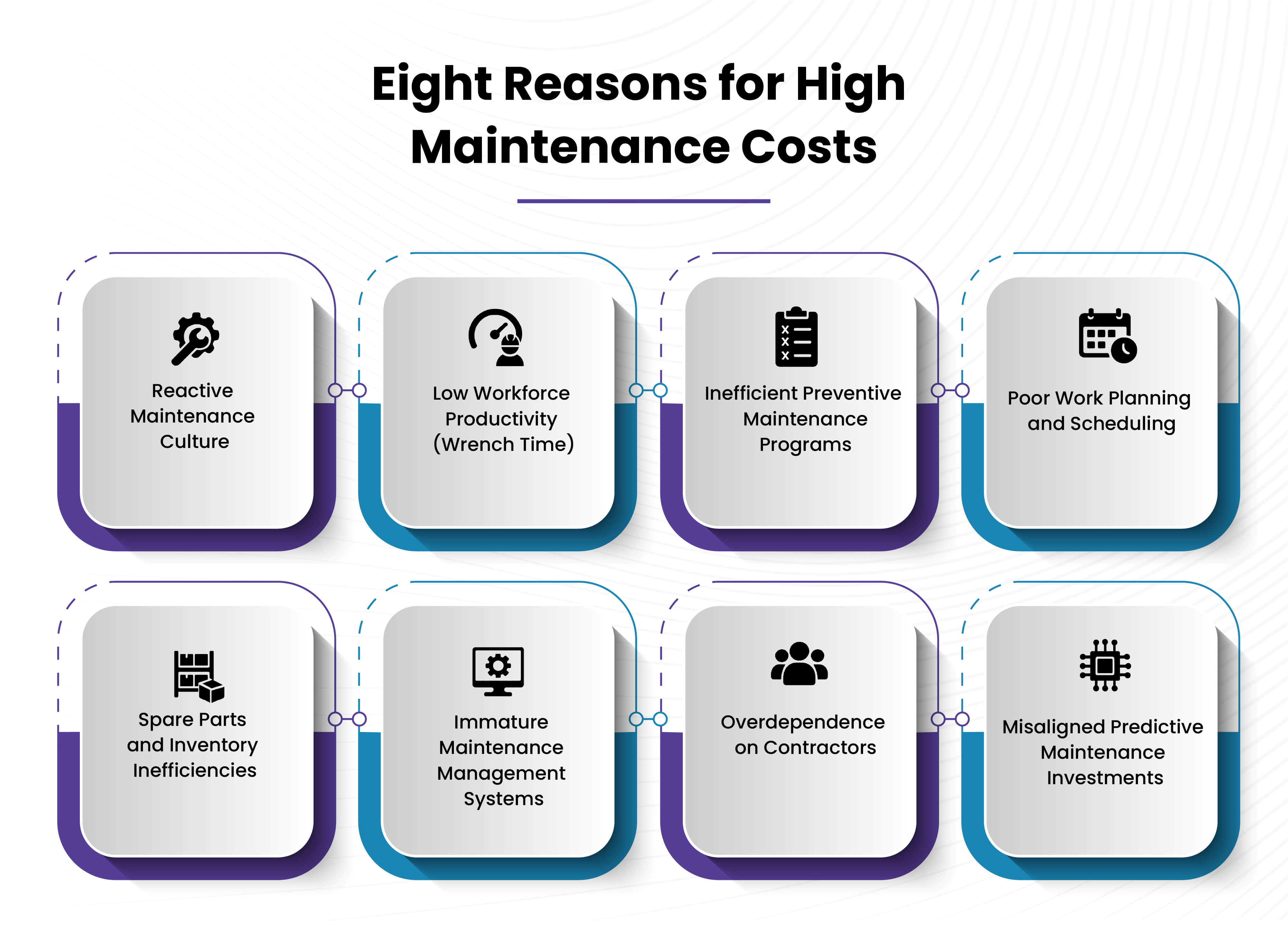
| Root Cause | Business Impact |
|---|---|
| Reactive Maintenance Culture | 3 to 5x higher repair and downtime costs |
| Low wrench time | 40 to 50% of labor budget wasted on non-productive activity |
| Excessive PM waste | Unnecessary labor, excess spare parts usage, and avoidable downtime |
| Poor work planning and scheduling | 30 to 50% longer job execution times |
| Spare parts / inventory inefficiency | Higher inventory carrying costs and expensive emergency purchases |
| Immature CMMS/EAM systems | Limited operational visibility and poor maintenance decision-making |
| Contractor mismanagement | High external labor costs and uncontrolled spending |
| Misaligned Predictive Maintenance Investments | Missed reliability improvements and delayed maintenance response |
Struggling With Rising Maintenance Costs Across Operations?
Book a personalized maintenance cost assessment to identify hidden cost drivers, improve maintenance efficiency, and uncover opportunities to reduce downtime and operational spend.
Proven Strategies to Reduce Maintenance Costs
Reducing maintenance costs does not require cutting corners or delaying necessary work. The most successful organizations reduce costs by eliminating waste, increasing labor productivity, and eliminating waste from the maintenance process. They focus on building a more planned, disciplined, and data-driven maintenance operations.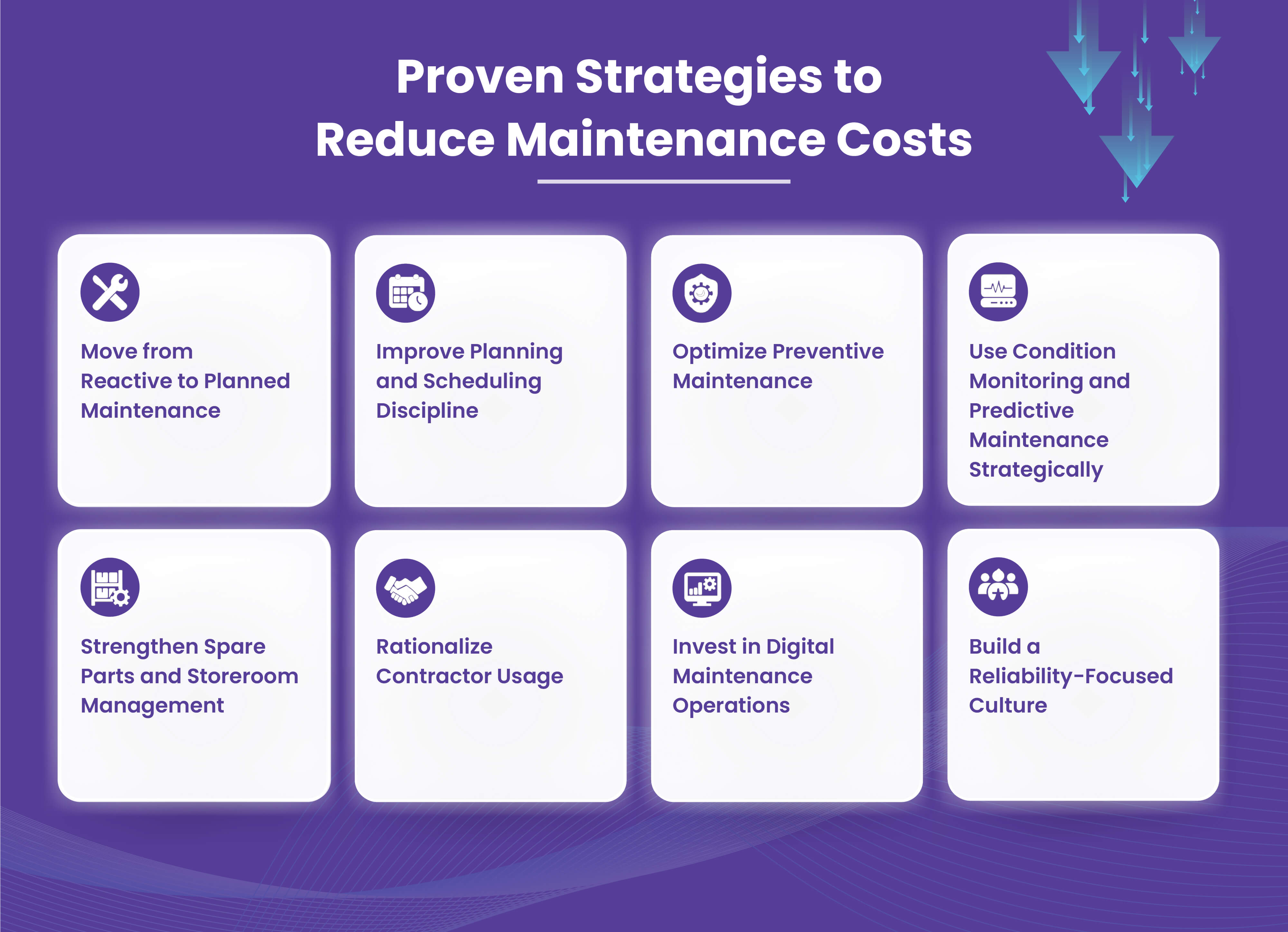
Here are the strategies that consistently deliver results across manufacturing, chemical, energy, mining, and other asset-intensive industries.
Move from Reactive to Planned Maintenance
Planned maintenance is significantly cheaper than reactive maintenance because labor, parts, permits, and downtime can all be coordinated in advance. Planned work also reduces secondary equipment damage and production disruption.
Most organizations begin by strengthening preventive maintenance programs and then gradually introducing condition-based and predictive maintenance on critical assets. The goal is simple: identify problems before they become failures.
Improve Planning and Scheduling Discipline
High-performing maintenance teams prepare jobs before technicians enter the field. That includes defining job scope, staging parts, assigning labor, arranging permits, and coordinating equipment availability with operations.
When technicians spend less time waiting and searching, wrench time improves naturally. Small improvements in planning discipline can order quality of work execution. When planners prepare complete, accurate work instructions, routine and work execution can create major efficiency gains.
Also, read: What is Overall Equipment Effectiveness (OEE)?
Optimize Preventive Maintenance
Not every asset requires the same maintenance frequency, and not every PM task adds value. Reviewing maintenance history often reveals tasks that can be eliminated, simplified, or moved to condition-based monitoring.
This reduces unnecessary labor and spare parts usage while allowing teams to focus on higher-value reliability work. Effective PM optimization improves reliability while lowering cost - not the other way around.
Also, read: A Complete Guide to Total Productive Maintenance (TPM)
Use Condition Monitoring and Predictive Maintenance Strategically
Condition monitoring helps maintenance teams intervene only when equipment actually shows signs of deterioration.
Technologies like vibration monitoring, oil analysis, thermography, and IoT sensors provide early warning signals before failures occur. This allows maintenance teams to plan repairs during scheduled downtime instead of responding to emergencies.
The biggest mistake companies make is trying to deploy predictive maintenance everywhere at once. The best approach is to start with a small group of high-criticality assets where downtime costs are highest. Once value is proven, the program can scale gradually.
Strengthen Spare Parts and Storeroom Management
Better inventory management reduces both excess stock cost and stockout risk. Leading organizations classify inventory based on criticality and usage patterns. Critical spares remain stocked, while slow-moving and low-risk parts are optimized to reduce carrying costs.
Simple improvements often create immediate savings:
- Minimum inventory levels
- Inventory audits
- Better storeroom layout
- Supplier consolidation and rationalization
- Repair-and-return programs for expensive components
A well-managed storeroom improves maintenance productivity just as much as it reduces inventory costs.
Rationalize Contractor Usage
Contractor spending should be reviewed with the same discipline applied to production or procurement costs. Many organizations reduce contractor costs by standardizing rates, improving contract oversight, and bringing repetitive work back in-house where appropriate.
The objective is not simply reducing contractor count. It is ensuring external labor is used where it creates the most value.
Invest in Digital Maintenance Operations
Modern maintenance organizations rely heavily on digital workflows and real-time data to improve visibility, workforce productivity, and maintenance effectiveness.
Traditional CMMS and EAM platforms play an important role by providing visibility into maintenance history, labor utilization, spare parts consumption, asset reliability, and downtime trends. However, many operational systems still require technicians to focus on reading and recordkeeping rather than enabling real-time frontline execution. As a result, maintenance teams often still depend on paper processes, phone calls, printed lists, radios, and disconnected applications to coordinate work in the field.
Connected worker platforms help close this gap by connecting frontline technicians, supervisors, planners, operational data, and maintenance workflows into a single execution environment. Instead of simply generating work orders, connected worker solutions enable technicians to access procedures, equipment history, inspections, collaboration tools, permits, and real-time asset information directly from mobile devices in the field.
Build a Reliability-Focused Culture
Long-term maintenance cost reduction is ultimately a leadership and culture issue. The best organizations create shared accountability for equipment reliability across operations, maintenance, engineering, and leadership teams. Operators participate in basic equipment care. Supervisors review KPIs consistently. Reliability issues are solved systematically instead of repeatedly patched.
When reliability becomes part of operational culture, maintenance costs decline naturally over time.
Real-World Example: How Indorama Ventures Reduced Maintenance Costs by $50 Million
A real-world example of large-scale maintenance cost reduction can be seen at Indorama Ventures' manufacturing site in Port Neches, Texas.
To improve maintenance execution, workforce productivity, and operational visibility, the site deployed Innovapptive's connected maintenance and frontline execution platform across maintenance operations. The results were significant. The facility reduced its annual maintenance budget by $50 million while improving overall operational efficiency. The initiative also reduced contractor dependency by 53 contractors, lowered overtime from 24% to 12%, and reduced maintenance backlog from 24 weeks to 10 weeks.
The site also improved inventory accuracy from 89.5% to 99.5%, helping unlock millions of dollars in working capital through better MRO spare parts management and inventory optimization.
How Indorama Ventures Achieved $50M in Maintenance Savings
See how a global manufacturer transformed maintenance operations, improved execution, and unlocked significant cost savings with Innovapptive.
Final Thoughts
Reducing maintenance costs is not about spending less on maintenance. It is about building a more reliable, disciplined, and efficient maintenance operation.
The organizations that consistently lower maintenance costs focus on the fundamentals:
- Reducing reactive work
- Improving planning and scheduling
- Increasing workforce productivity
- Optimizing preventive maintenance
- Managing spare parts effectively
- Using technology to improve visibility and decision-making
Most importantly, leading organizations are now focusing on closing the gap between maintenance insights and frontline execution.
Many companies can identify maintenance issues through CMMS data, condition monitoring systems, and predictive analytics. However, execution often slows down because of disconnected systems, manual workflows, delayed communication, and lack of real-time coordination between frontline teams.
Innovapptive's Connected Worker Platform helps bridge this gap by connecting technicians, planners, maintenance workflows, inventory systems, and operational data into a unified mobile-first environment. This improves execution speed, workforce coordination, field visibility, and maintenance decision-making across the organization.
In the next decade, the biggest competitive advantage in industrial operations will not come from simply collecting more maintenance data. It will come from how quickly organizations can convert maintenance insights into coordinated frontline action.
Ready to Reduce Maintenance Costs Across Your Operations?
Modernize maintenance execution, improve workforce productivity, and increase reliability with Innovapptive’s connected worker platform.

Unlock Margins Hidden in your Maintenance
Watch how leading manufacturers improve OEE, increase PM compliance, and reduce downtime through connected execution.
- 12-10-2026
Manufacturing Skills Gap: What It Costs and How to Close It
A plant can have every role filled and still experience a manufacturing skills gap. Very often,...

- 05-10-2026
10 Best Shift Handover Software Platforms for Plant and Process Operations
Shift handover software can mean different things depending on the operating environment. Some...

- 29-09-2026
Best SAP Maintenance Planning & Scheduling Software 2026
Your maintenance work orders live in SAP Plant Maintenance (PM), while the working schedule lives...