
What Is Total Productive Maintenance?
Total productive maintenance (TPM) is a proactive, company-wide maintenance methodology designed to maximise equipment effectiveness by eliminating downtime, defects, and accidents. Unlike traditional maintenance models that treat machine care as the exclusive responsibility of a maintenance department, TPM distributes ownership across the entire workforce, from the shop floor operator to senior plant leadership.
At its core, TPM defines equipment performance not as a technical function alone but as an organisational discipline. Every machine hour lost to breakdown, slow running, or quality rejection is a measurable business loss. TPM provides the structured practices needed to drive those losses toward zero.
Origins of TPM
TPM was formalised in Japan during the early 1970s by Seiichi Nakajima and the Japan Institute of Plant Maintenance (JIPM). It emerged from the broader Toyota Production System and lean manufacturing movement, which sought to eliminate waste in all forms across the production environment. Nippon Denso, a Toyota supplier, is widely credited as the first company to implement a full TPM programme, winning the JIPM Distinguished Plant Prize in 1971.
The methodology spread rapidly through Japanese automotive, electronics, and process manufacturing sectors before gaining global adoption through the 1980s and 1990s. Today, TPM is considered a foundational element of lean manufacturing programmes worldwide.
Goal of Total Productive Maintenance
The overarching goal of total productive maintenance is to achieve three zeros: zero unplanned breakdowns, zero defects, and zero accidents. These are not abstract targets, they are measurable outcomes that guide every TPM activity, from daily operator inspection routines to long-term reliability engineering projects.
Download: TPM Implementation Checklist
A step-by-step tool to guide your team from baseline assessment to sustained results
Why Total Productive Maintenance Matters in Manufacturing
Manufacturing operations face constant pressure from unplanned downtime, rising maintenance costs, quality inconsistency, and increasingly complex equipment.Reactive maintenance, where machines are fixed only after failure, consumes significant budget, disrupts production schedules, and erodes team morale. TPM replaces this reactive culture with a structured, prevention-first approach.
Impact on Equipment Reliability
Equipment reliability directly determines whether a plant can meet customer commitments. Every unplanned breakdown disrupts production flow, forces overtime scheduling, accelerates component wear, and often triggers a cascade of downstream quality issues. TPM addresses reliability at its root by shifting maintenance activities earlier in the failure cycle, shifting from breakdown response to prevention and prediction.
Plants that sustain a mature TPM programme typically report significant reductions in mean time between failures (MTBF) and unplanned downtime, while increasing mean time to repair (MTTR) through better-prepared maintenance teams and improved spare parts availability.
Connection Between TPM and Operational Efficiency
Operational efficiency in manufacturing is fundamentally constrained by equipment performance. A production line running at reduced speed, producing occasional rejects, or stopping unexpectedly cannot achieve its rated throughput. TPM directly targets these losses through its structured pillar system, improving the three components of Overall Equipment Effectiveness: availability, performance, and quality rate.
The Eight Pillars of Total Productive Maintenance
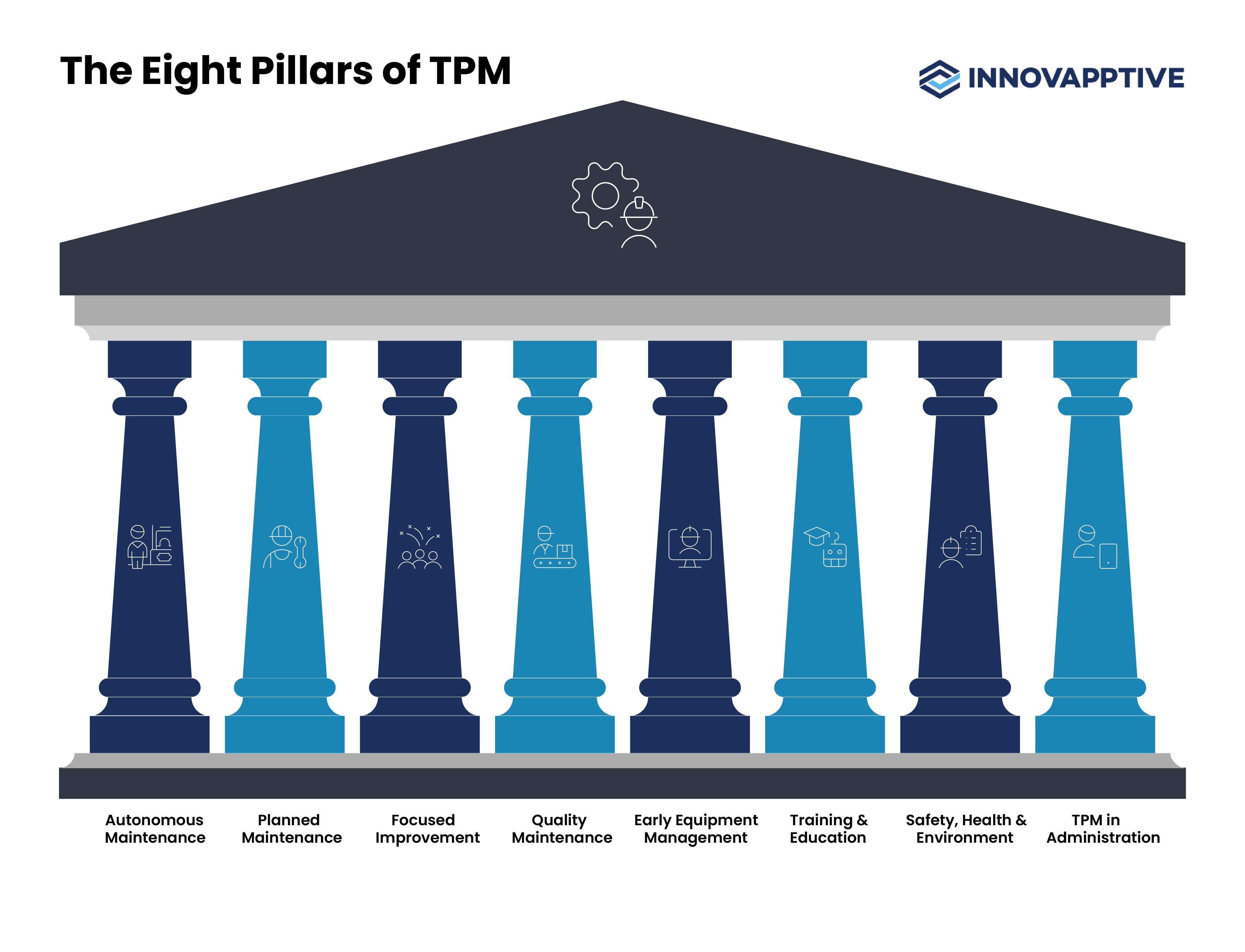
The eight pillars of TPM form the structural framework of the methodology. Each pillar addresses a distinct dimension of equipment and organisational performance. A successful TPM programme develops all eight pillars in parallel, supported by strong leadership commitment and a foundation of 5S workplace organisation.
1. Autonomous Maintenance
Autonomous maintenance is the most visible pillar of TPM and the one that most directly involves production operators. Rather than relying entirely on a dedicated maintenance team for routine tasks, operators are trained and empowered to perform basic equipment care, including cleaning, lubricating, tightening fasteners, and conducting visual inspections as part of their daily work routine.
This approach has two compounding benefits. First, it frees specialist maintenance technicians to focus on complex, value-added work such as predictive maintenance analysis, root cause investigations, and equipment improvement projects. Second, it gives operators a direct stake in equipment performance. An operator who cleans and inspects a machine every shift will detect early signs of wear or abnormality far sooner than a maintenance team visiting on a scheduled cycle.
2. Planned Maintenance
Planned maintenance replaces reactive, breakdown-driven maintenance with a structured schedule of preventive and predictive maintenance activities. Under this pillar, maintenance tasks are planned using equipment history, manufacturer guidance, failure mode analysis, and real-time condition monitoring data. The goal is to perform the right maintenance at the right time, eliminating both unexpected failures and unnecessary over-maintenance.
Planned maintenance under TPM is often integrated with a computerised maintenance management system (CMMS) that tracks asset history, schedules work orders, and monitors key reliability metrics such as MTBF and MTTR.
3. Focused Improvement (Kaizen)
Focused improvement, grounded in the Kaizen philosophy of continuous incremental improvement, targets specific, measurable equipment losses through structured cross-functional project teams. Rather than accepting recurring problems as normal operational constraints, focused improvement activities analyse their root causes and implement permanent countermeasures.
4. Quality Maintenance
Quality maintenance ensures that equipment conditions are maintained within precise tolerances required to produce conforming product. Rather than inspecting quality into finished goods, this pillar works upstream, ensuring that machines are capable of producing to specification before defects occur. It establishes quality standards directly tied to equipment condition parameters.
5. Early Equipment Management
Early equipment management applies TPM principles at the design and commissioning stage of new equipment. Maintenance engineers and operators contribute their operational experience during capital project planning, ensuring that new assets are designed for easy access, cleaning, inspection, and lubrication. This reduces the lifecycle cost of equipment and shortens the time to stable, reliable production after installation.
6. Training and Education
TPM cannot be sustained without a capable, engaged workforce. The training and education pillar develops the skills of both operators and maintenance technicians through structured training programmes, skills matrices, and on-the-job coaching. The aim is to build a multi-skilled team where operators understand basic maintenance principles and technicians understand production quality requirements.
7. Safety, Health and Environment
The safety, health and environment pillar ensures that TPM activities do not introduce new risks and that safety is systematically built into every maintenance procedure. Zero accidents is one of the three core goals of TPM, and this pillar provides the framework, including risk assessments, standardised work, safety audits, and near-miss reporting to achieve it.
8. TPM in Administration
The final pillar extends TPM thinking beyond the shop floor into supporting administrative functions such as production planning, procurement, order processing, and supply chain management. Administrative inefficiencies, such as long lead times for spare parts or slow work order processing, directly impact equipment uptime and maintenance effectiveness.
Key Elements of a Total Productive Maintenance System
Beyond the eight pillars, a functioning TPM system depends on several foundational elements that connect individual activities into a coherent, self-sustaining programme.
Operator Involvement in Maintenance
The single most important enabler of TPM is genuine operator involvement. When frontline production workers actively participate in equipment care, not as an add-on responsibility but as an integrated part of their role, the organisation gains a level of equipment awareness and early-detection capability that no maintenance department alone can replicate. Operators become the first line of defence against deterioration and failure.
Effective operator involvement requires more than assigning tasks. It requires training, standardised procedures, appropriate tools, visual management systems that make abnormalities immediately visible, and a management culture that recognises and rewards equipment ownership behaviour.
Cross-Functional Collaboration
TPM breaks down the traditional silos between maintenance, operations, quality, and engineering teams. Focused improvement projects bring together representatives from each function to analyse problems, share data, and implement solutions that no single team could achieve independently. This collaboration accelerates problem resolution and builds shared accountability for equipment performance.
See How Innovapptive Enhances your TPM Program
Innovapptives Connected Frontline Execution Platform accelerates TPM implementation by centralising work orders, tracking OEE in real time, and supporting autonomous maintenance workflows at the frontline.
How TPM Improves Overall Equipment Effectiveness (OEE)
Overall Equipment Effectiveness (OEE) is the primary performance metric used to measure TPM progress. The two methodologies are deeply interconnected: TPM provides the operating system, and OEE provides the measurement framework. Understanding how they relate is essential for any manufacturing leader implementing TPM.
Understanding OEE
OEE is a composite metric that measures how effectively a manufacturing asset is being utilised relative to its full potential. It is calculated as the product of three factors:
| OEE = Availability × Performance × Quality |
|
AVAILABILITY |
PERFORMANCE |
QUALITY |
|---|---|---|
|
Planned time actually running |
Running at rated speed |
Good parts produced |
A world-class OEE score is generally considered to be 85% or above, though the appropriate target varies by industry and equipment type. Most manufacturing plants begin TPM programmes with OEE scores in the 40 to 60% range, indicating substantial room for improvement.
TPM Loss Reduction Model
TPM targets what Nakajima identified as the Six Big Losses which are the six primary categories of waste that reduce OEE across manufacturing operations. Each loss maps directly to one of the three OEE components.
|
Availability |
Equipment Breakdown Unplanned stoppages caused by equipment failure, which are the most visible and costly loss category. |
|
Availability |
Setup and Adjustment Time lost during changeovers, warm-up periods, and equipment adjustments between production runs. |
|
Performance |
Idling and Minor Stoppages Short, frequent interruptions that do not trigger a formal maintenance call but accumulate into significant lost production time. |
|
Performance |
Reduced Speed Equipment running below its designed rate due to mechanical issues, material problems, or operator caution. |
|
Quality |
Process Defects Scrap and rework generated during stable production due to equipment condition issues. |
|
Quality |
Reduced Yield / Startup Losses Defects produced during startup, warm-up, or after changeovers before equipment reaches stable conditions. |
Benefits of Total Productive Maintenance
Manufacturers who sustain a mature TPM programme over two to three years consistently report measurable improvements across multiple performance dimensions. The benefits compound over time as the culture shifts from reactive firefighting to proactive improvement.
Productivity Improvements
TPM directly increases manufacturing throughput by reducing the frequency and duration of equipment stoppages. As OEE improves, the same physical assets produce more output within the same scheduled time, improving capacity utilisation without capital investment. In competitive manufacturing markets, this productivity gain translates directly into margin improvement and greater responsiveness to customer demand.
Cost Reduction
The financial case for TPM is compelling. Unplanned breakdowns are among the most expensive events in a manufacturing facility, as they involve emergency labour, expedited spare parts, scrapped material, and often contractual penalties for delayed customer deliveries. TPM systematically reduces breakdown frequency, shifting maintenance spend from emergency reactive work to lower-cost planned activities. Many manufacturers report maintenance cost reductions of 20 to 30% within three years of programme launch.
Workplace Safety Improvements
Well-maintained equipment is inherently safer equipment. TPM's safety pillar and its emphasis on clean, orderly, and inspected machinery significantly reduces the likelihood of equipment-related safety incidents. Additionally, the cultural shift toward proactive equipment care creates a workforce that is more attentive to hazards and more disciplined in following standardised work procedures.
The Best Maintenance Strategy Still Fails If The Field Cannot Execute It.
See how the frontline execution platform is changing industrial maintenance, and why the plants closing the gap between insight and action are pulling ahead.
How to Implement Total Productive Maintenance
Implementing TPM is a multi-year organisational journey, not a short-term project. Successful implementation requires sustained leadership commitment, structured training, rigorous measurement, and a willingness to change deeply embedded operating habits. The following five-step roadmap provides a practical framework for manufacturing organisations beginning this journey.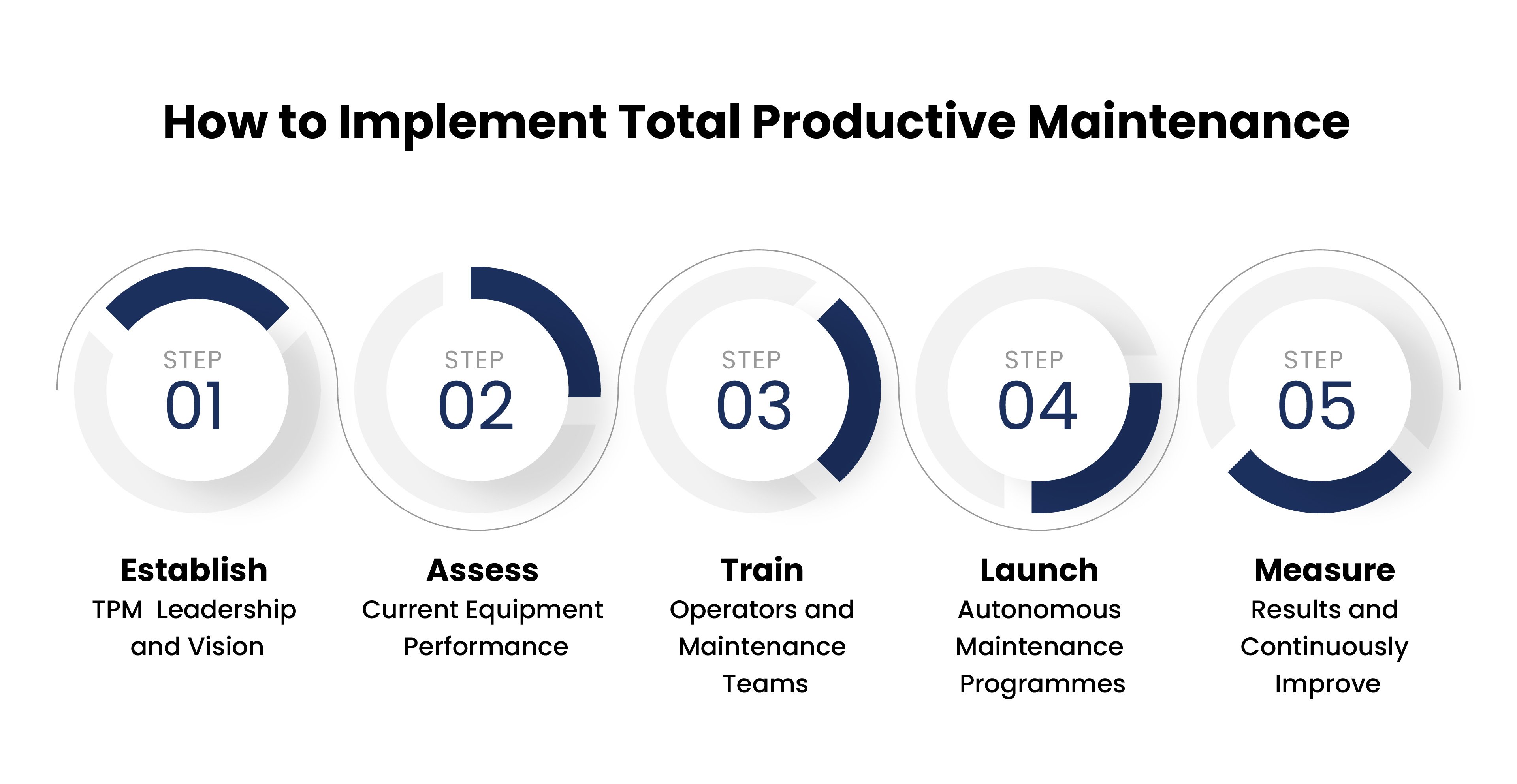
1. Establish TPM Leadership and Vision
TPM cannot be delegated to a maintenance department alone. Senior plant leadership must define clear TPM goals tied to business objectives, such as OEE targets, downtime reduction commitments, safety performance standards, and visibly sponsor the programme. A TPM steering committee with cross-functional membership, including operations, maintenance, quality, and HR, provides the governance structure to sustain the initiative through the inevitable challenges of cultural change.
2. Assess Current Equipment Performance
Before implementing changes, establish a clear baseline. Measure OEE for all critical assets, document current breakdown frequency and duration, and map your existing maintenance activities against the eight TPM pillars. This baseline assessment identifies your highest-priority improvement opportunities and provides the before-state data needed to demonstrate TPM's impact over time.
3. Train Operators and Maintenance Teams
Effective TPM requires a significant investment in workforce capability development. Operators need training in basic maintenance principles, equipment inspection techniques, and the use of visual management tools. Maintenance technicians need development in reliability engineering, predictive maintenance technologies, and root cause analysis methodologies. Training should be practical, delivered on the shop floor, and reinforced through ongoing coaching.
4. Launch Autonomous Maintenance Programmes
Begin autonomous maintenance on a pilot asset or production line rather than attempting a plant-wide rollout simultaneously. Develop standardised cleaning and inspection procedures, establish visual standards, and provide operators with the tools and time needed to perform their expanded responsibilities. Track compliance and early-detection results carefully to build the evidence base for broader rollout.
5. Measure Results and Continuously Improve
OEE, MTBF, MTTR, planned maintenance compliance rate, and safety incident frequency are the core metrics for tracking TPM progress. Review these metrics regularly at team, department, and plant leadership level. Use focused improvement Kaizen activities to address persistent loss categories identified through the measurement process. Celebrate progress visibly to sustain organisational momentum.
TPM Example in Manufacturing Operations
A Science Direct Study conducted at a chemical manufacturing plant revealed a highly reactive maintenance environment, with 67.6% of activities driven by breakdown maintenance, only 24.3% preventive maintenance, and operator involvement as low as 14%. As a result, Overall Equipment Effectiveness (OEE) stood at just 37% which is far below the 85% world-class benchmark with equipment availability at 74.8% and downtime largely driven by spare parts shortages (52% of incidents).
To address these gaps, researchers designed a full eight-pillar TPM model focused on shifting the plant from reactive to proactive operations. Key interventions included establishing autonomous maintenance to increase operator involvement toward the 60 to 70% industry benchmark, implementing structured preventive maintenance to push the PM-to-CM ratio above 70%, resolving spare parts visibility constraints, and introducing OEE as the central performance governance metric. The study concluded that TPM adoption could significantly reduce losses, improve profitability, and close the 48-point OEE gap.
At Indorama Ventures’ Port Neches facility, a similar shift was executed using Innovapptive. By digitising maintenance workflows and connecting frontline execution, the plant moved from a reactive, paper-based system to a predictive, data-driven operation, improving the PM-to-CM ratio from 45% to over 80%, reducing contractor dependency by 38%, achieving 99.5% inventory accuracy, and unlocking over $50M in annual EBITDA improvement at a single site.
See How we Deliver Measurable EBITDA Impact
Download the full case study to understand how a global chemical manufacturer transformed maintenance execution and unlocked $50M+ in annual value.
Common Challenges in TPM Implementation
TPM implementation is not without difficulty. Organisations that enter the programme without a clear understanding of the common obstacles are more likely to lose momentum or revert to old behaviours.
Resistance to cultural change is the most frequently cited challenge. Production operators accustomed to a clearly defined boundary between their role and the maintenance team's role may resist taking on expanded equipment care responsibilities. Overcoming this requires genuine management commitment, meaningful training, and visible recognition of operator contributions to equipment performance.
Inconsistent leadership support is a close second. TPM requires consistent investment of time, resource, and management attention. When production pressure builds, organisations often deprioritise TPM activities, particularly training and autonomous maintenance routines, are deprioritised in favour of short-term output targets. This erodes the programme over time.
Measurement infrastructure gaps also present a significant hurdle. TPM requires reliable, granular data on equipment performance. Many plants lack the data collection systems or the discipline to accurately record downtime events, categorise failure modes, or calculate OEE consistently. Establishing this measurement foundation is essential before meaningful TPM progress can be tracked.
TPM vs Traditional Maintenance Strategies
Not all maintenance approaches are created equal. This comparison highlights how TPM differs from reactive, preventive, and predictive strategies.
|
Approach |
Trigger |
Ownership |
Cost Profile |
Outcome |
|
Reactive Maintenance |
Equipment has already failed |
Maintenance dept only |
High - emergency labour and expedited parts |
Unpredictable; high downtime risk |
|
Time- or usage-based schedule |
Maintenance dept only |
Moderate - risk of over-maintenance |
Reduces breakdowns but not optimised |
|
|
Predictive Maintenance |
Condition monitoring data |
Maintenance dept + engineering |
Higher upfront; lower long-term |
Optimised timing; reduces failure risk |
|
Total Productive Maintenance (TPM) |
Proactive; integrated into daily operations |
Whole organisation |
Lower over time; planned and predictable |
Maximum OEE, reliability, and safety |
How to Measure Total Productive Maintenance Success
Measuring TPM success requires a suite of metrics that collectively capture equipment reliability, maintenance efficiency, quality performance, and safety outcomes. No single number tells the full story.
Overall Equipment Effectiveness (OEE) is the primary TPM metric. Track it at the asset, line, and plant level. Set improvement targets by period and review trends rather than point-in-time snapshots.
Mean Time Between Failures (MTBF) measures average operating time between unplanned breakdowns. Increasing MTBF indicates that TPM activities, particularly planned maintenance and autonomous maintenance, are successfully extending equipment reliability.
Mean Time to Repair (MTTR) measures how quickly the maintenance team restores a failed asset to operation. Decreasing MTTR indicates improving maintenance capability, better spare parts management, and clearer repair procedures.
Planned Maintenance Compliance Rate tracks the percentage of scheduled maintenance work orders completed on time. This metric is a leading indicator of TPM health, and a declining compliance rate often predicts future reliability deterioration.
Breakdown Frequency, Defect Rate, and Lost Time Incident Rate round out the core measurement framework, connecting TPM activities directly to quality and safety outcomes.
How Innovapptive Supports Your TPM Initiative
TPM disciplines break down when data stays fragmented across paper, ERP and disconnected point tools. Innovapptive's AI-powered Connected Worker Platform bridges that gap - unifying operator rounds, planned maintenance, permit workflows, and inventory readiness into a single execution layer. The result: higher PM compliance, faster work order closure, and the structured data foundation that makes TPM measurable and sustainable.
Innovapptive addresses this execution gap by operationalising TPM at the frontline. Instead of treating TPM as a periodic initiative, Innovapptive embeds it into daily workflows, ensuring that every inspection, maintenance activity, and operator action contributes to measurable OEE improvement. Below are the key capabilities mapped to each TPM pillar:
- Autonomous Maintenance: AI-powered rounds, mobile work instructions, and computer vision help operators detect and address issues early.
- Planned Maintenance: AI-driven planning, visual scheduling, and SAP integration enable disciplined, data-backed execution.
- Focused Improvement: Real-time data, AI-powered 5-Why analysis, and Kaizen tracking eliminate recurring failures.
- Quality Maintenance: Digital inspections and standardized workflows support zero-defect operations.
- Safety, Health & Environment: Digital permits, LOTO, and hazard identification embed safety into execution.
- Early Equipment Management: Asset history and connected data improve reliability from installation onward.
- Training & Education: Digital skills tracking and guided workflows accelerate workforce readiness.
- Administrative TPM: Configurable workflows and Value 360 dashboards simplify governance and track business impact.
Identify Your Next $50M+ Margin Improvement Opportunity
Discover where hidden losses exist across your operations,and how to systematically eliminate them using Innovapptive's Connected Worker Platform
Final Thoughts on TPM
Total productive maintenance is far more than a maintenance programme. It is a strategic manufacturing methodology that aligns people, processes, and equipment performance around the shared goal of operational excellence. By distributing equipment ownership across the workforce, targeting losses systematically through the eight pillars, and measuring progress through OEE, TPM creates a self-reinforcing improvement culture that compounds in value over time.
For manufacturing leaders evaluating TPM, the key question is not whether to implement it, but how to begin in a way that builds sustainable momentum. Starting with a clear baseline assessment, a committed leadership team, and a well-supported pilot programme on your highest-priority assets gives TPM the best foundation for long-term success.
Frequently Asked Questions About Total Productive Maintenance
1. What does total productive maintenance ensure?
Total productive maintenance ensures that manufacturing equipment operates at maximum effectiveness by preventing unplanned breakdowns, eliminating quality defects caused by equipment conditions, and creating a safe working environment. It achieves this through a structured system of proactive maintenance practices shared across the entire organisation, not just the maintenance department.
2. What is the goal of total productive maintenance?
The central goal of total productive maintenance is to achieve zero unplanned breakdowns, zero defects, and zero workplace accidents. These three zeros represent the ideal state of a manufacturing operation where equipment is perfectly reliable, consistently produces conforming product, and operates without safety incidents.
3. What are the key elements of total productive maintenance?
The key elements of total productive maintenance are the eight pillars, including autonomous maintenance, planned maintenance, focused improvement, quality maintenance, early equipment management, training and education, safety health and environment, and TPM in administration, supported by active operator involvement, cross-functional collaboration, 5S workplace organisation, and systematic OEE measurement.
4. How are total productive maintenance and OEE linked?
TPM and OEE are complementary frameworks. OEE provides the measurement system that quantifies equipment performance losses across availability, performance, and quality dimensions. TPM provides the operational methodology through its eight pillars to systematically reduce those losses. In practice, OEE scores are used to prioritise TPM improvement activities and to track the impact of programme initiatives over time.
5. How long does TPM implementation take?
A foundational TPM programme typically takes 18 to 36 months to establish measurable results across a manufacturing facility, depending on starting maturity, organisational size, and leadership commitment. The first six months focus on training, baseline measurement, and pilot autonomous maintenance. The second phase expands practices across all assets and launches focused improvement projects. Full TPM maturity is a multi-year, continuous improvement journey.
6. What is the difference between TPM and preventive maintenance?
Preventive maintenance is a scheduled, time-based maintenance strategy managed exclusively by a maintenance department. TPM is a broader organisational methodology that includes preventive maintenance as one component, the planned maintenance pillar, but extends far beyond it to encompass operator-led autonomous maintenance, continuous improvement projects, quality assurance, safety management, and capability development across the entire workforce.
Unlock Margins Hidden in your Maintenance
Watch how leading manufacturers improve OEE, increase PM compliance, and reduce downtime through connected execution.
- 05-10-2026
10 Best Shift Handover Software Platforms for Plant and Process Operations
Shift handover software can mean different things depending on the operating environment. Some...
- 29-09-2026
Best SAP Maintenance Planning & Scheduling Software 2026
Your maintenance work orders live in SAP Plant Maintenance (PM), while the working schedule lives...
- 28-09-2026
Best Work Order Software: Top 9 Platforms Compared
Selecting the best work order software is a different decision for a large industrial plant than...