
What Is the Manufacturing Skills Gap?
The manufacturing skills gap is the difference between the skills a plant needs to run safely and productively and the skills its current and available workforce can apply on the job. It includes roles that stay empty and roles filled by people who cannot yet perform the full task on their own.
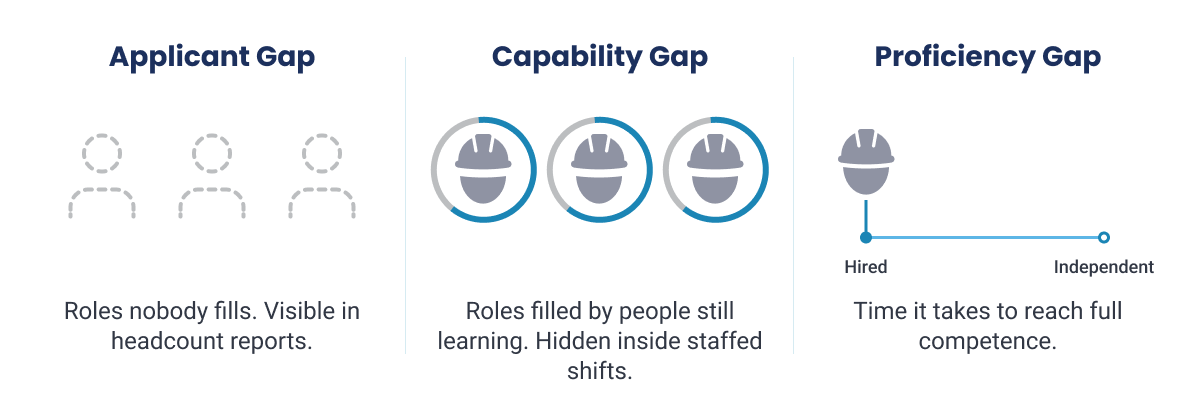
For a plant leader, it is more useful to split the gap into three parts, because each part needs a different fix and usually has a different owner.
| Gap | What it means | How it shows up in a plant | Who usually owns it |
|---|---|---|---|
| Applicant gap | Too few qualified people apply or are available. | Open requisitions, long hiring cycles, hard-to-fill technician roles. | HR and talent acquisition |
| Capability gap | People are present for a role but cannot yet do the full task alone. | Escalations to veterans, task restrictions, rework and repeat visits. | Often no one |
| Proficiency gap | The worker is improving, but the path to independent work is too long. | The training matrix shows green while the worker still needs expert support. | Often no one |
Most plants fund the applicant gap first as it has a clear owner and a visible metric, which capability risk lacks. The proficiency gap is measured least of all, because a completed training record looks like readiness on paper even when the worker still needs help on the floor.
Industry reports often treat the manufacturing skills gap and manufacturing skills shortage interchangeably. However, a skills shortage describes the labor market, where there are not enough trained people to hire, while a skills gap describes the distance between what your work requires and what your people can do today. A plant can have a skills gap even when it has plenty of applicants.
The US Manufacturing Skills Gap in Numbers
National data shows the gap is growing and moving toward technical roles. However, this number does help you determine what this growing gap is costing your plant. The latest figures show where the pressure is building:
- Manufacturing employers had 522,000 open jobs at the end of August 2026, up from 416,000 a year earlier, according to the Bureau of Labor Statistics.
- Deloitte and The Manufacturing Institute project that US manufacturing could need up to 3.8 million new employees between 2024 and 2033, and that 1.9 million of those jobs could go unfilled. This projection updates their widely quoted 2021 estimate of 2.1 million unfilled jobs by 2030.
- A September 2026 Deloitte and Manufacturing Institute analysis finds that, from 2025 to 2030, demand for manufacturing technicians is set to outpace production roles by about six to one with nearly half a million manufacturing technician roles already open.
- The same study put total demand for technicians at 2.3 million hires between 2025 and 2030. That figure covers manufacturing and neighboring industries, and it includes both new roles and replacements for people who retire.
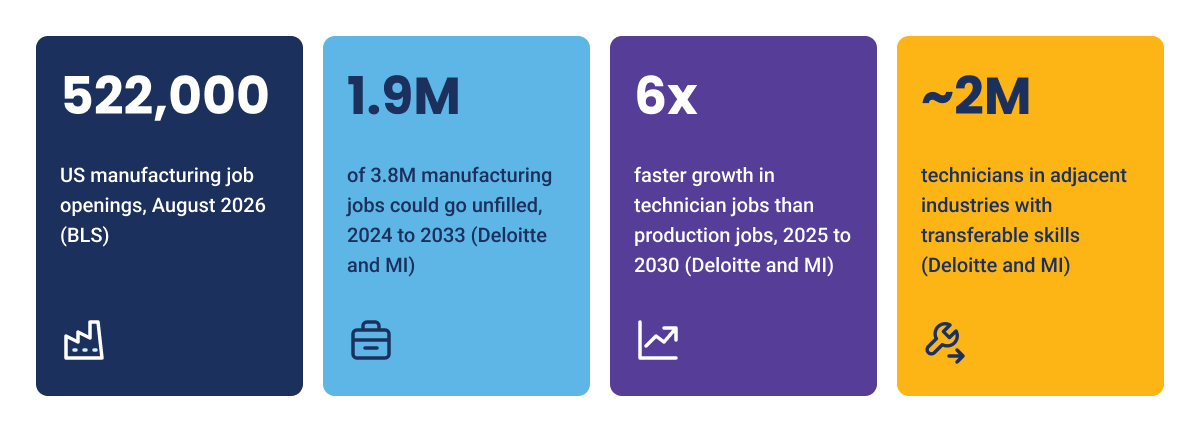
Taken together, these numbers say more than hiring is hard. It showcases that demand is growing much faster in technician roles than in production roles. For a plant, that means maintenance and controls requisitions may stay open longer than production plans assume. Meanwhile, the experienced technicians already on site will keep covering the gap through overtime and extra callouts.
It also means many of the people you do hire will bring adjacent experience instead of plant experience. How quickly they become productive will matter as much as how quickly they are hired. This changes the question plants should be asking. Manufacturers do not only need to find people who already know manufacturing. They need ways to make capable people productive faster.
What the Manufacturing Skills Gap Costs Your Plant
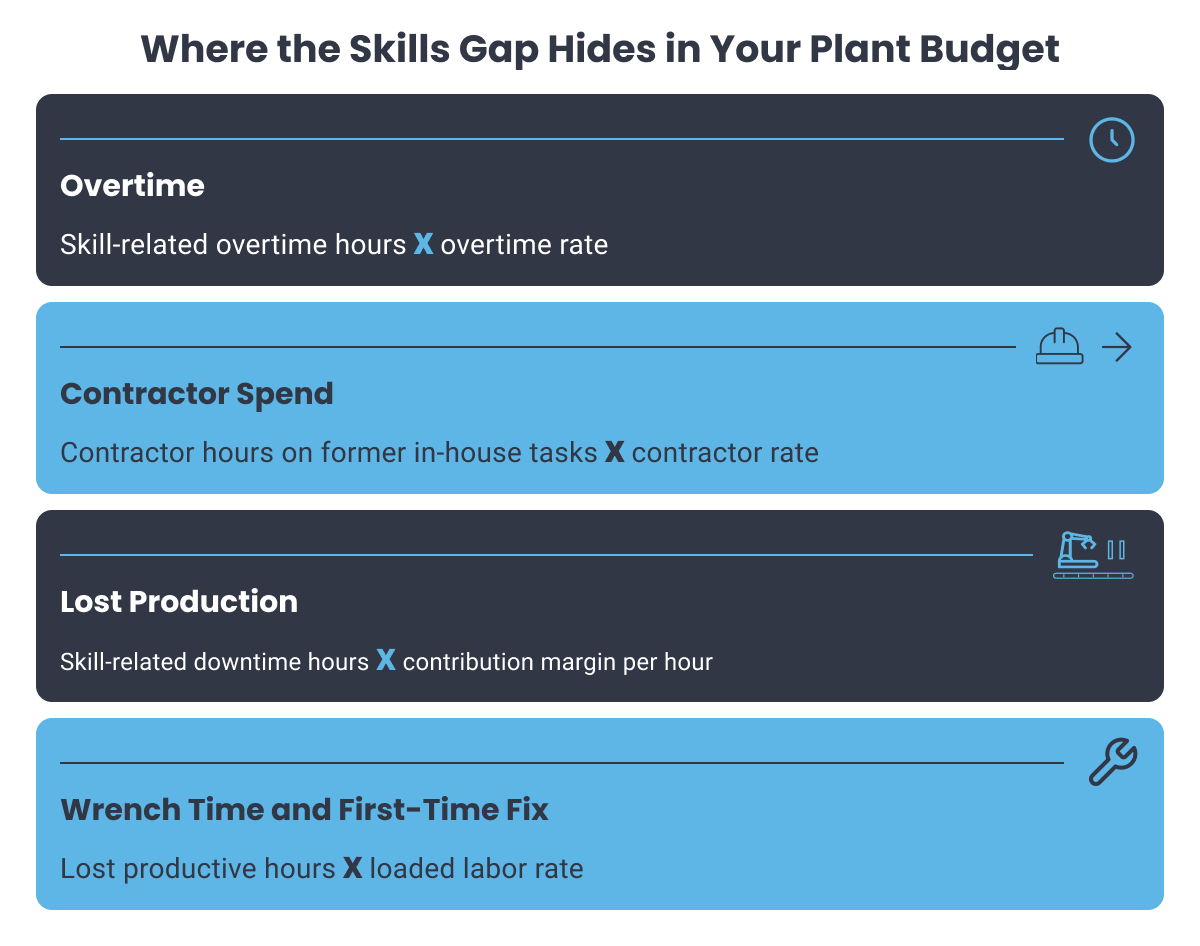
The skills gap rarely appears as a budget line of its own. Its associated cost generally shows up in four places: overtime, contractor spend, lost wrench time and downtime. These are also core maintenance costs, which is why closing the skills gap can help you reduce maintenance costs at the same time.
1. Overtime That Covers Work the Shift Could Not Finish
Overtime is often the first place a skills gap shows up. When no one on a shift is qualified to handle a particular task, the work does not go away. It waits for the next shift or the weekend, or it lands on the one technician who knows how to do it, usually at overtime rates. Because the root cause is missing capability and not a shortage of people, the extra hours are often written off as a scheduling problem, and the same pattern repeats month after month. Tracking overtime by task and asset, and not only by person, helps you see this early, since overtime often rises before contractors spend or downtime does.
2. Contractor Spend That Replaces Capability You Used to Hold
As experienced technicians retire, specialist work moves to contractors, and those invoices are rarely tagged as a skills cost. To test the link, list contractor work orders by task and asset, then compare them with the tasks your retired experts used to own. Where the lists overlap, part of the contractor bill is paying for capability the plant used to have.
3. Wrench Time Lost to Waiting, Searching and Rework
A technician who is unsure of the next step stops to find a manual or waits for a senior colleague. That idle time comes out of wrench time, the share of a shift spent on hands-on asset work. When a job is not done right the first time, the repeat visit lowers first-time fix rate and adds another round of labor.
4. Production Lost While a Line Waits for One Expert
Some assets effectively have one qualified troubleshooter. When that person is off shift or has retired, a one-hour fault can turn into a full shift of downtime. Compare downtime records with work order assignment history to find assets where the same name appears on every difficult repair.
To estimate each cost, use your existing plant records in the following way:
| Cost line | How the skills gap creates it | Where to find it | How to estimate it |
|---|---|---|---|
| Overtime | Work moves to whoever can do it, often after hours. | Timekeeping and workforce reports | Skill-related overtime hours x overtime rate |
| Contractor spend | Specialist tasks go outside after in-house experts leave. | Procurement records and work order history | Contractor hours on former in-house tasks x contractor rate |
| Wrench time and first-time fix | Technicians wait, search for answers or repeat work. | Mobile execution data and work order history | Lost productive hours x loaded labor rate |
| Lost production | Critical repairs wait for one expert. | Downtime logs and work order assignments | Skill-related downtime hours x contribution margin per hour |
Not every contractor dollar or overtime hour is a skills cost, but together they often reveal capability the plant no longer has in-house. An example of this in action is Indorama Ventures, a global chemical manufacturer. Despite significant investment in SAP and IBM Maximo, most frontline maintenance work at its Port Neches, Texas site was still paper-based and reactive. The site digitized work orders, operator rounds and inventory management on mobile devices connected to those existing systems. Over the course of the program, it cut maintenance overtime from 24% to 12% and reduced its reliance on outside contractors.
How Much Is the Skills Gap Costing Your Plant?
Book a margin walkthrough with our team to size the overtime, contractor spend and downtime tied to capability gaps in your own plant data.
Hiring Gap or Capability Gap: Which One Does Your Plant Have?
Most plants have both gaps but fund only the hiring side, because hiring has an owner, a budget line and a clear metric. If most of your signs sit in the right-hand column below, more recruiting alone will not fix the problem.
| Signs of a hiring gap | Signs of a capability gap |
|---|---|
| Job openings stay unfilled for months. | Shifts are fully staffed, but the same few people handle every difficult job. |
| Overtime rises because there are not enough people on the roster. | Overtime rises because work waits for the right person. |
| You delay shifts or decline orders for lack of technicians. | Repeat visits and rework are climbing on specific assets. |
| New hires leave during the probationary period. | New hires stay, but still need close supervision months after onboarding. |
Retirements Take Away Capability, Not Just Headcount
Replacing a retiring technician with another restores the headcount, not the capability. A technician who has worked on the same compressors for twenty years knows their failure history, which warning signs actually matter, and which spare parts tend to run late. A new hire starts without any of that, so for months the plant looks fully staffed on paper while it depends on fewer people for the difficult work.
The impact grows when several retirements hit the same asset class within a few years, because the remaining experts absorb more callouts, more overtime and more on-the-job coaching at once. The retirement wave is already changing the workforce mix, and the US Census Bureau notes that every baby boomer will be age 65 or older by 2030. For plant leaders, this means retirement planning should start with an asset-by-asset view of who holds critical knowledge, and not only a headcount forecast.
New Hires Take Time to Become Fully Capable
Finishing onboarding and job readiness are two different milestones. A training matrix can show a technician as qualified once they complete a course, but completing a course is not the same as handling a real fault under pressure. Supervisors know this, so they often keep newer technicians off critical or high-risk assets until they have more hands-on experience. A mistake on those assets can mean a safety incident, a damaged asset or a long outage.
That caution is sensible, but it has a cost. The difficult jobs keep going to the same few experienced people, which drives up their overtime and slows the newer technician's learning even further. The time between completing training and working independently is time to proficiency, and shortening it is one of the most direct ways to reduce the capability gap.
The Skill Mix Now Spans Technical, Digital and Adaptive Skills
Newer equipment adds PLCs, sensors and data screens to jobs that used to be mostly mechanical, so technicians now need digital skills on top of technical ones. EY and The Manufacturing Institute point to a third layer they call adaptive skills, including learning agility, root cause analysis and systems thinking.
For plants, this changes what a qualified technician looks like. A mechanic who can rebuild a gearbox may still struggle to read a PLC alarm history or work through a root cause analysis on a repeat failure. When job descriptions and training plans focus on only one of these skill sets, the missing ones show up later as escalations, repeat work and longer repairs.
So closing the skills gap is no longer only about hiring people with the right years of experience. Plants need a way to build technical, digital and problem-solving skills together, and to support workers on the job while those skills develop.
Where Expert Knowledge Goes When Experienced Workers Retire
Undocumented knowledge is the part of the skills gap that no hiring budget can buy back, because it was never written down. Common examples include:
- Early warning signs of failure that an experienced technician recognizes by sound, smell or vibration before any alarm trips.
- Workarounds for known issues on a specific pump, valve or line that no manual mentions.
- The real order of steps for a restart or changeover, which often differs from the official procedure.
Capturing this knowledge while experts are still on site is the most time-sensitive step a plant can take. The same problem is common in oil and gas, where operators use digital work instructions to preserve tribal knowledge from retiring experts, and the approach carries over directly to manufacturing plants.
Turn Retiring Expertise Into Everyday Guidance
See how digital work instructions help new hires close skills gaps, reduce rework and work more safely, using knowledge your experienced workers already have.
How AI Helps Close the Capability Gap
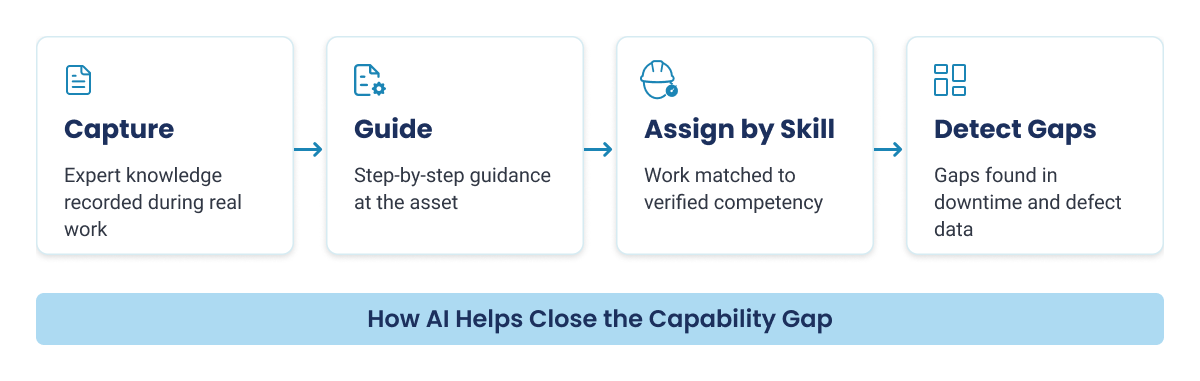
AI helps close the capability gap by putting expert-level guidance in front of the worker at the moment of work. Critical knowledge then no longer lives only in one person's memory. This helps the people you already have become fully capable sooner, without adding additional headcount.
The Deloitte study reaches a similar conclusion. It finds that embedding expertise into daily work helps less experienced workers, and people moving in from adjacent industries, contribute sooner. It also counts nearly 2 million adjacent-industry technicians whose skills may transfer to manufacturing. The four uses below sit within the wider field of AI in maintenance, and each one maps to a cost line above.
1. Capture Expert Knowledge While the Expert Is Still There
Documentation projects often stall because they ask busy experts to stop working and write. With AI, an expert records a short repair video or talks through the steps, and AI turns it into a step-by-step guide with photos and safety notes. That can reduce the need to outsource the task after the expert leaves.
With Innovapptive's digital work instructions software, for example, a video captured in the field becomes a structured procedure, and a reviewer approves it before it reaches technicians. This cuts procedure creation time by almost 90%.
2. Guide Technicians Through Work They Have Not Done Before
Step-level digital work instructions on a mobile device show a newer technician the right sequence, the limits to check and what a correct result looks like. When the guide does not cover the situation, the technician can ask an AI assistant about the asset's history or call in a remote expert. The immediate benefit is less time spent searching for answers and fewer repeat visits.
This works best when the guide comes with the job. Innovapptive embeds each procedure directly in the work order, operation or round, so it attaches automatically based on work order type and asset. Technicians do not have to search a library for the right PDF, and they can flag a step that needs correcting from the field.
3. Match Work to Verified Skills, Not Just Availability
A lot of time work is assigned based on who is free. However, plants need a better way to assign technicians. Skills-based assignment checks who is qualified and certified for the specific task before dispatch, so supervisors can see competency instead of guessing. When competency records update from completed work, the skills matrix becomes a live record. Overtime can fall when the right person gets the job the first time.
Innovapptive manages work instructions and skill tracking in the same platform. Procedures can be tied to certifications, and each technician's competency record updates as they complete digital work instructions, so supervisors assign work based on what people have actually done.
4. Find Skills Gaps Hiding in Downtime and Defect Data
Training records show who attended a course, while operations data shows who can do the work. AI can scan work orders, repeat failures and quality records for patterns, such as one fault that keeps returning on a certain shift, and point coaching at the real cause.
Because Innovapptive records step completion against each work order and links procedures, assets, incidents and training records in a knowledge graph, these patterns become visible. Supervisors can see where the same step keeps causing problems and get recommended actions to address it.
However, AI has clear limits. It cannot fill empty roles, and it does not replace hands-on practice, physical skill or safety accountability either. The point is not to remove the need for experience. It is to make more of that experience usable by the rest of the team.
Deloitte and The Manufacturing Institute see AI the same way. Their study describes AI as a way to widen the pool of qualified applicants and supplement on-the-job training, not replace it.
Closing the Skills Gap Starts With Closing the Execution Gap
From AI-guided troubleshooting to step-by-step work instructions and faster root cause analysis, see how AI agents support operators, technicians and reliability engineers in their daily work.
How Manufacturers Can Close the Skills Gap Beyond Hiring
Hiring will always be part of the answer, but plants that make real progress on the skills gap also build the capability of the people they already have. The best place to start is your own data, because a plant that cannot see its cost lines cannot pick the right first target or prove that anything worked. The most practical way for manufacturers to address skills gaps with digital solutions is to follow a clear order:
- Set a baseline: Pull 12 months of overtime, contractor spend, wrench time, first-time fix rate and downtime, and link them to specific tasks or assets where you can.
- Find single-point-of-knowledge tasks: List the assets and task families that only one or two people can troubleshoot on their own.
- Capture that knowledge first: Turn expert know-how for those tasks into visual, step-by-step guidance before attempting a plant-wide documentation project.
- Put guidance where the work happens: Make it available on mobile devices at the asset, including areas with poor connectivity.
- Assign work by verified skill: Use skills and certification data for dispatch, and use the same data to plan training.
- Scale the changes that improve your baseline metrics: Expand to the next set of assets once your baseline numbers improve. More training completions or app logins on their own are not a sign of progress.
Apprenticeships, community college partnerships and hiring from adjacent industries still matter, but they take years to pay off. Run them as your long-term supply plan alongside the near-term steps above. Small and mid-sized manufacturers can also get workforce support through the NIST Manufacturing Extension Partnership.
How to Measure Whether the Skills Gap Is Closing
Time to proficiency is the most useful single measure of the skills gap, because it tracks how long a worker takes to perform a task independently at the required standard. Even McKinsey recognizes it as a core productivity goal for manufacturers as experienced workers retire. Plants should note that training completion rate is a weak headline metric to track, because it can rise every quarter while the gap widens.
| Metric | What it tells you | Where the data lives | Direction of improvement |
|---|---|---|---|
| Time to proficiency | How fast a worker becomes independently capable on a task | Training system, supervisor sign-off and work order history | Down |
| First-time fix rate | Whether work is done right without a repeat visit | Work order system | Up |
| Wrench time | How much paid time goes to hands-on asset work | Mobile execution and workforce data | Up |
| Overtime hours per technician | Whether capability pressure is spilling into labor cost | Timekeeping system | Down |
| Contractor spend as a share of maintenance cost | How much capability you are buying from outside | Procurement and maintenance records | Down, where work can be safely brought in-house |
| Critical tasks with usable work instructions | How much expert knowledge is now reusable | Work instruction platform | Up |
| Single-point-of-knowledge tasks | How exposed you are to one person leaving | Skills matrix and work history | Down |
Watch overtime and first-time fix rate early, since they can respond as soon as technicians have guidance at the asset. Review contractor spend and time to proficiency quarterly, because they take longer to change.
How Indorama Ventures Reduced Its Reliance on Contractors
Contractor spend is one of the clearest metrics in the table above, and Indorama Ventures shows how it can move. Reducing contractor and overtime spend was one of the stated goals when the $15.4 billion chemical manufacturer deployed Innovapptive Connected Worker Platform at its Port Neches, Texas site. The site tracked contractor spend, MTTR and total cost savings on live dashboards as the program ran. At this single site, the results included:
- Contractor headcount down 38%, from 140 to 87.
- Work instruction use up from under 20% to 85%.
- Maintenance backlog down 58%, from 24 weeks to 10 weeks.
- $19 million in realized EBITDA savings in 2025, with a $50 million enterprise-wide cost takeout opportunity identified.
The rise in work instruction use is the figure most closely tied to the skills gap. It means far more jobs were being done with step-by-step guidance in hand, which is how one technician's know-how becomes something the whole crew can use.
Could Your Plant See Similar Results?
Get the full story behind Indorama's reduction in contractor dependency, including the workflows it digitized and how it measured savings.
How Innovapptive Helps Plant Leaders Close the Capability Gap
Innovapptive's connected worker platform gives plants one place to capture expert knowledge, guide work and manage skills, inside the mobile workflow technicians already use for work orders. It runs on top of SAP and IBM Maximo, so guidance and skills data attach to the work orders your plant already runs. Across the platform, 15 purpose-built AI agents support maintenance, operations and reliability teams, including:
- Turning expert know-how into guidance: AI Work Instructions converts expert videos into step-by-step guides, and AI Digitize turns existing paper and PDF forms into digital ones.
- Supporting technicians at the asset: AI Assist answers technician questions with real-time asset information, and AI Troubleshooting recommends fixes based on equipment history.
- Stopping repeat failures: AI 5-Why Analysis runs a structured root cause analysis on recurring problems, and AI Action Recommendations suggests preventive actions from the findings.
- Managing skills alongside the work: Managers can map competencies by person and team, and those records update as technicians complete digital work instructions.
Frost & Sullivan pointed to these AI agentic workflows, along with gains in productivity and cost savings, when it named Innovapptive its 2026 Global Company of the Year in the Augmented Connected Worker, End-to-End Platforms industry.
Start Closing the Capability Gap at Your Plant
Talk to our team about where capability gaps are driving overtime and contractor spend, or download the solution brief to see how digital work instructions help newer technicians work independently sooner.

Unlock Margins Hidden in your Maintenance
Watch how leading manufacturers improve OEE, increase PM compliance, and reduce downtime through connected execution.

- 12-10-2026
Manufacturing Skills Gap: What It Costs and How to Close It
A plant can have every role filled and still experience a manufacturing skills gap. Very often,...

- 05-10-2026
10 Best Shift Handover Software Platforms for Plant and Process Operations
Shift handover software can mean different things depending on the operating environment. Some...

- 29-09-2026
Best SAP Maintenance Planning & Scheduling Software 2026
Your maintenance work orders live in SAP Plant Maintenance (PM), while the working schedule lives...