
What Is AI in Maintenance?
AI in maintenance is the application of artificial intelligence technologies, including machine learning, IoT sensor analytics, natural language processing, and agentic AI, to automate, optimize, and improve industrial maintenance operations across the full asset lifecycle.
In practice, this means IIoT sensors continuously streaming equipment data (temperature, vibration, pressure, energy consumption) into ML models that detect anomalies, predict failures, and generate real-time operational outputs: automated work orders, scheduling recommendations, inventory reorder alerts, and technician guidance delivered to the shop floor. The result is a maintenance operation that acts on data rather than on symptoms.
It is important to note that AI maintenance is a broader category than predictive maintenance. While predictive maintenance is the most widely discussed application, the category also includes automated work order management, NLP-enabled maintenance requests, generative AI for standard operating procedures (SOPs), voice transcription tools for frontline workers, condition-based scheduling optimization, root cause analysis, and connected worker platforms that deliver all of these capabilities to technicians on mobile devices. Understanding this breadth matters because organizations can begin capturing AI value in maintenance without a full predictive maintenance program in place.
With mounting pressure to reduce maintenance budgets and asset reliability targets, industries across are swiftly adopting AI to optimize maintenance operations. According to a Forbes/Xometry survey, 80% of manufacturing CEOs plan to invest in AI within two years, and 61% are already actively embracing it.
AI in Maintenance vs. Traditional CMMS: What's the Real Difference?
For maintenance managers already running a Computerized Maintenance Management System (CMMS), the practical question is not what is AI? But what value does AI actually add? The table below provides a comprehensive overview of the AI-led value addition in maintenance operations.
| Capability | Traditional CMMS | AI-Enhanced CMMS | AI + Connected Worker Platform (Innovapptive) |
|---|---|---|---|
| Work order creation | Manual planner creates each order | Automated from IoT triggers and PM schedules | Automated + delivered to technician's mobile device with procedure attached |
| Scheduling logic | Fixed time-based intervals | Condition-based, asset-health-driven | Condition-based + balanced against technician availability, shift, and parts inventory |
| Failure detection | Threshold alerts after the fact | ML anomaly detection before threshold breach | Real-time anomaly - mobile push notification to on-shift technician |
| Technician guidance | Paper procedure or static PDF | Digital checklist | Adaptive digital work instructions that adjust to the asset's current failure mode |
| Data use | Historical record-keeping | Model training and prediction | Continuous feedback loop: technician field data improves model accuracy over time |
| Continuous improvement | Manual review cycles | Automated pattern recognition | AI root cause analysis identifies recurring failure patterns across asset classes |
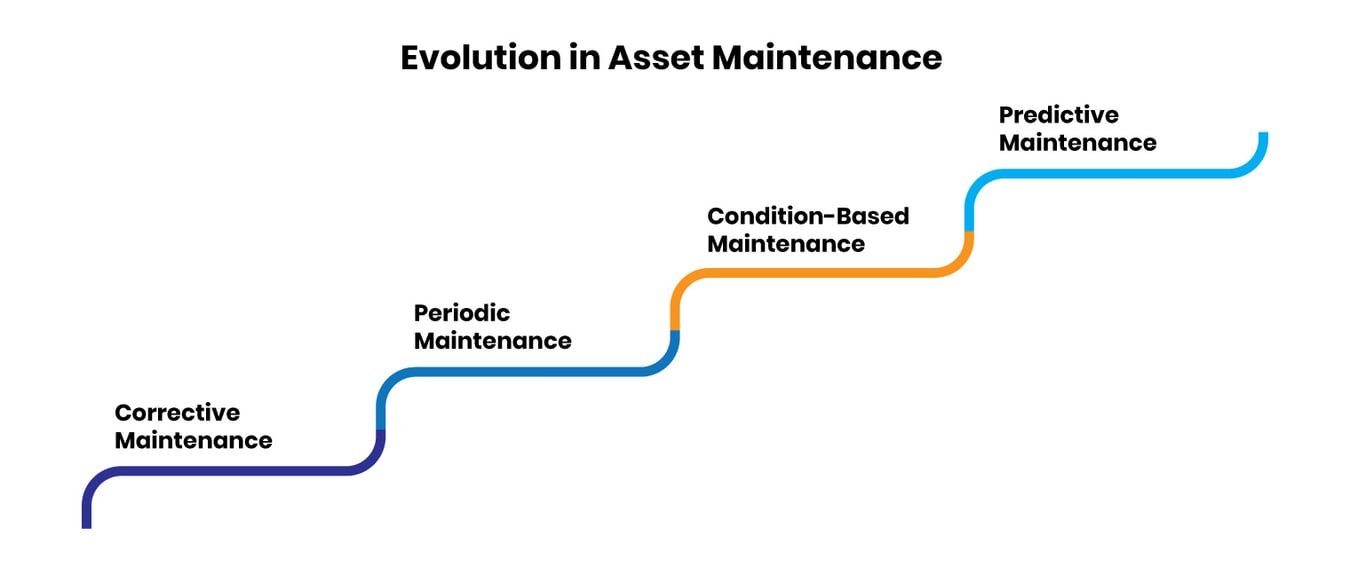
Most industrial maintenance teams today sit somewhere between the first and second columns; they have a CMMS but use it primarily as a record-keeping system. AI enhanced CMMS ensures that AI's recommendations reach the actual frontline person physically performing the work.
The True Cost of Reactive Maintenance: Why Industrial Teams Can't Afford to Wait
The urgency behind AI maintenance adoption is not driven by technology trends, it is driven by what reactive maintenance actually costs. Research published in ScienceDirect (2023) found that 70 to 80% of a facility asset's total lifecycle cost occurs during the operation and maintenance phase, making maintenance the single largest controllable cost driver in most industrial facilities. Further, according to a study by Plant Engineering, 61% of maintenance facilities still perform maintenance primarily reactively, meaning the majority of the industry is paying emergency labor rates and accepting unplanned downtime. Aggregated across industrial manufacturing, Deloitte estimates that reactive maintenance contributes to $50 billion in annual unplanned downtime losses. This is exactly the gap AI maintenance is closing by helping enterprises with the correct operational tools that reach the frontline, making maintenance predictive and continuous.
The Practical AI Blueprint for Maintenance & Reliability Leaders
Your existing CMMS is one AI layer away from predicting failures, automating work orders, and closing the loop on frontline execution. This blueprint shows you how.
How AI in Maintenance Reduces Costs
The business case for AI in maintenance is no longer theoretical. AI shifts maintenance spend from expensive, reactive firefighting to lower-cost, proactive intervention.
From Reactive to Proactive: Understanding Maintenance Cost Drivers
AI in maintenance reduces costs by targeting each of the major cost categories that drain maintenance budgets:
| Cost Driver | How AI in Maintenance Addresses It |
|---|---|
| Emergency repair labor premiums | Predictive alerts enable planned interventions during regular shifts eliminating overtime and emergency contractor call-outs |
| Production downtime losses | Failure prediction allows maintenance to be scheduled during production windows rather than causing unplanned stops |
| Over-maintenance / unnecessary PMs | Condition-based scheduling replaces fixed-interval PMs, assets that are healthy are not serviced unnecessarily |
| Parts waste and stockouts | AI demand forecasting aligns parts procurement with predicted maintenance needs, reducing both overstocking and emergency part sourcing |
| Safety incidents and regulatory penalties | Early AI alerts on equipment anomalies allow corrective action before failures create safety hazards or compliance violations |
Also, read: How to Reduce Maintenance Costs: Eight Proven Strategies
AI Maintenance ROI: What Does a 40% Cost Reduction Actually Look Like?
For a maintenance manager who owns a budget, industry benchmarks need to translate into real numbers. Consider a manufacturing facility with $2 million in annual maintenance spend: a 25 to 40% AI-driven cost reduction represents $500,000 to $800,000 in annual savings, often recovering the total cost of an AI maintenance program within the first 12 to 18 months.
The real-world data supports this range. Indorama Ventures' Port Neches facility reported projected annual maintenance savings of $29 million after implementing Innovapptive's Connected Worker Platform.
AI-Powered Work Order Management: From Manual to Automated
Work orders lie at the center of a reliable maintenance operation, every repair, inspection, and PM flows through them. Yet in most industrial facilities, work order management remains largely manual: planners create orders by hand, prioritize based on tribal knowledge, and dispatch via paper printout. The result is slow response times, inconsistent technician assignments, and a growing backlog of competing jobs with no objective ranking system. AI maintenance changes this across three layers: automated generation, intelligent prioritization, and mobile dispatch to the frontline.
Automated Work Order Generation: From IoT Triggers to Technician Dispatch
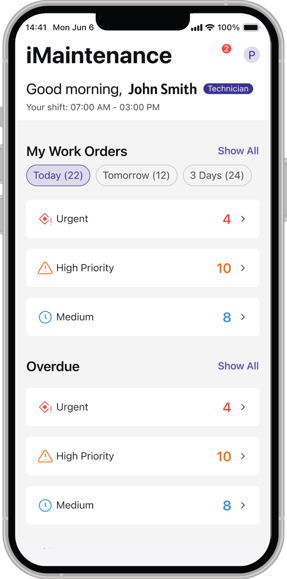
AI maintenance systems auto-generate work orders from four triggers: IIoT sensor breaches, scheduled PM completions, anomaly detection events, and operator-submitted alerts. Each order is instantly populated with asset history, recommended procedure, parts list, and safety steps and is then routed to the right certified technician based on skill set, shift, and proximity.
This end-to-end automation eliminates the minutes-to-hours delay between failure identification and technician dispatch that characterizes manual work order management.
AI-Based Work Order Prioritization by Risk and Asset Criticality
AI maintenance scores every work order across three variables: failure probability, asset criticality, and resource availability, recalculating the prioritization continuously as conditions change. The result: a live priority queue that surfaces the highest-risk jobs automatically, with no supervisor judgment call required. This ensures that the highest-risk, highest-impact jobs are given precedence, preventing low-criticality noise from burying a deteriorating critical asset.
Delivering Work Orders to Frontline Technicians: Mobile-First AI in Action
The most overlooked gap in AI maintenance implementations is getting the AI's decisions from the algorithm to the person who needs to act on them- the frontline staff. Most AI maintenance tools stop at the planning layer: they produce dashboards, alerts, and recommendations that live in a control room or on a planner's desktop. The technician on the shop floor gets no insights.
Platforms like Innovapptive's Connected Worker Platform deliver AI-generated work orders directly to technicians' mobile devices, ensuring the intelligence behind the scheduling decision reaches the person executing the work. Each work order arrives with full context: asset history, step-by-step procedure, parts list, and safety checklist, all accessible without a trip back to the maintenance office. Technicians update work order status from the field in real time, giving supervisors live visibility into job progress without physical walkabouts or phone calls. Critically, the data technicians capture in the field, observations, failure descriptions, parts consumed, flows back into the AI model, continuously improving prediction accuracy over time.
Key Applications of AI in Maintenance Management
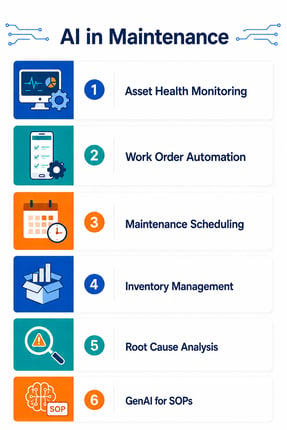
Beyond work orders, AI in maintenance management spans six operational domains: asset health monitoring, maintenance scheduling, spare parts optimization, root cause analysis, generative AI for SOPs, and safety risk monitoring, each addressing a distinct source of cost, risk, or inefficiency in the maintenance lifecycle.
1. Asset Health Monitoring and AI-Driven Anomaly Detection
IIoT sensors continuously monitor the health indicators of industrial equipment: bearing temperature, vibration frequency, motor current draw, pipeline pressure, humidity in electrical enclosures, and energy consumption trends. Machine learning models analyze this sensor stream not just against threshold values, but against the historical baseline of each specific asset, detecting anomalies that fall within acceptable threshold bounds but represent a statistically abnormal departure from that asset's normal operating signature.
This distinction matters. Threshold-based alerts are reactive by design; they fire when a reading exceeds a defined limit, which is often close to or already past the point of damage. AI-driven anomaly detection is genuinely predictive, it identifies the early pattern of a developing failure before any threshold is breached. This paves the way for predictive maintenance.
2. AI-Driven Maintenance Scheduling and Schedule Optimization
Time-based preventive maintenance (PM) schedules, service every 500 hours, replace every 12 months, are a practical compromise that was designed around the limits of human judgment. AI in maintenance removes those limits by enabling condition-based maintenance (CBM): scheduling each PM at the moment the asset's condition data indicates it is needed, not at a fixed calendar interval.
The AI balances asset condition data, production schedule windows, technician availability, and parts inventory to identify the optimal maintenance window, minimizing production disruption while ensuring the asset does not deteriorate past its safe operating condition. This eliminates both over-maintenance (unnecessary PMs that consume labor and parts on healthy assets) and under-maintenance (missed or delayed PMs on degrading equipment).
3. Spare Parts Inventory Management and Supply Chain Optimization
AI in maintenance eliminates the two costly extremes of spare parts management: overstocking and stockouts, by aligning procurement directly with predicted maintenance needs. It goes further by monitoring supplier lead times: when a critical component's lead time extends, the AI flags it and recommends early reorder or alternate sourcing before the gap becomes a shutdown risk.
4. Root Cause Analysis and Failure Pattern Recognition
Detecting a failure early is valuable. Understanding why it happens, and preventing it from recurring, is where AI in maintenance creates lasting cost reduction. Machine learning models applied to historical work order data, sensor histories, and asset specifications can identify why failures recur at a specific asset, location, or operating condition, not just flag them when they happen.
This failure pattern recognition enables prescriptive maintenance: AI that does not just predict failure but recommends the specific intervention that will prevent recurrence.
Root cause analysis powered by AI is one of the most underutilized applications in the maintenance AI landscape. It represents the shift from AI as an early warning system to AI as an operational learning engine.
5. Generative AI for Maintenance SOPs and Work Instructions
SOP writing is time-consuming, inconsistent, and frequently skipped under pressure, leaving many assets with no documented procedure at all. Generative AI changes this by drafting SOPs and maintenance procedures from equipment manuals, historical work orders, and uploaded PDFs, in a fraction of the time it takes a planner to write from scratch. Connected to mobile work order delivery, GenAI-generated instructions reach the technician at the moment of execution, closing the gap between planning and frontline action.
6. Safety Enhancement Through Predictive Risk Monitoring
Equipment failures do not only cost money, they create safety hazards. AI in maintenance contributes to safety performance by identifying equipment states that indicate elevated risk before they become incidents: boiler pressure anomalies, electrical fault precursors in motor current signatures, confined space environment conditions, and relief valve degradation patterns.
Early corrective action driven by AI alerts replaces post-incident investigation, shifting the safety posture from reactive reporting to proactive risk elimination.
AI Maintenance for SAP PM and IBM Maximo Users
Innovapptive extends your existing SAP/Maximo environment with AI-powered work order automation, mobile delivery to frontline teams, and real-time asset monitoring. Learn how asset-heavy enterprises like Indorama Ventures are realizing millions in maintenance savings.
AI in Maintenance by Industry
AI maintenance is not a one-size-fits-all technology, the applications, asset types, and regulatory considerations vary significantly by industry. The following overview covers four of the industrial sectors where AI maintenance programs are delivering the clearest operational and financial returns.
AI in Maintenance for Manufacturing
In discrete and process manufacturing, the assets most commonly targeted by AI maintenance programs include CNC machines, conveyors, compressors, pumps, motors, and HVAC systems. Vibration analysis for rotating equipment, thermal imaging integration for electrical panels, and OEE (Overall Equipment Effectiveness) optimization through unplanned downtime reduction are the leading use cases.
For manufacturing operations, AI in maintenance is directly tied to OEE, the composite measure of availability, performance, and quality. Every hour of unplanned downtime that AI prevents is an hour of production time recovered. For a high-throughput manufacturing line running at $10,000 per hour of output, even a modest reduction in unplanned downtime events produces ROI that substantiates the cost of the AI maintenance program. AI maintenance scheduling across large asset fleets, where hundreds of machines operate in interdependent production sequences, is particularly valuable, as a single unexpected failure can cascade across an entire line.
AI in Maintenance for Oil, Gas, and Chemicals
Oil, gas, and chemicals facilities operate some of the most asset-intensive and high-consequence environments in industrial manufacturing. Key assets include compressor trains, heat exchangers, pipelines, control valves, rotating equipment, and safety relief valves, each with distinct failure modes and potentially severe consequences if maintenance is deferred.
AI use cases in these industries include corrosion monitoring through ultrasonic sensor integration, vibration analysis for reciprocating and centrifugal compressor trains, pressure safety valve testing compliance tracking, and pipeline leak detection through acoustic and flow data analysis. AI maintenance programs in oil and gas and chemicals also support regulatory compliance, ensuring that inspection records, equipment integrity data, and maintenance histories are complete, current, and audit-ready at all times.
AI in Maintenance for Utilities and Energy
Power generation and transmission assets, gas turbines, steam turbines, transformers, transmission lines, cooling towers, and substation HVAC systems, operate at scale and in conditions where a single unexpected failure can affect thousands of customers and generate massive financial liability.
AI maintenance applications in utilities include transformer health monitoring through dissolved gas analysis and thermal imaging, turbine vibration diagnostics, and predictive replacement scheduling for aging grid infrastructure.
AI in Maintenance for Food and Beverage
Food and beverage maintenance is driven by three non-negotiables: food safety regulation, cold chain integrity, and spoilage cost. In these facilities, AI monitors the assets where failure carries the highest consequence, refrigeration units, pasteurizers, filling lines, and boilers, continuously tracking temperature profiles and sanitation cycles against safe operating parameters. When readings trend outside acceptable bounds, AI generates an alert before spoilage or contamination risk materializes. This continuous monitoring also produces a real-time audit trail, replacing periodic manual inspections with always-current compliance documentation.
Oil & Gas Compliance Leaders Meeting Regulatory Demands with Mobile Maintenance
Discover how industry leaders in oil & gas are navigating OSHA, EPA, and compliance challenges with mobile-first maintenance solutions, cutting unplanned downtime by 40% and audit preparation time by 50%.
Overcoming Barriers to AI Adoption in Maintenance
The barriers to AI adoption in maintenance are the reason most organizations that recognize the ROI still haven't implemented a full program. Understanding what they are and how they are addressed is essential for any maintenance manager to prepare a good business case.
Data Quality and Centralizing Maintenance Data
The most common barrier to AI maintenance isn't the technology, it's the data that exists before it's deployed. Most facilities have maintenance records split across CMMS, spreadsheets, paper files, and the tacit knowledge of experienced technicians. Standardizing data capture before deployment, through structured work order fields, digital inspection forms, and mobile maintenance logs, builds the dataset AI requires. The organizations that do this first report significantly faster time-to-value once AI goes live.
Integrating AI with Legacy Systems: SAP PM and IBM Maximo
For the majority of industrial customers, the core maintenance management system is already in place, either SAP Plant Maintenance (SAP PM) or IBM Maximo. These are enterprise-grade systems with significant organizational investment, established asset hierarchies, cost center structures, and approval workflows built over years of operation. The idea of replacing them completely to adopt AI is, for most organizations, a non-starter.
The good news for SAP PM and IBM Maximo users is that AI in maintenance does not require replacing your existing system, it requires extending it. AI overlays that integrate with your ERP's asset hierarchy and work order structure allow you to add predictive capabilities, mobile delivery, and voice AI without disrupting the infrastructure your teams already know. Innovapptive's Connected Worker Platform and SAP mobile work instructions are specifically built for this integration pattern, AI-driven work orders, condition monitoring, and mobile technician delivery all flow through the existing SAP or Maximo work order structure, preserving data integrity and audit trails while adding the AI layer on top. This approach significantly lowers both the technical risk and the organizational change management burden of AI adoption.
Making the Business Case for AI Maintenance Investment
For maintenance managers who need budget approval from a CFO or plant manager, the business case framework is straightforward: (1) establish the current maintenance cost baseline, total labor, downtime losses, parts spend, and safety incidents for the trailing 12 months; (2) apply industry benchmark cost reduction ranges (25 to 40% from Siemens TCOD 2024) to each cost category; (3) calculate the estimated annual savings; (4) compare against the program cost to derive payback period.
Most organizations that have piloted AI maintenance programs on a single asset class or production line report a payback period of 12 to 24 months. Further, maintenance managers working in facilities running a Total Productive Maintenance (TPM) program, can show how AI directly strengthens the two most scrutinized metrics in any maintenance budget review: Mean Time Between Failures (MTBF) and Mean Time to Repair (MTTR).
How Innovapptive Delivers AI in Maintenance: A Connected Worker Approach
Most AI maintenance platforms are designed for data scientists and maintenance engineers, they produce dashboards, alert summaries, and predictive reports that live in a planning office or control room. Innovapptive's approach is different: the Connected Worker Platform was built to take those outputs and deliver them to the frontline worker, the technician who physically performs the repair. This distinction is the core of what frontline-first AI maintenance means in practice.
Why Frontline-First AI Maintenance Is Different
The gap between an AI recommendation and a completed repair is not a data science problem, it is an execution problem. AI can predict a bearing failure with 95% confidence, but if that prediction sits in a planner's dashboard while the on-shift technician is unaware of it, the bearing fails anyway. Innovapptive closes this gap by designing the AI delivery mechanism around the frontline worker's operational reality: mobile-first, offline-capable, integrated with the ERP systems already in place, and usable on the shop floor without technical expertise.
The Indorama Ventures implementation at the Port Neches facility demonstrates this in practice: by replacing paper-based maintenance processes with Innovapptive's Connected Worker Platform, the facility empowered frontline maintenance teams with real-time data access, mobile work order delivery, and streamlined work execution, reducing maintenance backlog by 58% and $29M annual maintenance savings.
Core AI Capabilities in Innovapptive's Connected Worker Platform
- AI-driven work order automation for SAP PM / IBM Maximo: Generates, prioritizes, and routes work orders automatically based on sensor triggers, anomaly detection, and PM schedules, fully integrated with existing SAP or Maximo work order structures. Maintenance planners manage by exception rather than by manual creation.
- Mobile maintenance apps with real-time AI alerts: Push notifications deliver AI-generated alerts and work orders to field technicians' mobile devices the moment an anomaly is detected, with full asset context, procedure, and parts information included. No radio calls, no office trips.
- Digital work instructions with condition-based adaptation: Work instructions delivered to mobile devices are informed by the AI's diagnosis of the asset's current failure mode, surfacing the relevant procedure and prompting the technician to capture the specific data points that improve the next prediction.
- AI root cause analysis engine: Applies machine learning to historical work order data and sensor histories to identify recurring failure patterns across similar assets, enabling prescriptive maintenance recommendations that prevent failures from repeating, not just detect them early.
- Maintenance insights dashboard with condition monitoring aggregation: Consolidates asset health data, work order status, PM compliance rates, and anomaly alerts in a single operational view for maintenance managers and reliability engineers, with drill-down access to individual asset histories.
Innovapptive Named a Leader in the 2025 Frost Radar™ for Augmented Connected Worker Platforms
Frost & Sullivan recognized Innovapptive for innovation, growth, and end-to-end impact across maintenance, operations, warehousing, and workforce execution, with customers achieving 25% reduction in unplanned downtime and 10% reduction in maintenance costs.
Case Study: Indorama Ventures Saves $3.3M with AI-Powered Maintenance
Company: Indorama Ventures
Facility: Port Neches plant
Industry: Chemicals / Petrochemicals
Challenge: Maintenance operations were largely paper-based, creating delays in issue identification, inconsistent work execution, and limited visibility into asset health for planners and supervisors. Frontline technicians lacked real-time access to work orders, procedures, and asset history, slowing response times and increasing the risk of equipment failures that could have been prevented with earlier intervention.
Solution: Indorama Ventures implemented Innovapptive's Connected Worker Platform to replace paper-based maintenance processes with mobile-first, AI-enabled workflows. Frontline teams were equipped with mobile access to work orders, digital work instructions, and real-time asset data. The platform integrated with Indorama's existing ERP infrastructure, preserving established work order structures while adding AI-driven generation, prioritization, and mobile delivery.
Results:
| Key Performance Indicator | Performance Improvement |
|---|---|
| Realized EBITDA Savings | $29M annual maintenance savings |
| Maintenance Backlog | Reduced from 24 weeks to 10 weeks |
| Maintenance Overtime | Halved from 24% to 12% |
| Inventory Accuracy | Increased from 89.5% to 99.5% |
| Contractor Headcount | 38% reduction in contractor dependency |
This result reflects what AI maintenance looks like in practice at the facility level, not theoretical benchmarks, but projected savings from a live implementation that connected frontline technicians to AI-generated work orders, real-time asset data, and digital work instructions on their mobile devices.
Cut Contractor Dependency by 38% and Reclaim Your Maintenance Budget.
See the exact strategy used to double PM-to-CM ratios and boost parts availability to 95% by connecting every technician in real time.

Unlock Margins Hidden in your Maintenance
Watch how leading manufacturers improve OEE, increase PM compliance, and reduce downtime through connected execution.
- 12-10-2026
Manufacturing Skills Gap: What It Costs and How to Close It
A plant can have every role filled and still experience a manufacturing skills gap. Very often,...
- 05-10-2026
10 Best Shift Handover Software Platforms for Plant and Process Operations
Shift handover software can mean different things depending on the operating environment. Some...
- 29-09-2026
Best SAP Maintenance Planning & Scheduling Software 2026
Your maintenance work orders live in SAP Plant Maintenance (PM), while the working schedule lives...