
What Is Autonomous Maintenance?
Autonomous Maintenance is a manufacturing methodology where equipment operators take ownership of routine maintenance tasks, such as cleaning, inspection, lubrication, and minor adjustments, traditionally handled by maintenance technicians.
The core idea is simple: operators who work with machines daily are best positioned to detect early signs of wear, prevent minor issues from escalating, and keep equipment running smoothly.
AM doesn’t replace maintenance technicians; it redefines their role. Operators handle daily and weekly routines to sustain equipment condition, while maintenance professionals focus on complex repairs, overhauls, and predictive strategies. This division of labor ensures faster issue detection, reduced downtime, and a culture of proactive ownership, key drivers of manufacturing excellence.
The Core Principles of Autonomous Maintenance
Autonomous maintenance rests on two core principles that shape everything operators do on the floor.
- Prevent deterioration: Keep equipment running in good condition so normal use does not turn into early wear and failure. Operators clean, lubricate, tighten, and inspect so small problems are caught and fixed before they grow.
- Restore assets: Bring equipment that has already worn or degraded back to a like-new condition, then hold it there with consistent daily care and clear standards.
Both principles depend on the same idea: the operator at the machine is the first line of defense. As operators build skill and confidence, they detect abnormalities sooner and keep equipment closer to its ideal condition every shift.
Autonomous Maintenance Within TPM
To fully understand Autonomous Maintenance, it must be viewed within the broader context of Total Productive Maintenance,the manufacturing philosophy from which autonomous maintenance originates and derives its structure.
Total Productive Maintenance (TPM) is a company-wide initiative developed in Japan in the 1970s by Seiichi Nakajima at the Japan Institute of Plant Maintenance (JIPM). TPM aims to maximize equipment effectiveness by eliminating the six big losses: breakdowns, setup and adjustment time, small stops, reduced speed, startup defects, and production defects through active participation from every level of the organization.
Why Autonomous Maintenance Is the Foundation of TPM
TPM is structured around eight pillars, each targeting a specific dimension of equipment and operational effectiveness.
|
# |
Pillar |
Purpose |
|---|---|---|
|
1 |
Autonomous Maintenance |
Operators maintain their own equipment through cleaning, inspection, and lubrication |
|
2 |
Planned/Preventive Maintenance |
Scheduled maintenance activities performed by the maintenance team |
|
3 |
Quality Maintenance |
Maintaining equipment conditions to achieve zero defects in production |
|
4 |
Focused Improvement (Kaizen) |
Small-group activities to eliminate losses and improve efficiency |
|
5 |
Early Equipment Management |
Applying production and maintenance knowledge to new equipment design |
|
6 |
Training and Education |
Developing skills of operators and maintenance technicians |
|
7 |
Safety, Health & Environment |
Maintaining a safe and environmentally responsible workplace |
|
8 |
TPM in Administration |
Applying TPM principles to administrative and support functions |
Autonomous maintenance sits at the base of TPM implementation because it directly engages the largest workforce group: equipment operators in the daily care of manufacturing assets. When operators take ownership of equipment cleanliness, lubrication, and early abnormality detection, three critical outcomes emerge:
- Equipment condition improves consistently, not just during scheduled maintenance windows.
- Abnormalities are detected earlier, reducing the scale and cost of repairs.
- Operators develop a deeper understanding of equipment function, improving their ability to recognize and respond to deviations.
This operator engagement creates a foundation of equipment stability upon which all other TPM pillars, planned maintenance, quality maintenance, focused improvement, can build effectively.
Turn Your Operators Into Your First Line of Defense
The AI-Powered Digital Operator Playbook shows how to equip frontline operators with AI-guided rounds, inspections, and troubleshooting, so they catch and act on issues sooner.
Key Benefits of Autonomous Maintenance
Organizations that successfully implement autonomous maintenance programs report sustained improvements across reliability, safety, cost, and workforce culture. These benefits are connected, when one area improves, it helps improve the others too.
- Improved Equipment Reliability: Studies across TPM implementations show OEE improvements of 15 to 25% within the first two years of sustained Autonomous Maintenance programs. Regular cleaning and lubrication address the leading causes of deterioration before they become failures.
- Reduced Unplanned Downtime: Autonomous Maintenance programs typically achieve 30 to 50% reductions in breakdown frequency by catching abnormalities before they escalate into failures that halt production.
- Improved Workplace Safety: Clean, well-maintained equipment is safer equipment. Autonomous maintenance programs reduce exposure to leaks, overheating components, loose fasteners, and other hazardous conditions that accumulate when equipment is not regularly inspected. Operators trained in autonomous maintenance routines are also more likely to identify and report safety concerns proactively.
- Lower Maintenance Costs: Preventing failures is always less expensive than recovering from them. Mature autonomous maintenance programs consistently reduce contractor dependency, cut overtime spend, and shrink emergency repair costs, with documented maintenance OPEX reductions of 10% or more at sites with disciplined Autonomous Maintenance implementation.
- Stronger Workforce Culture: Autonomous maintenance shifts the mindset from passive operation to active ownership. Operators who take responsibility for equipment care develop deeper technical knowledge, stronger engagement, and a shared language with the maintenance team, breaking the reactive “I operate, you fix” dynamic that drives inefficiency in many facilities.
Real-World Example: Autonomous Maintenance with Digital Tools (Indorama Ventures)
Indorama Ventures, a global chemical manufacturer operating across 30+ countries, used Innovapptive’s Connected Worker Platform at its Port Neches facility to improve autonomous maintenance and reduce maintenance costs.
The plant was handling a heavy maintenance backlog, high contractor dependency, and paper-based workflows, even with SAP in place.
By digitizing frontline execution with mobile rounds, real-time task tracking, and connected workflows across operations, maintenance, and inventory, operators could take more ownership of routine tasks. This reduced manual effort, helped teams spot issues earlier, and improved overall maintenance efficiency without changing core ERP systems.
Within 12 months of deployment, the site recorded the following customer-audited outcomes at this single location:
- Maintenance backlog reduced from 24 to 10 weeks
- Contractor headcount reduced from 140 to 87
- Overtime lowered from 24% to 12%
- Planned-to-reactive maintenance ratio (PM-to-CM) improved from 45% to 80%
- Inventory accuracy improved from 89.5% to 99.5%
See How Autonomous Maintenance Drives Measurable EBITDA Impact
See how Indorama Ventures cut its maintenance backlog, reduced contractor dependency, and realized $19M in EBITDA savings at a single site, part of a $50M enterprise-wide opportunity identified through connected execution.
The 7 Steps of Autonomous Maintenance
Here are the seven steps of autonomous maintenance that provides a structured progression from basic cleaning to full operator-driven equipment management. Steps are sequential, each is formally audited before advancing to the next, and build operator capability and equipment ownership progressively over time.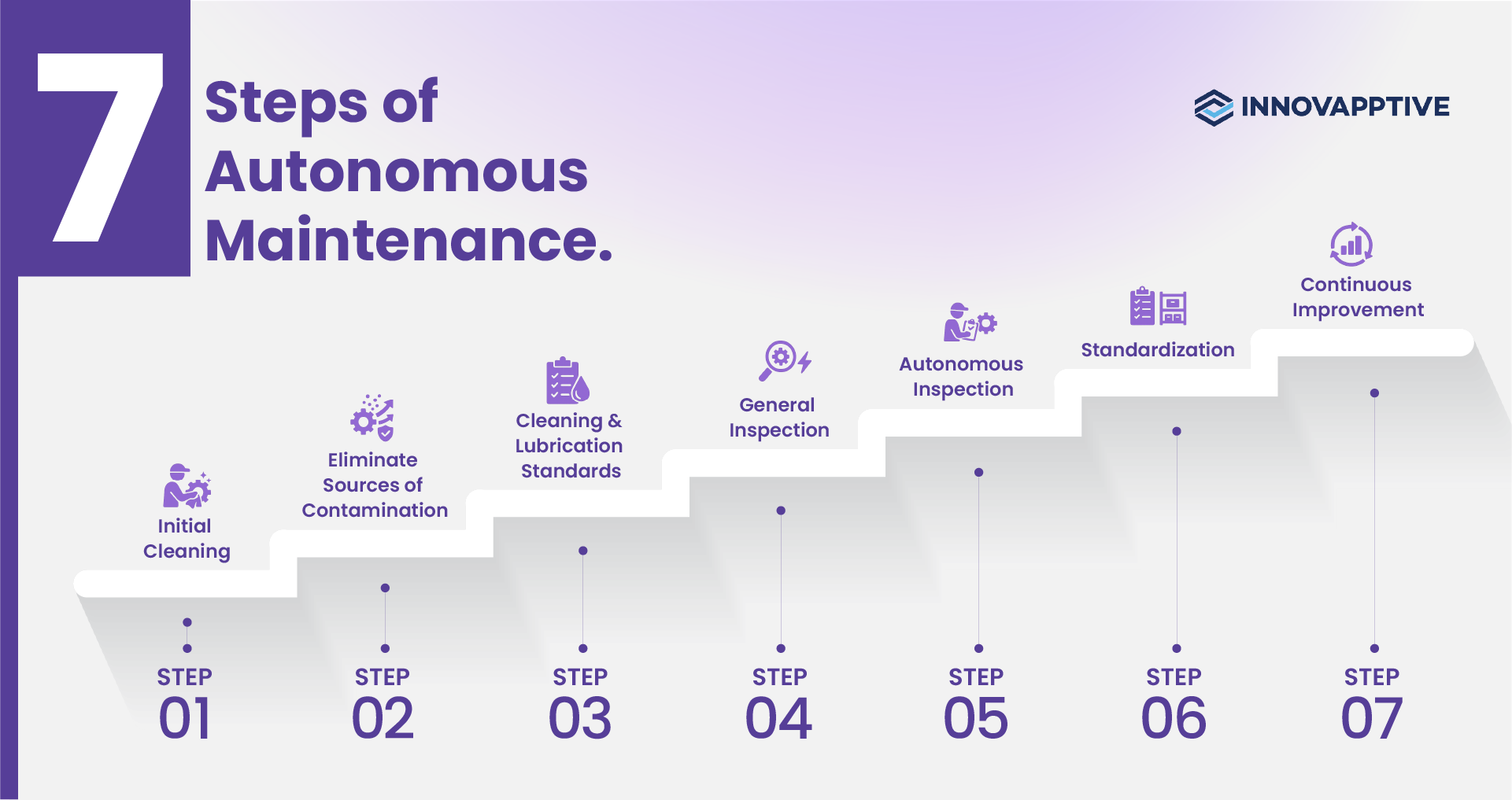
Step 1: Initial Cleaning
Operators clean the equipment thoroughly to remove dirt, grease, and debris. This helps them spot hidden problems like leaks, cracks, or loose parts. This step is critical for two reasons:
- It reveals hidden problems like leaks, cracks, or loose parts that might otherwise go unnoticed.
- It establishes a baseline for equipment condition before moving to the next steps.
This isn't just about aesthetics; it's about revealing the true state of your equipment and setting the stage for systematic maintenance.
Step 2: Eliminate Sources of Contamination
Next, teams identify and fix the root causes of contamination, whether it's leaks, poor sealing, or inadequate cleaning procedures. The goal is to make contamination impossible to occur by addressing the source.
This step also involves improving equipment accessibility, ensuring operators can clean and inspect critical areas without obstructions. Standardize cleaning routes and tools to make the process repeatable and efficient across shifts.
Step 3: Cleaning & Lubrication Standards
Set clear, written standards for cleaning and lubrication so there's no confusion. Just define:
- What needs to be cleaned/lubricated
- How to perform the task
- When (frequency) and by whom
Step 4: General Inspection
Operators are trained to inspect all critical parts of the machine, including mechanical, electrical, and hydraulic components, so they can catch early signs of problems. They focus on:
- Early signs of wear, such as unusual vibrations, noise, or discoloration
- Lubrication levels and leaks that may indicate developing issues
- Fasteners and belts for looseness or wear
- Sensors and gauges to make sure they are working properly
Step 5: Autonomous Inspection
Operators take responsibility for regularly inspecting their equipment on their own, following the set standards. With the basic training in place, they start performing these inspections independently as part of their daily work. Over time, this builds confidence and helps operators apply what they've learned in real conditions.
To make this work consistently:
- Integrate inspections into regular shift routines, such as shift handovers or planned breaks
- Use mobile checklists or simple tracking methods to ensure tasks are completed and nothing is missed
- Encourage operators to capture findings through notes or photos so patterns can be tracked over time
Step 6: Standardization
Workplaces need to standardize processes so everyone follows the same way of working, reducing variation and confusion. This includes:
- Creating simple visual work instructions using photos, diagrams, or videos
- Defining cleaning and lubrication checklists and keeping them easily accessible
- Applying 5S principles to keep work areas organized and consistent
- Assigning clear ownership for routine tasks
Step 7: Continuous Improvement
Operators and maintenance teams work together to continuously improve how autonomous maintenance is carried out on the floor, using data and on-the-ground experience to make equipment more reliable.
This includes:
- Reviewing inspection data to spot recurring issues
- Making small improvements, such as adjusting lubrication frequency or improving cleaning routines
- Testing changes in one area before scaling
- Sharing wins to keep teams engaged and motivated
In practice, teams often use daily huddles, root cause analysis, and small improvement efforts, supported by real-time data from digital tools, to keep progress going.
Give Your Operators a Checklist They Will Actually Use
Get a step-by-step clean, inspect, and lubricate checklist your operators can use on the floor from day one.
Autonomous Maintenance vs. Preventive Maintenance
Below table illustrates the differences between autonomous maintenance and preventive maintenance.
|
Dimension |
Autonomous Maintenance |
Preventive Maintenance |
|---|---|---|
|
Who performs it |
Equipment operators |
Dedicated maintenance technicians |
|
Task type |
Cleaning, lubrication, inspection |
Scheduled repairs, replacements, overhauls |
|
Trigger |
Daily/weekly routines |
Calendar- or meter-based schedules |
|
Skill level |
Trained operators |
Skilled maintenance professionals |
While preventive maintenance focuses on scheduled repairs and component replacement, autonomous maintenance empowers operators to handle daily and weekly routines that prevent deterioration before it becomes a problem. The two are not competitors; they are partners in reliability. AM ensures equipment is cared for between PM cycles, while PM addresses the more complex, technical work that exceeds operator capability. Together, they create a robust, proactive maintenance ecosystem that reduces unplanned downtime and extends asset lifespan.
KPIs for Measuring Autonomous Maintenance Success
To measure AM properly, you need both leading and lagging indicators, which reflect program activity and compliance, and lagging indicators, which reflect the business outcomes that activity is driving. Tracking only lagging indicators like Overall Equipment Effectiveness (OEE) makes it difficult to catch AM compliance problems before they affect reliability.
|
KPI |
What It Measures |
Target / Benchmark |
Review Frequency |
|---|---|---|---|
|
OEE (Overall Equipment Effectiveness) |
Composite score of Availability x Performance x Quality |
Establish baseline; target 15 to 25% improvement in year 1 to 2 |
Monthly |
|
MTBF (Mean Time Between Failures) |
Average operating time between equipment failures |
Rising trend indicates AM is preventing deterioration |
Monthly |
|
Unplanned Downtime Rate |
Production time lost to unexpected failures |
Target 30 to 50% reduction from pre-AM baseline |
Monthly |
|
Operator-Detected Abnormality Rate |
Abnormalities found by operators before causing failures |
Rising rate indicates growing AM maturity |
Monthly |
|
AM Task Compliance Rate |
Daily and weekly AM tasks completed on schedule |
Minimum 80%; below 80% triggers supervisor review |
Weekly |
|
Planned preventive work vs. reactive corrective work |
World-class target is above 80% PM |
Quarterly |
Establish baselines for all KPIs before program launch. Review leading indicators (compliance rate, abnormality detection rate) monthly. Review lagging indicators (OEE, MTBF, downtime rate) quarterly. Use trend data over time, not single-point snapshots, to assess program health.
How to Use These KPIs
Start by setting a baseline for each KPI before rolling out your AM program. Without that, you won’t know what improvement actually looks like.
Track leading indicators more frequently since they reflect whether the program is being followed on the floor:
- AM Task Compliance Rate
- Operator-Detected Abnormality Rate
Review lagging indicators to understand the overall impact on performance:
- OEE
- MTBF
- Unplanned Downtime Rate
Focus on trends over time, not one-off numbers. A single good or bad week doesn’t tell you much. What matters is the direction.
For example, if OEE improves steadily over a few months, it’s a good sign your AM practices are working. If AM task compliance drops below 80% and stays there, it usually points to gaps in standards, ownership, or time available for operators to complete their tasks.
See What Operator-Led Maintenance Looks Like on One Platform
Our solution brief shows how connected execution turns daily operator rounds, inspections, and issue reporting into a single, auditable Autonomous Maintenance workflow.
How to Implement an Autonomous Maintenance Program
A successful AM rollout is a phased, multi-year commitment. The organizations that get the best results treat it as a cultural transformation, not a project with a completion date.
- Select a Pilot Cell: Choose an area with engaged operators and supportive supervision. Avoid selecting the most troubled equipment first because early success matters for organizational confidence. Establish OEE and downtime baselines before you begin.
- Launch Step 1 (Initial Cleaning): Conduct a focused cleaning event with operators, maintenance technicians, and supervision working side by side. This serves as both a practical starting point and a visible statement about the program's seriousness.
- Complete Steps 1 through 3 (Initial Cleaning to Lubrication Standards): Move methodically through the first three AM steps. Conduct formal audits at each step before advancing. Develop procedures that can serve as templates for plant-wide rollout.
- Measure and Communicate Results: After 60 to 90 days in the pilot area, measure OEE, downtime, and operator-detected abnormality rates against your baseline. Share the results widely to build organizational momentum.
- Scale to Additional Areas: Use the pilot area experience, including lessons learned, training materials, and procedure templates, to accelerate AM implementation in subsequent areas. Cross-train pilot operators as AM coaches for new zones.
- Embed AM in Daily Management: Tie AM compliance to supervisor performance indicators, protect AM time in production scheduling, and conduct regular audits. Programs that are not embedded in management systems consistently regress within 12 to 18 months.
See the Bigger Shift to AI-Driven Frontline Work
Industrial AI in Action, shows how connected worker platforms are moving frontline execution from paper and manual steps to real-time, AI-assisted work across the plant.
How Digital Tools Support Autonomous Maintenance
Digital tools help operators perform autonomous maintenance more effectively by making routine tasks easier to complete, abnormalities faster to identify, and follow-up actions more consistent. Instead of relying on paper, memory, or manual coordination, operators can use connected tools to work in a more proactive and standardized way.
Key Capabilities of Digital Tools in Autonomous Maintenance
- AI-Powered Digital Checklists & Rounds: Operators replace paper with mobile checklists that verify completion and give supervisors real-time visibility into task progress, missed steps, and compliance gaps.
- AI-Led Troubleshooting & Anomaly Detection: AI enables operators to detect issues such as leaks or cracks early on, while AI guidance helps them troubleshoot faster and act without always waiting for maintenance support.
- Contextual Digital Work Instructions: Step-by-step instructions, visuals, and digital guides are available at the point of use, helping operators perform tasks correctly and preserve critical know-how.
- Automated Root Cause Analysis (RCA): Built-in AI 5-Why Analysis helps teams identify likely failure drivers using maintenance history and issue context, enabling faster corrective and preventive action.
- Dynamic Prioritization & Integrated Workflows: AI prioritizes issues based on risk and asset criticality, while high-priority findings can flow directly into SAP or IBM Maximo for resolution.
- Real-Time Execution Dashboards: Managers gain live visibility into anomalies, compliance, and task execution, allowing them to rebalance work early and improve operational performance.
How Innovapptive can help
Innovapptive’s Connected Worker Execution Platform is designed to digitize and streamline how autonomous maintenance is executed by operators, while giving supervisors and maintenance teams the visibility and control to ensure consistency and faster response.
1. Digital CIL (Clean, Inspect, Lubricate) Tasks
The platform replaces paper checklists with mobile rounds.
- GPS-Verified Tasks: Ensures that operators are physically present at the equipment while performing inspections.
- Mobile Accessibility: Operators can complete daily checks directly on handheld devices, ensuring data is captured in real-time.
2. AI-Powered Notifications & Prioritization
To prevent minor issues from becoming major breakdowns, the system uses automation to manage abnormalities.
- Risk-Based Prioritization: The platform automatically prioritizes identified issues based on risk level and asset criticality.
- Automated Alerts: When an operator identifies a fault during an inspection, the system can trigger immediate notifications to the maintenance team.
3. Knowledge Transfer & Support
The platform helps bridge the skill gap for operators who are not trained maintenance technicians.
- Digital Work Instructions: Provides step-by-step guides with embedded videos and photographs.
- Visual Guidance: These visual aids ensure that operators of any skill level can perform complex maintenance tasks correctly and safely.
4. Live Visibility & Management Dashboards
For supervisors and plant managers, the platform centralizes data to provide a birds-eye view of the AM program.
- Real-Time Dashboards: Displays live visibility into compliance rates, permit statuses, and parts readiness.
- ERP Integration: It integrates natively into systems like SAP or IBM Maximo, ensuring that frontline data flows into the company's main records without manual entry.
These capabilities run on one system. Innovapptive delivers them through a connected worker platform, with maintenance management software that puts operator rounds, inspections, and work execution on a single mobile app and connects them to SAP and IBM Maximo, so a fault spotted on a round becomes a scheduled work order without anyone re-keying it.
For manufacturing leaders evaluating autonomous maintenance as a long-term reliability and margin strategy, the technology question is not whether to digitize. It is whether the platform chosen has the capabilities to transform the entire autonomous maintenance execution chain rather than digitize one slice of it.
Ready to See Autonomous Maintenance Without the Paper?
Get a working walkthrough of operator-led inspections, real-time issue reporting, and connected maintenance workflows, mapped to your equipment and your SAP or IBM Maximo setup.

Unlock Margins Hidden in your Maintenance
Watch how leading manufacturers improve OEE, increase PM compliance, and reduce downtime through connected execution.
- 12-10-2026
Manufacturing Skills Gap: What It Costs and How to Close It
A plant can have every role filled and still experience a manufacturing skills gap. Very often,...
- 05-10-2026
10 Best Shift Handover Software Platforms for Plant and Process Operations
Shift handover software can mean different things depending on the operating environment. Some...
- 29-09-2026
Best SAP Maintenance Planning & Scheduling Software 2026
Your maintenance work orders live in SAP Plant Maintenance (PM), while the working schedule lives...