
What Is Preventive Maintenance?
Preventive maintenance is the practice of performing scheduled inspections, servicing, and repairs on equipment before a failure occurs, as opposed to waiting for a breakdown. The goal is to extend asset lifespan, reduce unplanned downtime, and lower total maintenance cost over time.
Unlike reactive maintenance where repairs happen only after breakdowns, preventive maintenance uses planned interventions based on time intervals, operating hours, production cycles, or equipment condition.
Industrial enterprises use preventive maintenance to:
- Reduce costly equipment failures
- Improve production uptime
- Increase maintenance planning efficiency
- Extend asset life
- Improve worker safety and compliance
- Reduce emergency maintenance costs
Must Read: Learn 8 Proven Strategies to Lower Maintenance Costs
Types of Preventive Maintenance
Industrial PM programs draw on five recognized types of preventive maintenance, each suited to different asset profiles, operating conditions and data availability. Most enterprise programs combine multiple types rather than relying on a single approach.
| Type | How It Works | Best For | Example |
|---|---|---|---|
| Time-Based Maintenance | Fixed calendar intervals regardless of condition | Low-to-medium criticality assets; assets with time-correlated wear (HVAC, lubricant systems, safety valves) | Monthly lubrication of pump bearings; quarterly filter replacement |
| Usage-Based Maintenance | Trigger at defined run-hours, cycles, or throughput | Rotating equipment, compressors, engines, conveyor drives, where wear tracks to operational load | Compressor overhaul at 8,000 run hours; belt inspection every 50,000 production cycles |
| Condition-Based Maintenance | Trigger when a measured parameter crosses a threshold | High-criticality assets with sensor coverage, turbines, heat exchangers, critical pumps | Vibration-triggered bearing inspection when amplitude exceeds 10 mm/s RMS |
| Predictive Maintenance | Uses sensor data + analytics to forecast failure probability and schedule intervention before the predicted failure window | Assets with rich historical failure data and real-time sensor infrastructure | AI-based remaining useful life modeling on refinery compressor trains |
| Prescriptive Maintenance | Combines predictive analytics with AI-generated action recommendations, the system not only forecasts failure but prescribes the specific corrective action | Mature digital maintenance environments with integrated CMMS, IoT, and AI capabilities | Agentic AI that detects anomaly, predicts failure mode, and generates a pre-populated work order with the recommended task list |
Most organizations begin with time-based preventive maintenance and gradually expand toward condition-based and predictive approaches as their maintenance maturity improves.
Upgrade Your Maintenance Mix with Machine Intelligence
Take your predictive and preventive efforts to the next level with a step-by-step blueprint designed to unlock hidden insights from your asset data.
What Are the Benefits of Preventive Maintenance
Industrial enterprises that move from reactive-only maintenance to structured preventive maintenance programs consistently report reductions in unplanned downtime, lower total maintenance spend, and improved asset utilization.
Reduced Unplanned Downtime
Unplanned downtime in continuous process operations, refineries, chemical plants, mining circuits, carries staggering costs. Industry estimates consistently place the cost of an unplanned stoppage between $50,000 and $250,000 per hour when lost production, emergency labor, expedited parts, and cascade damage are all accounted for.
Facilities using formal PM programs report significantly fewer unplanned stoppages compared to reactive-only strategies; research from ARC Advisory Group has found that manufacturers with high PM compliance rates experience 52.7% less unplanned downtime than those operating reactively.
Extended Asset Lifespan
Regular servicing slows asset degradation by removing the conditions that accelerate wear: excess heat, contamination, misalignment, inadequate lubrication, and fatigue loading. This translates directly into extended capital replacement cycles, assets that would need replacement in 10 years under reactive management often run 15 to 18 years under structured PM.
Industry benchmarks indicate that PM programs extend equipment life by 20 to 40% compared to reactive-only approaches, representing significant capital deferral for asset-intensive industries.
Lower Total Maintenance Cost
Planned maintenance costs significantly less than emergency repair, for three important reasons: parts are sourced through normal procurement channels rather than expedited freight, labor is scheduled during regular shifts rather than as overtime callouts, and secondary damage is avoided.
Reactive repairs frequently cause cascade damage, a failed bearing damages a shaft, which damages a mechanical seal, which causes a process leak requiring environmental remediation and regulatory notification.
The cost of that cascade failure can be 10 to 50 times the cost of the original bearing replacement that preventive maintenance would have triggered. The cost ratio of planned versus unplanned maintenance in heavy industry typically runs 3:1 to 9:1 in favor of planned work, making PM one of the highest-ROI investments available to a maintenance organization.
Improved Safety and Regulatory Compliance
Preventive maintenance significantly reduces the probability of equipment-related safety incidents caused by degraded or failed components. A bearing failure on a rotating machine can quickly become a catastrophic mechanical release, while a corroded pressure vessel fitting can trigger a major process safety event.
By systematically servicing and inspecting these assets, facilities eliminate hazards before they threaten the workforce. Furthermore, a structured PM workflow provides an audit-ready digital paper trail that satisfies strict regulatory frameworks like OSHA PSM, protecting the enterprise from severe non-compliance penalties and environmental liabilities.
See how Innovapptive helps industrial enterprises build and execute preventive maintenance programs inside SAP and IBM Maximo environments.
What are the Limitations of Preventive Maintenance?
While preventive maintenance improves reliability and reduces downtime, it also comes with operational and resource challenges. Organizations that over-maintain equipment or rely on outdated maintenance schedules can increase costs without improving reliability.
Common limitations of preventive maintenance include:
Risk of Over-Maintenance
Performing maintenance too frequently can waste labor hours, increase spare parts consumption, and introduce maintenance-induced failures by unnecessarily disturbing equipment that is operating normally.
Higher Planning and Labor Requirements
Preventive maintenance programs require dedicated planning, scheduling, documentation, and technician availability. As asset counts grow, managing PM activities manually becomes difficult.
Dependence on Accurate Asset Data
A PM program is only as effective as the data behind it. Missing asset records, outdated maintenance history, or incorrect PM intervals can reduce program effectiveness.
Difficulties Scaling with Paper-Based Systems
Paper checklists, spreadsheets, and disconnected systems create execution gaps, incomplete records, and inconsistent reporting across sites.
Limited Visibility into Actual Equipment Condition
Traditional time-based PM may not reflect the real operating condition of the asset. Some equipment may require maintenance earlier than scheduled, while others may continue operating reliably beyond the planned interval.
What Are the Examples of Preventive Maintenance
Preventive maintenance varies by industry, asset type, and operational risk. A refinery compressor, a mining haul truck, and a manufacturing CNC machine all require different maintenance strategies, frequencies, and inspection methods.
Preventive Maintenance Examples in Oil and Gas
Oil and gas facilities maintain rotating equipment, pressure systems, and safety-critical assets under strict reliability and regulatory requirements.
- Centrifugal Pumps: Pump maintenance is commonly triggered by runtime hours rather than calendar intervals. Typical PM tasks include: bearing lubrication, mechanical seal inspection, impeller clearance checks, alignment verification
- Gas Compressors: Compressors often combine usage-based and condition-based maintenance. Common tasks include: vibration monitoring, lube oil analysis, valve inspection, temperature monitoring
- Emergency Shutdown (ESD) Valves: ESD valves require routine testing to ensure proper operation during emergency events. Typical maintenance includes: quarterly partial stroke testing, annual full stroke testing, actuator inspection, position verification
Preventive Maintenance Examples in Chemical Plants
Chemical plants use preventive maintenance to improve reliability while supporting OSHA Process Safety Management (PSM) compliance.
- Agitators and Mixers: Digital procedures are commonly used to capture inspection readings and completion records. Routine PM tasks include: seal inspection, gearbox oil replacement, vibration checks, coupling inspection
- Safety Instrumented Systems (SIS): Protective systems require scheduled proof testing to verify sensors, logic solvers, and final control elements are functioning correctly. Typical tasks include: sensor calibration, valve testing, alarm verification, functional testing
- Pressure Equipment: Pressure vessels and piping systems are inspected using Risk-Based Inspection (RBI) programs. Common PM activities include: ultrasonic thickness testing, corrosion inspection, visual examination, pressure testing
Preventive Maintenance Examples in Mining Operations
Mining equipment operates under extreme conditions and high-duty cycles, making preventive maintenance essential for production reliability.
- Haul Trucks: Mining haul trucks follow OEM-defined maintenance intervals based on operating hours. Typical PM tasks include: engine oil and filter replacement, brake inspection, tire condition checks, hydraulic system inspection
- Conveyor Systems: Conveyor maintenance combines scheduled inspections with condition-based monitoring. Routine tasks include: belt alignment inspection, idler roll checks, tension verification, pulley inspection, technicians also monitor for overheating bearings and abnormal noise during inspections.
- SAG and Ball Mills: These high-value assets require continuous monitoring and planned inspections. Typical maintenance activities include: liner thickness measurement, lubrication system inspection, bearing temperature monitoring, gear inspection
Preventive Maintenance Examples in Manufacturing and Utilities
Manufacturing plants and utility systems rely on preventive maintenance to maintain production uptime and equipment efficiency.
- CNC Machines: Routine maintenance helps maintain machining accuracy and reduce scrap rates. Preventive maintenance tasks commonly include: spindle lubrication, coolant concentration checks, way lube inspection, alignment verification
- Air Compressors: Plant air compressors typically follow time-based PM schedules. Common tasks include: air filter replacement, belt inspection, drain valve testing, oil level checks
- Transformers: Industrial transformers combine time-based and condition-based maintenance. Typical inspections include: dissolved gas analysis (DGA), oil sampling, thermal inspection, bushing inspection
- Boilers: Boilers require both operational and regulatory maintenance activities. Routine tasks include: water chemistry checks, blowdown valve testing, safety valve inspection, burner inspection
Eliminate Friction from Safety-Critical Oil & Gas Maintenance
Don't let paper logs or rigid workflows slow down your critical asset maintenance. See how mobile-first software simplifies complex testing for pumps, compressors, and safety systems.
How to Create a Preventive Maintenance Program
An effective preventive maintenance program combines asset data, maintenance procedures, scheduling, and field execution into a repeatable reliability process. The goal is not just to schedule maintenance tasks, but to ensure the right work is completed on the right assets at the right time.
The following six-step framework reflects how leading industrial organizations build preventive maintenance programs within enterprise environments like SAP PM and IBM Maximo.
Step 1: Build Your Asset Inventory
Start by creating a complete inventory of maintainable assets across the facility. Each asset record should include:
- Equipment ID
- Functional location
- Manufacturer and model
- Installation date
- OEM maintenance recommendations
- Maintenance history
For enterprise organizations, asset data should be centralized within SAP PM, IBM Maximo, or the organization's CMMS. Maintaining separate spreadsheets alongside the ERP often leads to duplicate records, missed PMs, and inconsistent maintenance history.
It is also important to classify assets by criticality and functional location early in the process. This creates the foundation for maintenance prioritization and scheduling.
Step 2: Assess Asset Criticality
Not all equipment requires the same maintenance strategy or level of investment. A criticality assessment helps maintenance teams prioritize assets based on:
- Safety impact
- Production impact
- Downtime cost
- Failure frequency
- Spare parts availability
High-criticality assets such as compressors, turbines, pressure vessels, and safety systems typically require more frequent inspections and condition-based monitoring.
Lower-criticality assets can often operate with longer maintenance intervals, helping maintenance teams focus labor and resources where reliability risk is highest.
Step 3: Define Maintenance Triggers and Frequency
Once asset criticality is established, define how and when maintenance tasks should be triggered. Common preventive maintenance triggers include:
- Calendar intervals
- Runtime hours
- Production cycles
- Sensor readings
- Equipment condition thresholds
Maintenance frequency should be based on:
- OEM recommendations
- Regulatory requirements
- Failure history
- Operating conditions
A common mistake is applying the same PM interval across all assets. Rotating equipment, for example, often benefits from usage-based or condition-based maintenance rather than fixed calendar schedules.
Over-maintaining equipment can increase labor costs and even introduce maintenance-related failures.
Step 4: Create Standardized Maintenance Procedures
Every preventive maintenance task should follow a documented procedure that technicians can execute consistently.
Procedures should clearly define:
- Inspection points
- Required measurements
- Replacement criteria
- Required tools and PPE
- Pass/fail conditions
- Documentation requirements
Paper-based procedures and tribal knowledge create execution gaps in the field. It is imperative for organizations, especially with asset-heavy operations to digitize maintenance procedures and deliver them directly to technicians by leveraging mobile based connected worker platforms. Digital procedures improve consistency, simplify compliance tracking, and capture completion data in real time.
Step 5: Build the Preventive Maintenance Schedule
After PM tasks and frequencies are defined, consolidate them into a master maintenance schedule.
An effective PM schedule accounts for:
- Technician availability
- Production schedules
- Planned shutdowns
- Regulatory inspections
- Seasonal operating conditions
Balancing workload across weeks and months helps reduce maintenance backlog and improve schedule compliance.
Step 6: Deploy, Track, and Optimize
The final step is executing and continuously improving the program.
Modern maintenance organizations use CMMS platforms and Connected Worker solutions to:
- Automatically generate work orders
- Assign tasks to technicians
- Deliver digital work instructions
- Capture inspection data
- Track maintenance KPIs
- Maintain complete asset history
Integrating preventive maintenance workflows directly with SAP PM or IBM Maximo creates a single source of truth for maintenance operations and eliminates disconnected systems.
From day one, organizations should track KPIs such as: PM compliance, schedule compliance, MTBF, MTTR, planned maintenance percentage. Continuous monitoring and optimization help maintenance teams reduce reactive work, improve reliability, and increase operational efficiency over time.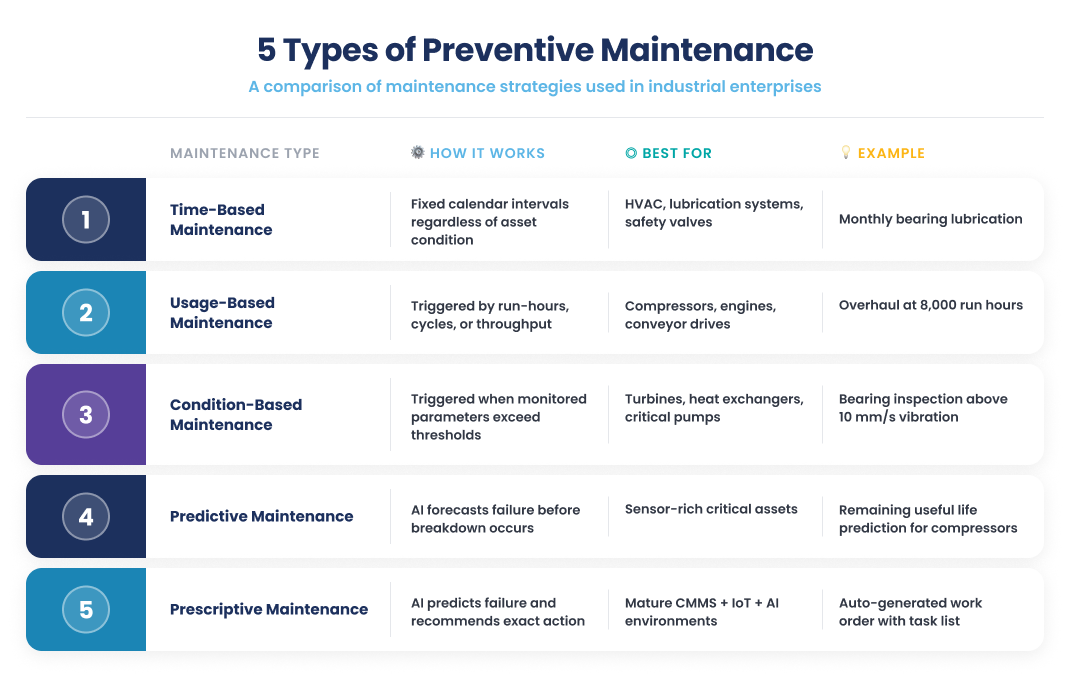
Preventive Maintenance Plan vs. Preventive Maintenance Schedule: Key Differences
A preventive maintenance plan is a strategic document. It defines which assets are included in the PM program, what type of maintenance each requires, at what trigger frequency, and what resources and procedures are needed to execute it. It answers the question: what are we maintaining, and why?
A preventive maintenance schedule is an operational execution tool derived from the plan. It assigns specific PM tasks to specific dates, shifts, and technicians based on resource availability and production windows. It answers the question: who is doing what, and when?
The key differences between preventive maintenance plan and preventive maintenance schedule are as follows:
| Preventive Maintenance Plan | Preventive Maintenance Schedule | |
|---|---|---|
| Definition | Strategic document defining scope, asset coverage, trigger types, and procedures | Operational calendar assigning tasks to dates, shifts, and technicians |
| Scope | Entire PM program: assets, frequencies, trigger logic, resource requirements | Rolling execution window, typically 4 to 13 weeks of scheduled work orders |
| Output | PM program design and policy documentation | Work order queue, Gantt chart, or digital task assignments in CMMS/ERP |
Transform Your Frontline with Connected Worker Technology
Learn how connected worker platforms digitize frontline workflows and maximize your preventive maintenance success.
How AI and Connected Worker Platforms Elevate Preventive Maintenance Programs
Traditional PM programs execute fixed tasks on fixed schedules. AI now augments these programs in three concrete ways: smarter dynamic scheduling, automated anomaly detection, and agentic work order management. None of these capabilities require replacing an existing SAP or Maximo environment, they layer on top of the existing ERP infrastructure to make PM execution more precise and less dependent on manual oversight.
AI-optimized PM scheduling uses real-time sensor data to dynamically adjust when PM tasks fire, moving beyond fixed calendar or usage thresholds. Rather than waiting for a pump to hit 2,000 run hours, the system monitors vibration, temperature, and flow efficiency in real time and recommends advancing the PM interval when anomalous readings suggest degradation is accelerating, or deferring it when the asset is running in pristine condition.
Automated anomaly detection applies machine learning models to continuous sensor streams to identify patterns that precede equipment failures, before those patterns are visible to a human operator. When an anomaly signature matches a known failure precursor, the system flags the asset and recommends a targeted PM inspection, effectively extending the condition-based trigger model to assets that would otherwise remain on time-based schedules.
Agentic AI for PM execution AI agents that autonomously trigger, generate, assign, and track PM work orders inside SAP PM or IBM Maximo based on real-time data inputs, without requiring a maintenance planner to manually review every trigger event.
The AI agent monitors asset health signals, identifies which PM tasks are due or overdue, creates the work order in SAP or Maximo, assigns it to the appropriate technician based on availability and skill profile, and monitors completion.
The Connected Worker Platform is the execution layer that makes AI-generated PM recommendations actionable for frontline workers: the AI identifies what needs to be done, the platform delivers the task to the technician's mobile device with the full procedure, the technician executes it, and completion data feeds back to both the ERP and the AI model.
This closed loop, from sensor signal to work order to field execution to data capture, is what transforms AI-driven preventive maintenance from a concept into an operational capability.
Preventive vs. Predictive vs. Reactive Maintenance: Choosing the Right Strategy
Most industrial facilities use all three maintenance strategies simultaneously, the question is not which one to choose, but which to apply where. The following comparison clarifies the distinctions and positions each strategy within an enterprise maintenance framework.
| Strategy | How It Works | Best For | Cost Profile |
|---|---|---|---|
| Reactive Maintenance | Repair or replace after failure occurs | Truly non-critical assets where failure has no safety, production, or cost consequence; assets that are cheap to replace and have redundancy | Lowest upfront cost; highest total cost due to emergency labor, expedited parts, and cascade damage |
| Preventive Maintenance | Scheduled tasks based on time, usage, or condition thresholds | Broad asset base, the foundation of any enterprise maintenance program; particularly strong for assets with predictable degradation patterns | Moderate upfront investment; significantly lower total cost than reactive-only; predictable, budgetable spend |
| Predictive Maintenance | Real-time sensor monitoring + analytics to forecast failure probability and schedule intervention only when data warrants it | Highest-criticality rotating equipment with sensor infrastructure; assets where unnecessary PM interventions carry their own risk | Higher infrastructure cost (sensors, analytics platform); lowest intervention cost per asset where applicable |
Most enterprise PM programs use a hybrid approach: preventive maintenance as the foundation covering the broad asset base, with predictive maintenance layered on for the highest-criticality, highest-cost assets where the investment in sensor infrastructure is justified by failure consequence.
Preventive Maintenance KPIs: How to Measure Program Effectiveness
A PM program that is not measured cannot be improved, and cannot be defended when budgets are challenged. The following eight KPIs provide the metrics framework for evaluating whether a preventive maintenance program is delivering on its operational objectives. Tracking these from program launch creates the baseline data needed to demonstrate ROI and justify continued investment.
| KPI | What It Measures | Target Benchmark |
|---|---|---|
| PM Compliance Rate | Percentage of PM tasks completed on schedule within the defined window | ≥ 90% for high-criticality assets; ≥ 85% overall |
| Planned Maintenance Percentage (PMP) | Planned maintenance hours as a percentage of total maintenance hours (planned + reactive) | ≥ 80% — industry standard for a mature PM program |
| MTBF (Mean Time Between Failures) | Average operating time between unplanned equipment failures | Trending upward over successive measurement periods |
| MTTR (Mean Time to Repair) | Average time to restore equipment to operating condition after failure | Trending downward; benchmarks vary by asset class |
| PM-to-CM Ratio | Ratio of preventive maintenance work orders to corrective (reactive) maintenance work orders | Target ≥ 4:1 for mature programs; < 2:1 signals reactive-dominated culture |
| Schedule Compliance | Percentage of scheduled PM work orders completed in the planned period without deferral | ≥ 85%; high deferral rates signal scheduling, resource, or backlog problems |
| Wrench Time | Productive (hands-on) labor as a percentage of available technician time | Industry average: 25 to 35%; best-in-class with digital tools: 45 to 55% |
| OEE (Overall Equipment Effectiveness) | Combined measure of equipment availability, performance, and quality — PM directly affects availability | Varies by industry; trending upward is the PM-driven target |
Modern CMMS and Connected Worker Platforms automatically capture most of these KPIs through work order data, completion timestamps, deferral codes, labor hours, and asset downtime events, without requiring manual reporting by maintenance teams.
Once your PM program is running, the next step is optimization, reducing over-maintenance, improving schedule compliance, and cutting costs.
See our guide on preventive maintenance optimization.
Experience the Future of Industrial Maintenance in Minutes
Don't just imagine a paperless, mobile-first maintenance workflow, explore our interactive product tour to see exactly how frontline technicians execute PMs in real time.
Scaling PM Execution with Innovapptive's Connected Worker Platform
A preventive maintenance plan inside SAP or IBM Maximo is only as effective as the data driving it from the field. Innovapptive's Connected Worker Platform bridges this gap by replacing inefficient paper checklists and administrative silos with an intuitive, mobile-first ecosystem. Through our Mobile Maintenance solution, frontline technicians receive digital work instructions, standardized step-by-step procedures, and instant safety protocols directly on their mobile devices. By eliminating manual data entry and lag times, operations can drastically reduce administrative friction, elevate schedule compliance, and raise hands-on wrench time far above the standard industry average.
This seamless transition from back-office scheduling to frontline execution is why global asset-intensive operations and leading market analysts turn to Innovapptive. Recognized as an industry Leader in the Frost Radar™ 2025 report for Augmented Connected Worker Platforms, our technology creates a reliable, closed-loop single source of truth for plant health. For instance, Indoramma, the chemical manufacturing giant leveraged this synchronized approach to slash maintenance backlogs from 18 weeks down to just six, driving multi-million dollar EBITDA improvements.

Unlock Margins Hidden in your Maintenance
Watch how leading manufacturers improve OEE, increase PM compliance, and reduce downtime through connected execution.

- 12-10-2026
Manufacturing Skills Gap: What It Costs and How to Close It
A plant can have every role filled and still experience a manufacturing skills gap. Very often,...

- 05-10-2026
10 Best Shift Handover Software Platforms for Plant and Process Operations
Shift handover software can mean different things depending on the operating environment. Some...

- 29-09-2026
Best SAP Maintenance Planning & Scheduling Software 2026
Your maintenance work orders live in SAP Plant Maintenance (PM), while the working schedule lives...