
What Is Preventive Maintenance Optimization (PMO)?
Preventive Maintenance Optimization (PMO) is a structured methodology that reviews every task in an existing maintenance program by evaluating it against actual asset failure data, criticality, and operational risk. This process then adjusts the task frequency, type, and scope to align them with the equipment's real needs. Ultimately, PMO helps eliminate waste, minimize unplanned failures, and optimize maintenance costs while improving reliability.
PMO evaluates four dimensions of every scheduled task:
- Task necessity - is this task needed at all?
- Task frequency (is it scheduled too often or not enough?)
- Task type (should it be time-based, condition-based, or eliminated in favor of run-to-failure?)
- Resource allocation (is skilled labor and parts budget going to the highest-risk assets?).
Why Preventive Maintenance Optimization Matters: The Business Case
Most industrial maintenance programs suffer from two simultaneous problems: too much maintenance on the wrong assets, and not enough maintenance on the critical ones. Over time, preventive maintenance schedules created during commissioning remain unchanged even as operating conditions, production loads, and failure patterns evolve. The result is excessive PM activity that consumes technician labor, spare parts, and planned downtime without meaningfully reducing failures.
The over-maintenance trap is defined by performing preventive tasks too frequently. This approach unnecessarily consumes craft labor and spare parts, while also increasing planned downtime that reduces production capacity. Furthermore, this strategy is risky, as maintenance-induced failures, typically caused by unnecessary disassembly and reassembly, account for an estimated 30 to 55% of equipment failures in certain environments, as noted by the ARC Advisory Group.
The under-maintenance trap produces the more visible failures: unplanned downtime in continuous process industries can exceed $260,000 per hour, and emergency work orders cost 3 to 9X more than equivalent planned work when overtime, parts expediting, and production loss are included.
A well-executed Preventive Maintenance Optimization program addresses both traps simultaneously. Research from McKinsey's Operations Practice confirms that manufacturers who adopt optimized maintenance strategies see significant results, including a 10 to 25% reduction in overall maintenance costs and a 25% drop in unplanned downtime. These improvements, which also include 10 to 25 percentage-point gains in OEE, are worth an estimated $1M to $3M annually per production line in automotive and heavy manufacturing.
The Future of Maintenance is AI-Driven
Unlock the true potential of your asset data with our step-by-step blueprint for deploying an effective AI maintenance strategy.
What are the signs your Preventive Maintenance Program Needs Optimization?
If your maintenance program shows three or more of the following signals, PMO is overdue:
- PM intervals still rely entirely on OEM defaults.
- Schedule compliance remains below 80%.
- Repeat failures occur on the same assets.
- Emergency work exceeds 30% of maintenance volume.
- Maintenance costs increase without reliability improvement.
- Failure codes are inconsistently captured.
- PM task lists have not been reviewed in years.
- Technicians bypass or shortcut recurring PM tasks.
- PM schedules generate excessive backlog.
- Operations teams distrust maintenance schedules.
What are the Three Approaches to Preventive Maintenance Optimization
There is no single PMO methodology suitable for every industrial operation. The right approach depends on factors such as CMMS maturity, asset criticality, available failure history, and organizational expertise. This section covers the three most widely used PMO approaches and explains when each methodology is most effective.
FRACAS-Based PMO (Failure Reporting, Analysis, and Corrective Action System)
FRACAS-based PMO uses historical failure data and corrective maintenance history to optimize preventive maintenance programs. By analyzing recurring failures, downtime events, and work order trends, organizations can identify ineffective PM tasks and redesign maintenance schedules around actual operational behavior. This approach is best suited for facilities with mature CMMS data and strong reliability engineering processes.
RCM-Derived PMO (Reliability-Centered Maintenance)
RCM-derived PMO applies reliability-centered maintenance principles to optimize existing maintenance programs rather than building them from scratch. The methodology focuses heavily on failure modes, risk exposure, and operational consequences to determine the most effective maintenance strategy. This approach is particularly valuable for safety-critical and highly regulated industries.
Judgment-Based PMO
Judgment-based PMO relies on the operational experience of technicians, supervisors, and reliability teams to evaluate maintenance effectiveness. It is often the fastest and most practical starting point for organizations with limited CMMS data quality or incomplete failure history. This approach helps organizations begin PM optimization while simultaneously improving maintenance data discipline.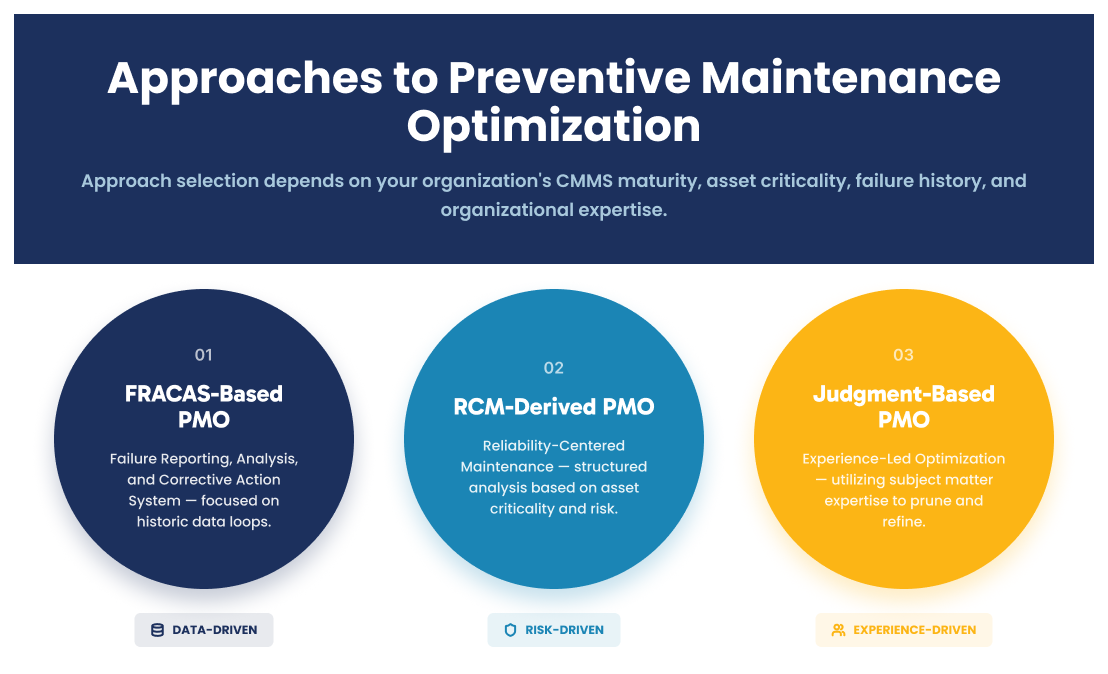
How to Choose the Right PMO Approach
| Criteria | FRACAS-Based | RCM-Derived | Judgment-Based |
|---|---|---|---|
| CMMS Data | 12+ months, failure codes populated | Partial OK - FMEA supplements gaps | Minimal or none required |
| Asset Criticality | All levels | High-criticality, safety-critical focus | Works at any criticality level |
| Team Expertise | CMMS analyst + reliability engineer | Reliability engineer + FMEA facilitation | Senior technicians + maintenance supervisor |
| Time to First Results | 8 to 16 weeks per asset class | 12 to 24 weeks per asset class | 2 to 6 weeks per asset class |
| Best Starting Scenario | Mature facility, strong CMMS discipline | Safety-critical assets, regulatory environment | New program, poor data, fast start needed |
How to Implement Preventive Maintenance Optimization
Implementing preventive maintenance optimization requires more than simply changing maintenance intervals. Successful PMO programs follow a structured process that combines asset criticality analysis, failure mode evaluation, maintenance task review, and continuous performance monitoring. This section outlines a practical six-step framework for implementing PMO in asset-intensive operations.
Step 1: Establish Baseline Metrics
Before optimizing preventive maintenance tasks, organizations need a clear understanding of current maintenance performance. Baseline metrics help quantify operational improvement and create alignment around PMO objectives.By establishing this data-driven foundation, organizations can accurately measure the ROI and effectiveness of their PMO efforts over time.
Step 2: Rank Assets by Criticality
Not all assets contribute equally to operational risk, production impact, or maintenance cost. Asset criticality ranking helps maintenance teams prioritize PMO efforts on the equipment that drives the highest business impact.Focusing initial efforts on high-priority systems ensures optimization initiative yields the greatest possible return on reliability.
Step 3: Analyze Failure Modes and Work Order History
Preventive maintenance optimization depends on understanding how assets actually fail in real operating environments. Analyzing failure history, repeat work orders, downtime trends, and parts consumption helps organizations identify ineffective maintenance tasks and hidden reliability issues.Leveraging this historical data ensures updated maintenance strategy directly addresses real-world vulnerabilities rather than just theoretical risks.
Step 4: Review and Reclassify PM Tasks
The core activity in any PMO initiative is evaluating whether preventive maintenance tasks are necessary, correctly timed, and aligned with actual failure behavior. Maintenance teams must determine which tasks should remain unchanged, which require modification, and which should shift to condition-based monitoring. This targeted reclassification eliminates non-value-added work, freeing up technicians for more proactive, high-impact activities.
Step 5: Implement Changes in SAP PM or CMMS
Preventive maintenance optimization only delivers value when maintenance changes are properly implemented inside operational systems. Many PMO initiatives fail because updated task lists never reach technicians or because maintenance execution remains disconnected from planning systems.Meticulously updating master data and task lists ensures strategic improvements are seamlessly translated into daily field execution.
Step 6: Monitor and Continuously Improve
Preventive maintenance optimization is an ongoing operational discipline rather than a one-time project. Maintenance strategies must evolve continuously as operating conditions, asset behavior, and failure patterns change over time. Establishing a consistent feedback loop guarantees that the maintenance program remains agile, efficient, and perfectly aligned with operational goals year after year.
KPIs and Metrics to Track for Preventive Maintenance Optimization Success
Measuring preventive maintenance optimization success requires clear operational metrics tied to reliability, execution quality, and maintenance efficiency. KPIs such as schedule compliance, MTBF, MTTR, planned-to-reactive work ratios, and maintenance cost as a percentage of RAV help organizations track progress and benchmark performance. This table covers the most important PMO metrics and industry benchmarks.
| KPI | Formula | Industry Benchmark |
|---|---|---|
| Schedule Compliance Rate | (Completed PMs ÷ Scheduled PMs) × 100 | ≥85%; world-class ≥95% |
| MTBF | Total uptime ÷ Number of failures | Increasing year-over-year; asset-class specific |
| MTTR | Total repair time ÷ Repair events | Best-in-class 25% below industry avg |
| Planned-to-Unplanned Ratio | Planned WOs ÷ Total WOs | 6:1 to 85% planned, 15% reactive |
| Maintenance Cost as % of RAV | Annual cost ÷ Total RAV × 100 | 1–3% world class; 4–5% average; >5% poor |
| PM Task Completion Rate | (Fully completed PMs ÷ Issued PMs) × 100 | ≥90% |
| OEE (Overall Equipment Effectiveness) | Availability × Performance Rate × Quality Rate | ≥85% world class |
How Innovapptive Bridges the Gap Between Maintenance Strategy and the Frontline
Executing a successful preventive maintenance optimization (PMO) strategy ultimately depends on how seamlessly back-office planning translates into field execution. Innovapptive’s Connected Worker Platform bridges this gap by unifying disjointed data into a single, cohesive ecosystem. Through dedicated tools for Mobile Maintenance and real-time planning and scheduling, asset-intensive operations can eliminate administrative bottlenecks and wrench-time delays. By standardizing field workflows with Digital Checklists and granular work instructions, front-line technicians capture highly accurate asset history data that automatically populates Maintenance Insights, giving leadership the real-time visibility needed to continually refine and optimize asset performance.
This comprehensive approach to operational reliability is why industry analysts and global leaders trust Innovapptive to drive tangible business value. Recognized as a market Leader in the Frost Radar™ 2025 report for Augmented Connected Worker Platforms, our platform helps organizations transition away from static spreadsheets and legacy silos. For instance Indorama, the chemical manufacturing giant leveraged this synchronized approach to slash maintenance backlogs from 18 weeks down to just six, driving multi-million dollar EBITDA improvements.
Ready to Slash Unplanned Downtime?
Watch our mobile maintenance solution in action & discover how real-time data capture can transform your operational efficiency and asset reliability.

Unlock Margins Hidden in your Maintenance
Watch how leading manufacturers improve OEE, increase PM compliance, and reduce downtime through connected execution.

- 12-10-2026
Manufacturing Skills Gap: What It Costs and How to Close It
A plant can have every role filled and still experience a manufacturing skills gap. Very often,...

- 05-10-2026
10 Best Shift Handover Software Platforms for Plant and Process Operations
Shift handover software can mean different things depending on the operating environment. Some...

- 29-09-2026
Best SAP Maintenance Planning & Scheduling Software 2026
Your maintenance work orders live in SAP Plant Maintenance (PM), while the working schedule lives...