
What Maintenance Digitalization Means, and How It Differs From Digitization and Digital Transformation
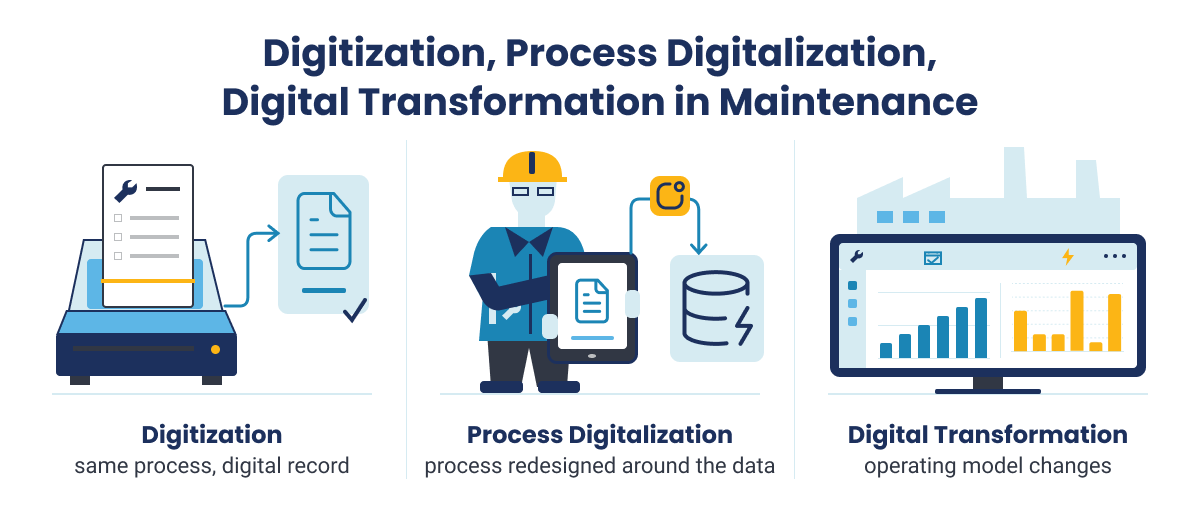
Maintenance digitalization changes how maintenance work is planned, carried out and recorded, so that data captured during the job drives the next decision. It is often confused with two related terms: digitization and digital transformation. Digitization changes the format of a record, while digital transformation changes how the whole maintenance function is managed. The table shows how they differ in practice.
| Term | What changes | Maintenance example | Common pitfall |
|---|---|---|---|
| Digitization (converting records) | The record moves from paper to a digital file, but the process stays the same. | Paper round sheets are scanned or typed into a spreadsheet at the end of the shift. | The plant has digital files, but technicians work exactly as they did before. |
| Digitalization (redesigning the process) | The process is redesigned around data captured at the asset. | Operators complete rounds on a handheld device, and an out-of-range reading creates a notification automatically. | The new workflow runs alongside paper, so the same data is often entered twice. |
| Digital transformation (changing the operating model) | The way the maintenance function is managed changes. | Maintenance moves from reacting to breakdowns to planning work around real technicians availability. | Leaders announce the change before enough processes are digitalized to support it. |
The difference matters when budgets are approved. A project that only converts paper records into digital files will not deliver the savings expected from redesigning the process, even if both are described as digitalization.
Why Buying Maintenance Software Is Not Digitization
A plant can run SAP Plant Maintenance (SAP PM) or IBM Maximo, monitor critical equipment with sensors and review maintenance dashboards every week, while its technicians still rely on printed work orders. If a technician has to walk to the storeroom to check whether a part is in stock, wait for a permit to be signed and hand in paper notes for someone in the office to type up later, the maintenance workflow is still disconnected. This denotes that the plant has bought technology, but it has not built the capability the technology was meant to support. The capability is the ability to move from a detected problem to a completed and correctly recorded job, with the right people, parts and permits in place at each step.
The key to this is resolving the gap between the maintenance plan in the system and the work performed in the field. Closing that gap takes accurate equipment data, a sound preventive maintenance (PM) strategy, disciplined planning and scheduling, and tools that technicians find easier to use than paper. When these pieces work together, technicians get the instructions, parts information and approvals they need, and their hours, completion details and findings go straight into the system of record.
This is why experienced reliability practitioners warn that technology cannot make up for weak maintenance fundamentals. It is also why many transformation leaders now start by defining the capabilities they need, putting those capabilities in the right order and only then choosing the tools. The rest of this guide follows that same order.
Is Your Maintenance Data Ready for AI?
Most AI initiatives stall on incomplete work history and inconsistent failure codes. This blueprint explains why clean, structured data is step zero and how AI agents help fix it.
The Four Stages of Maintenance Digitalization Maturity
Most plants fit into one of four stages of maintenance digitalization maturity: paper and tribal knowledge, spreadsheets and disconnected tools, connected execution, and condition-driven, AI-assisted maintenance. The stages describe what planners and supervisors can see and act on, not which software the plant owns. A site with a modern ERP system can still be at Stage 2 if its technicians work from paper.
| Stage | What a typical shift looks like | Primary operational limitation | Business consequence |
|---|---|---|---|
| Stage 1: Paper and tribal knowledge | Work orders are printed or handwritten, and equipment history lives in the memory of senior technicians. | Completed work, time spent and findings are not recorded in a form planners can use. | Technicians lose hours to searching, waiting and repeat visits, which pushes up overtime. |
| Stage 2: Spreadsheets and disconnected tools | Records are digital but spread across shared drives, email and separate apps, so the same data is entered more than once. | Job status, crew availability and stock levels sit in separate files and are often out of date. | Planners call in extra contractors and order buffer stock because they cannot trust the data in front of them. |
| Stage 3: Connected execution | Technicians receive and close work on a mobile device at the asset, and the system of record is updated without retyping. | Condition data is not yet linked to work orders, so developing problems are often found only when symptoms appear. | Some failures that could have been planned still turn into breakdown repairs and lost production. |
| Stage 4: Condition-driven and AI-assisted | Sensor data and AI tools flag problems and prepare work orders before a breakdown occurs. | Alerts and recommendations grow in volume, and teams must keep data accurate and decide which signals deserve action. | Without disciplined prioritization and data upkeep, alert fatigue sets in and response slows, eroding trust in the system. |
For plants at stage 2, the most useful next step is usually to connect maintenance execution to the system of record. This removes retyping, gives planners a current view of work in progress and confirms that parts and permits are ready before a technician is sent out. Many plants are tempted to move straight to the predictive tools of stage 4, but those tools rely on the accurate work history that stage 3 produces. Without that history, alerts have no dependable way to become planned work.
It is often seen that plants remain stuck at stage 2 because adding a spreadsheet costs almost nothing, while connecting execution needs a budget and a project team. The case for change becomes much easier to make once the cost of disconnected work is visible.
Find Your Plant's Stage in Five Questions
Answer these questions for a typical week at one site. Each yes points to a gap that is common at Stage 1 or Stage 2.
- Do planners phone supervisors to find out which jobs were completed today?
- Do technicians type completion details into a desktop system after the job is finished?
- Does it take more than a few minutes to find the last five readings for a critical asset?
- Do crews ever arrive at a job before the parts or the permit are ready?
- Does someone reconcile different spreadsheet versions before the weekly scheduling meeting?
Three or more yes answers suggest your plant is at stage 1 or stage 2, and connecting execution should be the priority. One or two suggest that stage 3 is partly in place. In either case, the next step is to put a cost on these gaps.
Turn Your Maturity Gaps Into a Business Case Finance Will Approve
In two days on site and four weeks end to end, Innovapptive’s value engineers map your execution gaps, quantify the EBITDA each one costs and deliver a phased improvement roadmap.
Where Maintenance Costs Actually Leak Before Digitalization
Disconnected maintenance work shows up in four cost lines: labor and overtime cost, outside contractor spend, MRO inventory capital and lost production revenue. Each one is driven by an execution bottleneck, and each bottleneck comes from information that is missing when the work is planned or carried out. Better reports do not change these numbers on their own. The savings come from changing how the work is prepared and done.
1. Labor and Overtime Cost
Wrench time is the share of a shift a technician spends on hands-on work. In plants that run largely on paper, it is commonly estimated at around 30 percent, so most of a paid shift goes to walking to the storeroom, waiting for permits, looking for the right drawing and filling in paperwork. When the productive part of the shift is that short, planned work does not fit, and it spills into overtime or the next week's backlog. The bottleneck here is Wrench Time percentage, and the SMRP Best Practices, Metrics and Guidelines provide standard definitions for measuring it.
2. Outside Contractor Spend
Contractor spend often rises because planners cannot see their own technicians capacity, not because the workload is truly too high. To decide whether a job can be done in-house, a planner needs to know who is available on each shift, who is on leave or in training, who holds the right certification and how much of the week is already booked. In most plants that information sits in an HR system, a training spreadsheet and a supervisor's notebook, so calling a contractor becomes the safe choice.
While each call looks reasonable on its own, together they add up to one of the largest controllable costs in the maintenance budget, and the total usually becomes clear only at budget review. The bottleneck is Cross-Team Coordination. At Indorama Ventures' Port Neches site, bringing crew, schedule and work data together helped reduce contractor headcount from 140 to 87.
3. MRO Inventory Capital
When parts issues and returns are not recorded as they happen, the quantity in the system stops matching the quantity on the shelf. Planners stop trusting the numbers and order extra stock as a buffer, yet the parts they actually need still run out. The plant ends up with more money tied up in inventory and lower parts availability at the same time. Because jobs get planned around stock that may not exist, this leak is closely tied to Planning Accuracy. Scanning parts at the point of issue and return keeps the count accurate, and Indorama Ventures reported inventory accuracy rising from 89.5 percent to 99.5 percent.
4. Lost Production Revenue
An emergency repair commonly costs several times more than the same job done as planned work, and industry estimates range from three to ten times. Much of the extra cost comes from the steps between spotting a problem and fixing it, such as raising a notification, creating the work order, finding parts, getting the permit and assigning a crew. On paper, each step can add hours, and a technician who arrives without the right part or instruction may have to come back, which is why First-Time Fix Rate is the bottleneck to watch. On a production-critical asset, every extra hour adds to the cost of unplanned downtime, which is usually far larger than the repair bill itself.
The table below links each cost leak to the execution bottleneck that drives it and the digitalized workflow that closes it.
| Cost leak | Execution bottleneck behind it | Digitalized workflow that closes it |
|---|---|---|
| Labor and Overtime Cost | Wrench Time percentage | Mobile work orders that carry a complete digital work package to the asset |
| Outside Contractor Spend | Cross-Team Coordination | Live crew availability, skills and schedule load visible to planners in one place |
| MRO Inventory Capital | Planning Accuracy | Barcode-based parts issue, return and kitting recorded at the point of work |
| Lost Production Revenue | First-Time Fix Rate | Digital work instructions and connected permits that help crews finish the job on the first visit |
The Technology Layers of a Digitalized Maintenance Operation
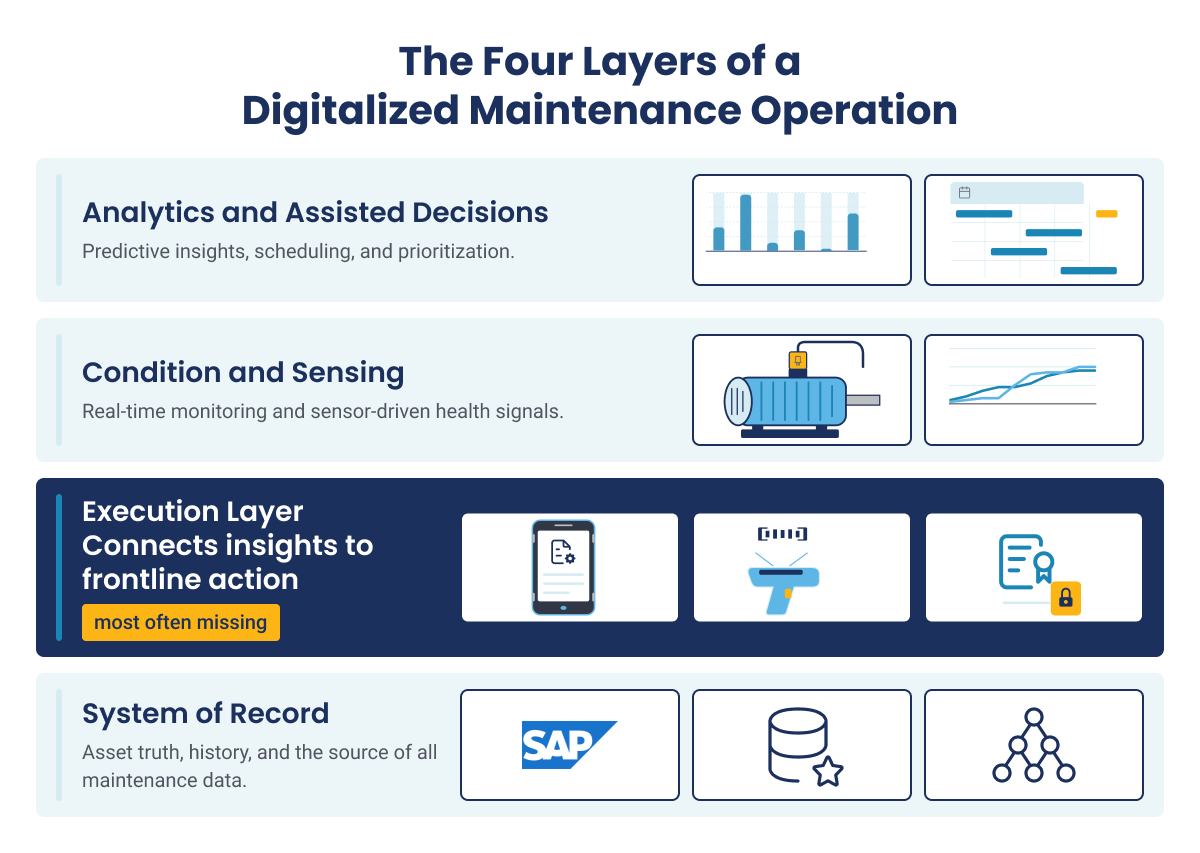
Lists of maintenance digitalization tools often place maintenance software, IoT sensors, AI, mobile apps and digital twins side by side, as if a plant should choose between them. In practice, they work as four connected layers, and each one depends on the layer below it.
| Layer | What it does | Typical examples | What happens without it |
|---|---|---|---|
| 1. System of record | Keeps the official list of equipment, the work order history and maintenance costs. | SAP PM, IBM Maximo, Oracle EAM | There is no single trusted record of assets, work or spend. |
| 2. Execution layer | Puts work orders, instructions, permits and parts information in technicians' hands, and sends completed work back to the system of record. | Mobile work orders, operator rounds, digital work instructions, electronic permits, barcode parts issue | Planned work reaches the field late or incomplete, and the record fills with gaps. |
| 3. Condition monitoring | Tracks equipment health through sensors and process data. | Vibration sensors, historians, alarms | Problems are found only when equipment shows symptoms or fails. |
| 4. Analytics and AI | Helps teams interpret data and decide what to act on first. | Backlog and schedule analytics, AI-assisted planning | Priorities are set by opinion rather than data. |
These layers work together rather than compete. SAP Plant Maintenance, IBM Maximo or Oracle EAM continues to hold the enterprise maintenance record, while the execution layer connects those systems to frontline teams and sends completed-work information back to them. Condition monitoring adds information about equipment health, and analytics helps teams decide where to act first.
The order of the layers matters. A condition alert does not improve reliability just because it appears on a dashboard. Someone has to review it, create the work order, confirm parts and permits, and get the job to the right technician. If those steps still run on paper and phone calls, the alert waits. This delay between detecting a problem and completing the work is known as execution latency, or the insight-to-action gap, and it explains why plants that buy sensors before connecting execution often see little return.
For the same reason, IT teams usually ask two questions before approving a rollout. They want to know that the execution layer writes back to the system of record through standard, supported interfaces, and that it keeps working offline in low-connectivity and intrinsically safe areas.
Your Alerts Are Not the Problem. The Time It Takes to Act on Them Is.
See how AI-powered execution platforms shorten the path from detection to resolution. AI agents enrich notifications, guide troubleshooting, recommend work scopes and speed up permit approvals.
Which Maintenance Processes to Digitalize First
A good rule is to start with the work that happens most often, involves the most people and takes place at the asset. That is where retyping, delays and lost information add up fastest, and where early success builds support for the rest of the program. In the sequence below, each step also prepares the ground for the next one.
- Mobile work order execution: Every technician handles work orders on every shift. When technicians receive jobs and record their hours, completion notes and failure details in a mobile maintenance app, the maintenance record is updated as the work is done instead of days later. Planners get an accurate picture of what was completed, and every later workflow builds on that data.
- Operator rounds and inspections: Operators record hundreds of readings every shift, more data than any other routine task produces. On paper, an abnormal reading can sit on a clipboard until the end of the shift or never reach a planner at all. With digital operator rounds software, readings are checked against limits as they are entered, and a reading outside the limit can raise a notification straight away. The plant gets earlier warning of developing problems, and operators see quickly that the new tools save them time.
- Digital work instructions: Once work orders are on a mobile device, the instructions attached to each job become the main factor in getting it right the first time. Step-by-step digital work instructions tied to the specific equipment help less experienced technicians follow the correct procedure, and they capture the know-how of senior staff before those people retire.
- Permits, isolations and safe work: A crew that waits an hour at the job site for a permit to be issued and isolations to be verified loses that hour of wrench time, and every job scheduled after it slips as well. Paper permits also leave gaps in the audit trail that regulators examine after an incident. An electronic permit to work software links the permit to the work order, so supervisors can see what is approved, what is pending and which isolations are in place before the technicians sets out. Jobs then start when they were scheduled to start.
- Parts issue, return and kitting: A scheduled job cannot start if the parts are missing, and a technician who discovers this at the asset either waits, walks back to the storeroom or leaves the job half done. Digital inventory management software lets storeroom teams pick and stage the parts for each job before the crew arrives, and it records every issue and returns with a barcode scan. Schedules become more reliable, wrench time goes up and the inventory count stays accurate enough for planners to trust.
However, there is one common exception to this order. If a plant has an open regulatory finding or a recent serious incident, permits and inspections should move to the front of the sequence, because reducing that risk is the most urgent priority for the business.
Outside those cases, dashboards and reporting tools should not be the first investment. A dashboard can only show what is in the system, so if work is still recorded on paper and typed in later, it simply displays incomplete data more clearly. Connecting execution first gives reporting a reliable foundation to build on.
Master Data: The Foundation That Decides Whether Digitalization Works
Connected workflows are only as useful as the equipment data behind them. If technicians cannot find the right equipment in the system, or if failures are recorded as free text, digitalization only delivers unreliable information faster. Four types of master data need attention before rollout.
- Equipment hierarchy: Every piece of equipment a technician can be sent to must be listed in the right place in the plant structure, so that work and history are recorded against it.
- Failure coding: Failures need consistent codes for cause, mode and effect, so that history can be analyzed instead of read line by line.
- Spare parts links: Parts must be linked to the equipment they fit, so that a work order can list the parts it needs.
- Criticality ranking: Each piece of equipment needs a ranking of how much its failure matters, so that planners can prioritize work objectively.
Failure history takes years to build and cannot easily be recreated later, so it pays to get coding right from the start. ISO 14224 sets out a standard way to record reliability and maintenance data, including equipment types, failure causes and consequences, and it was developed for oil, gas and petrochemical operations. ISO 55000 provides the wider asset management principles that support criticality ranking.
Master data does not need to be perfect across the whole plant before work begins. It needs to be right for the equipment included in the first phase, which is a much smaller and more manageable task.
A Phased Roadmap for Digital Transformation in Maintenance
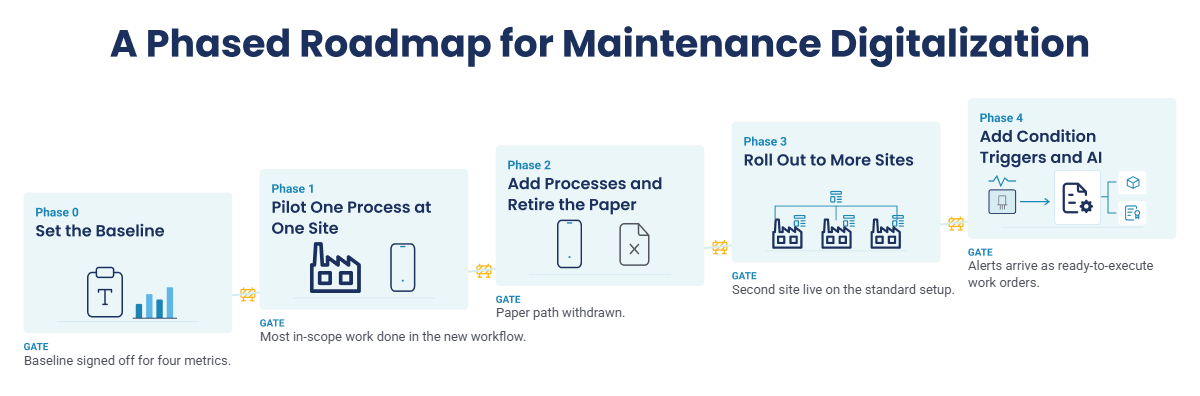
Phases of a maintenance digitalization program fail most often when they have no exit criteria. Each phase should end with evidence that the new process is being used and is producing a measurable improvement. A software go-live date alone is not enough to move to the next phase.
Phase 0: Set the Baseline Before You Change Anything
Measure a small number of metrics before anything changes, because a program without a baseline cannot prove a return. Four metrics are usually enough: wrench time or schedule compliance, maintenance backlog in weeks, the PM-to-corrective maintenance (CM) ratio and total maintenance spend. A short list that everyone trusts is better than a long list that nobody maintains.
Exit criterion: a signed-off baseline for these four metrics.
Phase 1: Pilot One Process at One Site
Take the first process from the sequence above and choose a pilot site based on willingness, not size. A motivated site with an engaged maintenance supervisor will prove more than a large site that was told to take part. Clean the master data only for the assets in scope.
Exit criterion: most in-scope work is executed in the new workflow rather than around it, and at least one baseline metric has moved.
Phase 2: Add Processes and Retire the Paper
Add the next two processes from the sequence and complete the write-back to the system of record for all of them. Then withdraw the paper path. This is the step most programs skip, and it is the main reason they plateau. As long as paper remains an option, people will fall back on it during busy shifts, and the data will never be complete.
Exit criterion: the paper path is withdrawn, not left as an option.
Phase 3: Roll Out to More Sites Without Starting Over
Standardize configuration, forms and templates so that the second site does not become a second implementation project. Name a governance owner, usually in a central reliability or operational excellence team, who controls the standard and approves local changes.
Exit criterion: a second site is live on the standard configuration with no code changes.
Phase 4: Add Condition Triggers and AI-Assisted Planning
Only now should the team connect condition data and AI-assisted work package creation, because both depend on the reliable execution record built in the earlier phases. As the technology layers section explains, an alert is only useful when the execution layer can turn it into work.
Exit criterion: condition alerts arrive as ready-to-execute work orders with parts and permits confirmed, rather than as notifications.
Planning Your Pilot? See What a Strong First Phase Looks Like.
Innovapptive’s Mobile Maintenance solution brief shows how technicians receive, execute and close SAP or Maximo work orders on mobile devices, even offline, so your pilot captures clean data from day one.
Why Maintenance Digitalization Projects Fail
Maintenance digitalization projects often stall when a broken process is automated as it is, the old paper process stays available, technicians avoid tools that slow them down, or every site builds its own workflows. More broadly, BCG research found that 70 percent of digital transformations across industries fall short of their objectives, which makes process design, adoption and rollout discipline risks worth addressing from the start.
1. Digitalizing a Process That Should Have Been Removed
If a step exists only because someone once asked for it, automating it makes the waste permanent and faster. It also makes the step harder to remove later, because it is now built into the system configuration. A simple test helps: can the team explain why each step exists and who owns each approval? The fix is to review the process before choosing software and to remove any step that nobody can justify.
2. Keeping Paper as a Backup
When paper forms remain available, people return to them on busy shifts, and the digital record is never complete. This is why Phase 2 requires paper forms to be withdrawn rather than left as an option.
3. Technician Resistance Is Usually a Design Problem
Technicians rarely resist technology. They resist tools that slow them down. In industrial plants, adoption depends on three practical requirements: the app must work offline in low-connectivity and intrinsically safe areas, it must be usable with gloves on, and it must take fewer steps than the paper form it replaces. Track adoption by the share of work completed in the app, not by the number of licenses issued.
4. Treating Every Site as a New Project
When the first site customizes forms and workflows to suit one supervisor's preferences, the second site cannot reuse them and has to start almost from scratch. The rollout then takes as long at the second site as it did at the first. Agreeing on a standard configuration early, with a central owner who approves changes, lets later sites go live much faster.
Finally, connecting frontline devices to plant systems raises security questions. The NIST SP 800-82 Guide to Operational Technology Security is a useful reference for the IT and OT teams reviewing the design.
How to Measure the Return on Maintenance Digitalization
The benefits of maintenance digitalization arrive in a predictable order. Data quality and adoption improve first, followed by technician productivity and planning, and finally cost and uptime. Setting this expectation early matters, because a program judged on cost savings in its first quarter may be cancelled before the metrics that drive cost have had time to move.
|
Benefit |
Metrics to track |
When improvement typically shows |
|---|---|---|
|
Reliable maintenance data |
Share of work completed in the new workflow; work orders closed with failure details |
Within weeks |
|
More productive shifts |
Wrench time; schedule compliance; first-time fix rate |
One to two quarters |
|
Better planning |
Parts availability before work starts; backlog in weeks |
Two to three quarters |
|
Lower cost and higher uptime |
PM-to-CM ratio; contractor spend; overtime; inventory accuracy; unplanned downtime |
Three to four quarters |
Only set baselines on metrics you can measure reliably today. If wrench time is currently estimated from memory, it will be impossible to tell later whether it improved or was simply measured more accurately.
What Successful Maintenance Digitalization Looks Like: Indorama Ventures
Indorama Ventures, a $15.4 billion global chemical manufacturer, already ran SAP Plant Maintenance and IBM Maximo at its Port Neches, Texas, site, yet frontline maintenance was still largely paper-based and reactive. The site kept its existing systems and connected them to the frontline by digitalizing work orders, operator rounds and inventory workflows on mobile devices, supported by structured change management. Within 12 months of deployment, the site reported the following results.
|
Maintenance KPI |
Before |
After |
Change |
|---|---|---|---|
|
Maintenance backlog |
24 weeks |
10 weeks |
58% reduction |
|
Contractor headcount |
140 |
87 |
38% reduction |
|
Maintenance overtime |
24% |
12% |
50% reduction |
|
PM-to-CM ratio |
45% |
80% |
35 points higher |
|
Parts availability |
55% |
95% |
40 points higher |
|
Inventory accuracy |
89.5% |
99.5% |
10 points higher |
|
Digital work instruction use |
Under 20% |
85% |
More than four times higher |
Indorama Ventures reported $19 million in realized EBITDA savings in 2025 from this single-site program and identified a further $50 million cost takeout opportunity across the enterprise. As Micah Mosley of Indorama Ventures Texas put it, "This wasn't about digitizing forms. Innovapptive transformed how work gets done." These are one customer's reported results at one site rather than a guaranteed outcome, but they show the scale of savings that connected execution can unlock.
From a 24-Week Backlog to 10 Weeks in Under a Year
Read the full Indorama Ventures case study to see how the site connected SAP PM and IBM Maximo to its frontline teams, the change management that drove adoption, and how the program turned execution gaps into $19 million in realized EBITDA savings.
How Innovapptive Supports Maintenance Digitalization Without Replacing Existing Systems
The layer most plants are missing is the execution layer, and that is where Innovapptive works. Innovapptive is an Industrial Execution Platform and Connected Worker Platform that sits on top of SAP Plant Maintenance, IBM Maximo or Oracle EAM. It extends your system of record rather than replacing it, so there is no rip and replace. Master data and financial posting stay in SAP, Maximo or Oracle, while Innovapptive holds the execution data and evidence captured at the asset and writes the results back.
In practice, this means:
- Technicians receive, complete and close work orders and operator rounds on mobile devices. With RapidSync offline mode, they keep recording readings, photos and completion details in low-connectivity and intrinsically safe areas, and the data syncs back to the system of record automatically when the device reconnects.
- Integration Manager connects these frontline workflows to SAP, Maximo, Oracle and other enterprise systems, so completed work updates the maintenance record without retyping. This answers the integration question IT teams raise before approving a rollout.
- Digital work instructions, electronic permits and parts kitting are linked to each work order, so crews arrive with what they need to finish the job.
- The RACE Configuration Engine lets teams build and change forms, checklists and workflows without custom code, so a second site can go live on the standard setup instead of becoming a new project.
- 15+ AI agents help turn findings into action, for example by creating a work order with its priority, components and permit requirements already filled in, or by converting an expert's video into step-by-step instructions.
Condition monitoring and machine-health platforms integrate with this execution layer, so their alerts become planned work rather than unread notifications. In naming Innovapptive its 2026 Global Company of the Year for Augmented Connected Worker, End-to-End Platforms, Frost & Sullivan highlighted these AI agents and the platform's continued extension into daily frontline operations.
What If Every Work Order Closed at the Asset, Not at a Desk?
Innovapptive sits on top of the systems you already run and puts work orders, permits and parts in technicians’ hands, online or offline. Take the tour yourself or see it live with an expert.

Unlock Margins Hidden in your Maintenance
Watch how leading manufacturers improve OEE, increase PM compliance, and reduce downtime through connected execution.

- 15-10-2026
Maintenance Digitalization: A Digital Transformation Guide
Maintenance digitalization is the shift from paper, spreadsheets and disconnected tools to...
- 12-10-2026
Manufacturing Skills Gap: What It Costs and How to Close It
A plant can have every role filled and still experience a manufacturing skills gap. Very often,...

- 05-10-2026
10 Best Shift Handover Software Platforms for Plant and Process Operations
Shift handover software can mean different things depending on the operating environment. Some...